
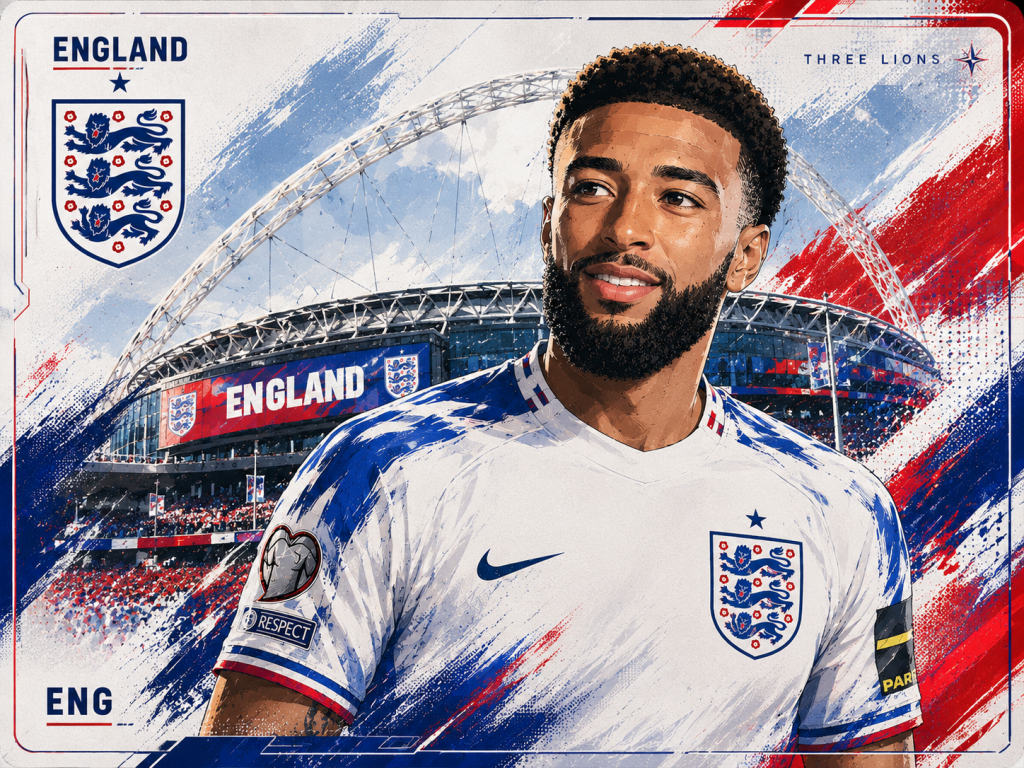
There is something deeply suspicious about the way English football discusses certain players.
Some arrive with orchestral music already playing behind them. Academy documentaries. Tactical explainers. Viral passing compilations filmed like perfume adverts. Others simply perform well for several years while people continue speaking about them as if they are temporarily borrowing somebody else’s seat.
Jayden Bogle increasingly feels like the second category.
Which is odd, because if you actually watch him play for Leeds United rather than consume football through highlight accounts and England squad graphics, the argument becomes difficult to dismiss.
But Bogle belongs in that conversation now. Properly.
Not as a novelty pick.
Not as “good depth”.
Not as the guy pundits suddenly pretend they always rated after a successful international tournament.
As an actual England-level footballer, that Thomas Tuchel should consider.
The Useful Thing About Being Overlooked
Bogle’s career has never really been accompanied by glamour.
Released by Reading F.C. at 14. Briefly at Swindon Town F.C.. Then rebuilt through Derby County F.C. under Frank Lampard during that strange Championship season where Derby briefly felt like a football club held together with adrenaline and aggressive optimism.
Even then, people noticed the attacking energy first.
The overlaps.
The direct running.
The willingness to treat open grass like an insult that needed correcting immediately.
Defenders like this tend to create anxiety because they look slightly uncontrollable. Coaches love structure. Bogle occasionally plays as though he has spotted an alternative route through the match entirely.
To be fair, modern football increasingly needs that.
His time at Sheffield United F.C. became a strange mixture of progress and interruption. Promotions. Relegations. Chaos. Momentum repeatedly interrupted by the dreaded Google search phrase: “Jayden Bogle injury”.
Football supporters remember injuries differently depending on the player. When glamorous stars get hurt, it becomes mythology. When practical footballers do, it becomes administration.
But even there, the qualities remained obvious.
Aggressive recovery pace.
Fearlessness in transition.
A slightly reckless belief that every counter-attack could still become dangerous if he kept running long enough.
Leeds United and the £5 Million Joke That Stopped Being Funny
The funniest transfers are usually the ones everyone confidently predicts incorrectly.
When Leeds United paid around £5 million for Bogle in 2024, there was a detectable smugness from parts of South Yorkshire.
Leeds had apparently overpaid.
Bogle was apparently flawed.
The contract situation apparently favoured Sheffield United.
Football supporters adore these little moments because they create temporary emotional superiority before reality arrives and ruins everything.
Instead, Bogle became one of the signings of the Championship season.
Six goals.
Four assists.
PFA Team of the Year.
EFL Championship Team of the the Season.
A central figure in Leeds returning to the Premier League.
Not bad for a full-back supposedly worth less than the cost of modern squad filler.
What made it particularly interesting was how quickly he evolved.
Early-career Bogle often resembled somebody trying to outrun tactical structure entirely. Current Bogle feels more balanced without losing the chaos that makes him dangerous. Against elite opposition this season, he has looked increasingly complete rather than simply energetic.
That matters.
Because Premier League survival tends to expose footballers eventually. Romantic narratives disappear somewhere around February away matches under cold floodlights when teams are desperately trying not to lose.
And yet Bogle kept standing out.
“Controlled Chaos” Is Actually Valuable
The Chelsea performance at Stamford Bridge probably explains the current conversation best.
Leeds players arriving at grounds like that are often expected to behave carefully. Respectfully. Like temporary visitors inside somebody else’s expensive museum.
Bogle instead played with what was described as “controlled chaos”.
That phrase lingered because it felt accurate.
He defended aggressively.
Recovered quickly.
Kept attacking.
Kept overlapping.
Kept dragging the game into uncomfortable spaces.
This is important internationally because England do not lack technically gifted right-backs. They lack variety between profiles.
Trent Alexander-Arnold gives you extraordinary distribution.
Reece James, when healthy, offers physical authority and composure.
Tino Livramento provides athletic upside and modern flexibility.
Bogle gives you disruption.
And tournament football quietly values disruptors more than people admit.
Particularly late in matches.
Particularly in transitions.
Particularly when games stop resembling tactical diagrams and start resembling survival exercises.
Nobody mentioned it much at the time, but some of England’s most frustrating tournament exits have involved the team becoming emotionally flat. Predictable. Slow. Safe in the wrong ways.
Bogle does not really play safe football.
Which is one reason Leeds supporters have taken to him so quickly.
The Three Lions Shirt Feels Closer Than People Think
The interesting thing about the 2026 World Cup discussion is timing.
Should Thomas Tuchel take him now?
Possibly.
Would it also make sense if Bogle narrowly missed the tournament but became part of the next England cycle immediately afterwards?
Also possible.
International football often behaves conservatively until it suddenly doesn’t. Entire narratives can change because one player suffers an injury in March or another loses form at precisely the wrong moment.
And Bogle’s form has become increasingly difficult to ignore.
The raw Jayden Bogle stats only tell part of it. One goal and two assists in the Premier League will not dominate social media graphics.
But his influence on Leeds’ transitions, overlaps, recovery shape, and attacking width matters enormously. Leeds look more dangerous when he plays aggressively. They look more emotionally alive.
That is harder to quantify.
England squads increasingly need players who can alter the emotional rhythm of matches rather than simply maintain structure.
Bogle can do that.
There is also something psychologically useful about footballers who have climbed the long route instead of arriving through pre-written expectation. Released as a teenager. Rebuilt elsewhere. Doubted repeatedly. Mocked over transfer value. Then quietly turning into a Premier League-level full-back anyway.
Players like this rarely panic when environments become hostile because hostility has been following them for years already.
Leeds United News and the England Question
The broader Leeds United news cycle often focuses on survival mathematics, ownership debates, transfer speculation, or Daniel Farke’s tactical tweaks. That is modern football. Everyone speaks in permanent urgency.
But underneath all that, Bogle’s emergence may end up being one of the club’s most important developments.
Because England recognition changes perception permanently.
Suddenly the player is not merely “good for Leeds”.
Not merely “solid in the Premier League”.
Not merely “surprisingly decent”.
International football acts like institutional validation. Ridiculous, really, considering how chaotic international football itself often is. But people still treat it like a royal seal pressed into wax.
And if Bogle eventually pulls on the three lions shirt, whether before the 2026 World Cup or afterwards, it will not feel like sentimentality.
It will feel overdue.
Partly because England need multiple tactical profiles at right-back.
Partly because form should matter.
Partly because football occasionally rewards persistence after years spent pretending not to notice it.
And partly because watching Jayden Bogle sprint past exhausted defenders at minute 87 while everyone else is beginning to seize up feels oddly international already.
Like the game has sped up around him and he simply decided to keep running anyway.
Who is Jayden Bogle?
Jayden Bogle is an English right-back who plays for Leeds United. Born on July 27, 2000, he developed through Derby County after being released by Reading as a teenager. He is known for attacking overlaps, recovery pace, direct running and high-energy performances from full-back.
Could Jayden Bogle play for England?
Jayden Bogle could play for England if his Premier League form with Leeds United continues. England have strong right-back options, including Trent Alexander-Arnold, Reece James and Tino Livramento, but Bogle offers a different profile built around transition running, disruption and attacking width.
How much did Leeds United pay for Jayden Bogle?
Leeds United signed Jayden Bogle from Sheffield United in 2024 for around £5 million. The transfer has since looked excellent value, with Bogle becoming a major part of Leeds’ promotion campaign and earning recognition in Championship team-of-the-season selections.
What makes Jayden Bogle different from other England right-backs?
Jayden Bogle stands out because of his aggressive overlapping, recovery pace and ability to change the tempo of a match. While England’s other right-backs may offer passing range, defensive power or tactical flexibility, Bogle brings disruptive energy that can be especially useful in transition-heavy games.
Did Jayden Bogle help Leeds United win promotion?
Jayden Bogle played a key role in Leeds United’s promotion push after joining from Sheffield United. His goals, assists, attacking width and improved defensive balance made him one of Leeds’ most important full-backs during their return to the Premier League.






2 responses to “Jayden Bogle and the Strange Reluctance Around England”
[…] times she looked less like a full-back and more like the entire emergency […]
LikeLike
[…] loyalty in football becomes complicated once England squads and World Cups enter the equation. Especially at 29. Especially with Premier League clubs circling overhead like […]
LikeLike