Sometimes the most important match on a pay-per-view isn’t the loudest one—it’s the one that has to steady the ship.
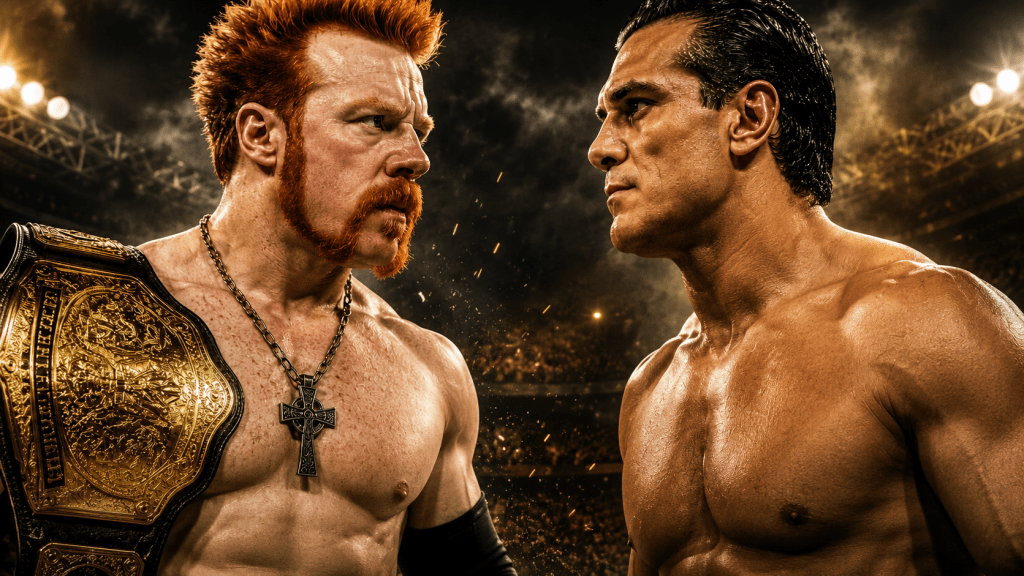
On July 15, 2012, inside the heat-soaked, vocal pressure cooker of the US Airways Centre in Phoenix, Arizona, WWE placed the World Heavyweight Championship match—Sheamus (c) vs Alberto Del Rio—as the third bout on the main card, deliberately positioned right after the chaotic SmackDown Money in the Bank ladder match. That placement wasn’t accidental. It was a structural decision: calm the storm, redirect the crowd, and re-centre the show around a title WWE desperately needed to stabilise the blue brand in the early “Post-Brand Split” SuperShow era.
And the match delivered exactly what it was designed to deliver: 14:24 of stiff, methodical violence, classic limb-targeting psychology, and a finish that protected the champion while leaving a loaded gun on the table—because hovering over every second was the suffocating, azure spectre of the newly won Money in the Bank briefcase.
If you’re someone who still scrolls WWE News feeds for forgotten gems, or you live for the “this felt REAL” energy that older WWE Wrestling title defenses could generate, this one is worth revisiting—especially because it functioned like a bridge between eras: a last stand for the traditional big-man main event standard on SmackDown, right before the company’s creative winds shifted toward smaller, more agile forces.
And yes, what happened after the bell nearly turned the whole night upside down.
A Championship That Needed More Than a Winner—It Needed Stability
By mid-2012, WWE was navigating treacherous waters. The early SuperShow period blurred brand identity, and the World Heavyweight Championship—the “Big Gold Belt” with WCW lineage—needed stability as an anchor for SmackDown. Stability doesn’t just mean “who holds it.” It means how the champion wins, how the audience feels about it, and whether the belt’s presence creates gravity.
That was the subtext of Sheamus’ reign. He came into Phoenix with something to prove after his reign-defining controversy: the 18-second victory over Daniel Bryan at WrestleMania 28. It was decisive, sure, but it left a cloud—less “dominant champion” and more “lightning-strike booking.” Money in the Bank was a chance to validate him the hard way, in the kind of match that hurts and lingers.
Across the ring stood a challenger who didn’t just want the title—he wanted destiny. Alberto Del Rio arrived with his aristocratic superiority, his sneer, and the performance pressure of a feud that had been stalled by reality.
Because just a month earlier, Del Rio suffered a legitimate June concussion, derailing their scheduled clash at No Way Out and forcing WWE to pivot, temporarily sliding Dolph Ziggler into the title picture. Del Rio’s return wasn’t just a comeback—it was an attempt to reclaim momentum, reassert inevitability, and dismantle the champion with a surgeon’s cold confidence.
Blue-Collar Brawler vs Entitled Aristocrat: An Archetype Clash Done Right
This feud worked because it wasn’t complicated. It was foundational.
Sheamus, the “Celtic Warrior,” embodied rugged, working-class resilience—a “shoot-style” brawler who thrives on physical stiffness and impact. His offence doesn’t ask permission; it takes space. He’s billed at 6’4 ” 267 lbs, fighting out of Dublin, Ireland, and his entire aura is built around the idea that he can end your night with one catastrophic strike: the Brogue Kick.
Del Rio, billed as 6’5″5″, 239 lbs, fighting out of San Luis Potosí, Mexico, was the entitled aristocrat with technical mastery and an MMA-influenced submission focus. He rolled into Phoenix in a 1966 Octane AC Cobra, flanked by his personal ring announcer, Ricardo Rodriguez, an accessory designed to broadcast wealth, arrogance, and insulation from consequence.
At its core, it was a socio-economic pressure cooker: Rio’s gimmick externalised the anxieties of the 2010s—corporate greed and unearned status flaunted in your face—while Sheamus fought like a man defending his livelihood. Two silhouettes. Two philosophies. One belt that needed credibility.
The Concussion Shadow and the MITB Threat: Two Invisible Opponents in One
Here’s the thing about this match: it wasn’t just Sheamus vs Del Rio.
It was also Sheamus vs. Rio’s return narrative—the pressure of a stalled program that now had to pay off.
And it was Sheamus vs the ticking clock of opportunism—because earlier in the night, Dolph Ziggler won the SmackDown Money in the Bank briefcase, creating constant tension that a third man could strike at any moment. The briefcase doesn’t just sit backstage; it changes how every near-fall feels. It makes every moment of damage look like an invitation.
The Match: A Slap Heard Around Phoenix and a Plan Built Around One Shoulder
The opening told you everything. Del didn’t begin with a traditional lock-up.
He began with a sharp, insulting slap to the face—a provocation meant to bait the hot-headed champion into a blind, tactical err… That’s Rio’s arrogance weaponised: disrespect as strategy.
Sheamus, predictably, surged earHe’sHe’s a momentum fighter, and the crowd fed into it. The Phoenix audience—split between casual fans who adored the plucky powerhouse heroics and hardcore sceptics resentful of the push—was fully alive, reacting to every swing like the building itself was keeping score.
But then came the first critical derailment: Ricardo Rodriguez. The distraction at ringside broke Sheamus’ rhythm, and Del Rio capitalised by dropkicking the champion to the arena floor. From there, the challenger shifted into the coldest part of his game: disassembly.
Rio’sio’s strategy was classic “limb” psychology, and he chose the perfect location on Sheamus’ left shoulder, targeted specifically to neutralise the Irishman’s concussive striking power. On the outside, Del Rio escalated aggressively—smashing Sheamus’ left arm against the steel stairs and forcing a collision with the ring post. Twasn’tsn’t flashy. It was methodical. A challenger attempting to turn the champion’s greatest weapon into a liability.
Back inside the ring came the technical highlight: Del Rio countered a slingshot shoulder block into a mid-air armbreaker, a moment of precision that felt like a thesis statement.
The longer it went, the more the bout became a tug-of-war between two truths:
- Sheamus could change the outcome with one burst.
- Del Rio could erase that burst by crippling the limb that powered it.
It’s the kind of standard psychology that isn’t supposed to feel exciting—until it’s executed with stiffness and timing that make the audience believe. Retrospective audience reviews have described it”as “intensely stiff and physical, with real heat and a crowd fully invested.” At the same time, detractors wrote it off” as “boring, basic wrestling, emblematic of repetitive era booking. Both reactions can be true depending on what you want out of a title match: fireworks or a fight.
Industry analyst Dave Meltzer of the Wrestling Observer Newsletter awarded it 3.0 Stars, praising “ts “good wrestling, standard psychology.” That rating fits the match’s mission statement. It wasn’t designed to steal the show. It was designed to restore the championship’s centre of gravity.
The Climax: White Noise, Headbutts, and One Final Detonation
By the closing stretch, Sheamus’s left arm had lost mobility and power, but the champions don’t win by being healthy—they win by being stubborn.
He absorbed headbutts, found a window, and landed a Swinging Neckbreaker, then hit White Noise. The crowd rose with every surge because the story was now simple: can he summon one last explosion with a compromised frame?
He did.
In a final burst of adrenaline, Sheamus connected with a thunderous Brogue Kick and secured the pinfall, leaving Phoenix with the belt still around his waist and the reign more validated than it had been coming in.
The match ended, but the night’s most dangerous chapter was seconds away.
The Denied Cash-In: A Hesitation That Changed Everything
Immediately after the grueling war, Del Rio and Rodriguez launched a vicious post-match assault on the exhausted champion, leaving Sheamus battered on the mat. It was cowardly, calculated, and—crucially—perfectly timed to invite the third act.
Dolph Ziggler sprinted down the ramp, briefcase in hand. The arena erupted. The contract was handed to the referee. This was the nightmare scenario made real: a champion, hurt and slumped, about to be stripped by opportunism.
But then… hesitation.
Instead of letting the moment become pure theft, Ziggler got pulled into a screaming match with a frustrated Del Rio. That single lapse—one beat of ego, one second of distraction—gave Sheamus enough oxygen to survive.
And before the referee could call for the opening bell to officially start the cash-in match, Sheamus recovered and detonated a Brogue Kick on Ziggler’s jaw, cutting the cash-in off at the knees. Sheamus stumbled out with his title secure, leaving Ziggler knocked out—briefcase intact, opportunity shattered.
That’s the kind of ending that feels like absolute gadzookery in the best way: chaos with consequences, a near-theft turned into a sudden crater in the ramp-side momentum.
Why It Matters Now (Yes, Even You’re Thinking About WWE 2K26)
Revisiting this match in 2026 hits differently, especially if you’re the kind of fan who toggles between nostalgia and modernp pacing—maybe even while thinking about how this world plays in WWE 2K26 with sliders turned up and strikes sounding like cannon fire. Because Sheamus vs Del isn’t a highlight-reel spirit, it’s a template.
It’s a reminder that a championship match can succeed by being structured:
- a contrast of archetypes (blue-collar brawler vs entitled aristocrat),
- an injury narrative that shapes every decision (the left shoulder),
- and a looming external threat that re-frames every second (the Money in the Bank briefcase).
It’s also a snapshot of a crowd culture in transition—casual fans rallying behind heroic grit, hardcore sceptics craving the slicker opportunist, and everyone reacting as if they understood what the belt needed: legitimacy.
In a strange wit as surprising—in pure narrative whiplash—as the phrase “se “contemporary Bolton election results” appearing in your wrestling recap search bar. Not because politics belongs here, but because the shock factor is similar: you think you know what you’re about to get… and then the situation flips on one detail.
That’s the real legacy: the match was the eye of a five-month hurricane, but the denied cash-in was the lightning strike that made the whole segment unforgettable.
Call it an old-school anchor. Call it a stiff bridge between eras. Call it a xylorimba of moving parts—strange, percussive, and oddly beautiful when everything hits at once.
Either way, Sheamus walked out champion… and Ziggler learned the cruellest truth of the briefcase: sometimes the hardest pisn’tsn’t cashing in.
It’s keeping your eyes on the prize long enough to let the bell ring.



2 responses to “Sheamus vs Alberto Del Rio at Money in the Bank 2012 Was a Mid-Card Anchor… and a Pressure Test for the Big Gold Belt”
[…] Sky vs Asuka at WWE Backlash 2026 was built around a student-versus-master story rooted in Japanese joshi wrestling […]
LikeLike
[…] through Concacaf’s official platforms and selected sports broadcasters in the United States, Mexico, and […]
LikeLike