There’s a particular cruelty in being left off WrestleMania 42. Not injured. Not retired. Not even beaten. Just… omitted. Like a name rubbed off a chalkboard.
Both Giulia and Tiffany Stratton walked into this match carrying that absence like a second spine. Rigid. Unforgiving. Structurally altering everything they did.
Giulia’s 245-day reign as Women’s United States Champion had become something close to doctrine. Not just long. Not just dominant. Defining. A reign that didn’t ask permission from WWE’s system so much as endure it. She bent the division around her through force, through impact, through that unmistakable Joshi stiffness that makes every forearm look like a personal grievance.
Stratton, meanwhile, wasn’t chasing history. She was chasing correction. A 301-day former world champion reduced to watching the biggest show of the year from the sidelines. The kind of slight that doesn’t fade. It calcifies. It becomes fuel.
Victory here meant more than a belt. It meant narrative control. It meant forcing WWE to look back at what it ignored and admit the mistake.
Instead, what we got… was something messier. Something uglier.
The Rot Beneath the Surface
Tiffany Stratton entered this match like a storm that had been waiting offshore for weeks. You could feel it in the way she moved. Sharp. Economical. Every motion trimmed of excess. The “chip on her shoulder” line wasn’t promo fluff. It was architecture. Everything she built in this match came from it.
Her route here wasn’t clean either. That number one contender’s match against Jordynne Grace was a grind. The kind that leaves fingerprints on your lungs. She earned this. No shortcuts. No protection.
And yet, even that feels secondary when you look across the ring.
Because Giulia wasn’t just defending a title. She was defending an identity that WWE still doesn’t seem to fully understand.
“The Beautiful Madness” arrived from Stardom carrying a catalogue of violence and poetry that didn’t need translation. But WWE, predictably, tried to translate it anyway. Enter Kiana James. The mouthpiece. The “business solution.” The corporate gloss layered over something that was already complete.
At first, it made sense. Language barriers are real. Promos matter. Fine.
But somewhere along the way, the balance broke.
Kiana didn’t just speak for Giulia. She started speaking over her. Then around her. Then instead of her.
You could see it in the entrances. In the camera framing. In the way Giulia, a former world champion in Japan, began to feel like a supporting character in her own reign.
That’s not partnership. That’s erosion.
And erosion always collapses something eventually.
Violence vs Velocity
This match only ran eight minutes.
Eight.
And somehow, it still felt like a knife fight.
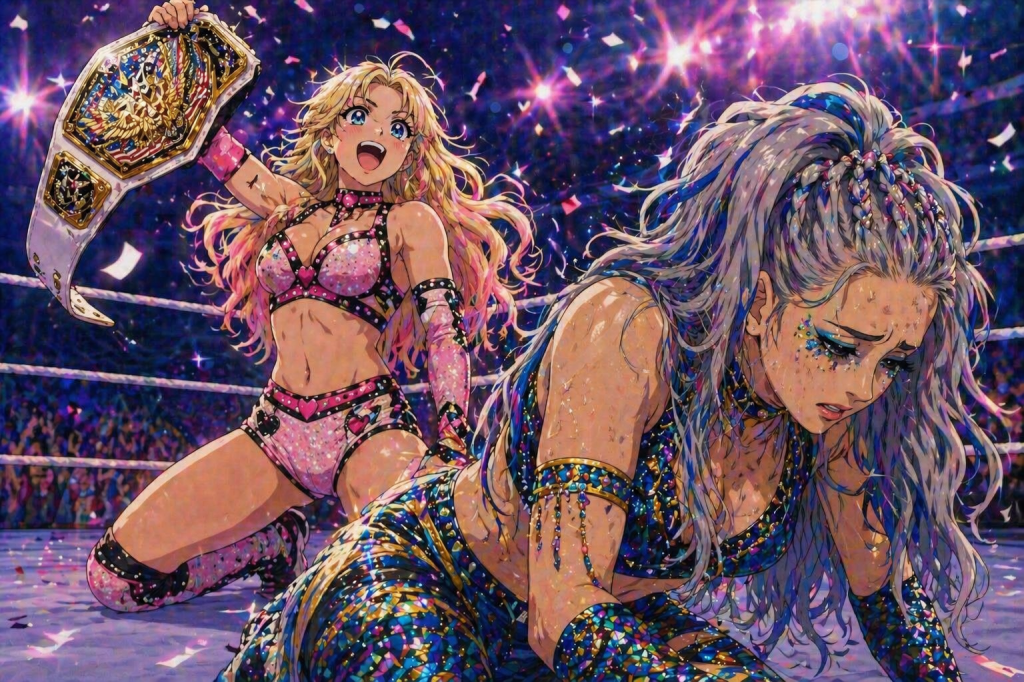
Giulia came in wearing ice blue, like she was trying to freeze the moment in place. Stratton burned red across from her, all velocity and intent. It looked like a painting that had already decided how it would end.
From the opening exchange, Giulia did what Giulia does. She dragged the match into the ground. Not metaphorically. Literally. Clinches. Short forearms. Grinding transitions. She doesn’t just wrestle you. She compresses you. Reduces your options until you’re operating inside her rhythm.
Early on, she took Stratton to the apron and delivered a draping neckbreaker that felt like it echoed. Not a move. A statement. Targeting the neck. Targeting the PME before it could exist.
That’s the thing about Giulia at her best. She doesn’t react to your offense. She deletes it before it happens.
There was a moment, mid-match, where she countered a strike into a top-rope butterfly suplex. Both women crashing down in a heap of limbs and breath and noise. The kind of impact that resets a crowd’s nervous system.
For a few seconds, everything paused.
And in that pause, you could almost see the version of this match we should have gotten. Fifteen minutes. Twenty. Space to breathe. Space to escalate. Space for Giulia to actually construct something instead of sprinting through fragments.
Instead, we got acceleration.
Stratton shifted gears.
Springboard stunner. Snap. Clean. No wasted movement. She doesn’t just fly. She calculates air.
The momentum tilted. Not gradually. Suddenly. Like a table kicked from one side.
The Finish: A Crown Dropped, Not Taken
And then… the interference.
Because of course there was.
Kiana James, orbiting the match like a satellite that didn’t understand gravity, decided to insert herself at the worst possible moment. Stratton setting up her final sequence. The crowd leaning forward. The match finally finding its shape.
And Kiana stepped in.
Not to enhance it. Not to elevate it.
To break it.
Giulia turned, instinctively. A forearm. Sharp. Unforgiving. And it landed on the wrong target.
Kiana dropped.
Time fractured.
Stratton didn’t hesitate. Rolling senton. Fluid. Immediate. Then up. Then airborne.
The Prettiest Moonsault Ever.
Clean rotation. Perfect landing. One, two, three.
Just like that, 245 days disappeared.
Not through escalation. Not through outlasting. Not through being definitively better.
Through distraction. Through miscommunication. Through narrative clutter.
It’s not just frustrating. It’s insulting.
Because Giulia didn’t lose to Tiffany Stratton at her absolute best. She lost to a version of the match that never fully formed.
And that matters.
Atmosphere & Culture: When the Machine Eats the Artist
There’s a version of this story that WWE will tell.
Tiffany Stratton redeems herself. Overcomes the WrestleMania snub. Captures a historic title. Momentum restored. Star rebuilt.
And look, that part isn’t wrong. Stratton was excellent here. Precise. Focused. Dangerous in that way elite athletes are when they’ve been denied something they believe is theirs.
But the Giulia side of this story?
That’s where the discomfort lives.
Because what we’re watching, in real time, is a system trying to sand down something that was never meant to be smooth.
Giulia is not a “project.” She is not a “work in progress.” She arrived fully formed. A wrestler who already understood how to make people feel something without speaking a word.
And instead of leaning into that, WWE has wrapped her in translation. In explanation. In unnecessary scaffolding.
Kiana James wasn’t the cause of the loss.
She was the symptom.
What Comes Next for Giulia: A Crossroads That Feels Like a Trap
So where does this leave Giulia?
On one path, there’s adaptation. Learn the system. Cut the promos. Play the game the way WWE wants it played. Become a version of herself that fits the machine.
She has shown that she can adapt her character in small skits with Kit Wilson on Instagram.
She’s highly thought of by her peers. She shown on her instagram story, she’s hard at work in the gym. This doesn’t have to be end with WWE.
On the other, there’s resistance. Strip it all back. Demand space. Rebuild the aura through action, not words.
But here’s the uncomfortable truth.
WWE doesn’t always reward the second path.
And that’s where the frustration turns into something sharper.
Because Giulia doesn’t need “repackaging.” She needs protection. Time. Matches that breathe. Stories that don’t rely on interference as a crutch. A run that actually reflects who she is.
Right now, it feels like she might not get that.
And that should worry anyone who understands what she was before she arrived.
This is a wrestler who went through World Wonder Ring Stardom like a storm system. Who carried factions, titles, entire arcs on her back. Who bled, shaved her head, rebuilt herself, and still came out sharper on the other side.
This is someone who fractured her wrist in Marigold and kept going for 24 minutes because stopping wasn’t an option.
And now?
She’s losing eight-minute matches because her manager can’t stay out of the way.
It doesn’t sit right.
Final Thought: The Silence After Impact
Tiffany Stratton stands tall. Deservedly, in many ways. Gold around her waist. Narrative restored. A future that looks bright again.
But the real story lingers in the shadows she leaves behind.
Giulia, standing in Fort Worth, not broken… but misused.
And there’s a difference.
Broken things can be rebuilt.
Misused things?
They get lost.
If WWE isn’t careful, that’s exactly what happens here. A generational talent, diluted into something safer. Smaller. Easier to script.
And if that happens, it won’t just be Giulia’s loss.
It’ll be the company’s.
Because some wrestlers don’t need to be explained.
They just need to be let loose.
Is Giulia an Italian name?
Yes. Giulia is the Italian version of the name Julia. It reflects her Italian heritage and is part of her real identity as Eimi Gloria Matsudo, who is of both Italian and Japanese descent.
What ethnicity is Giulia?
Giulia is of mixed ethnicity. She has an Italian father and a Japanese mother. Although she was born in London, she was raised in Japan and built her wrestling identity within the Japanese joshi puroresu system, particularly through promotions like World Wonder Ring Stardom.
Does WWE Giulia speak English?
Yes, Giulia can speak some English, but it is not her first language. Japanese is her primary language, which is why WWE paired her with Kiana James as a mouthpiece. However, as her career progresses, there is growing expectation that she will deliver more of her own promos and connect directly with the audience.
What wrestling promotions did Giulia compete in before WWE?
Before joining WWE, Giulia competed in several major Japanese promotions, most notably World Wonder Ring Stardom, where she became one of the company’s top stars. She also wrestled in Ice Ribbon and appeared in New Japan Pro-Wrestling through cross-promotional events.
What championships has Giulia won?
Giulia has held multiple major titles, including the World of Stardom Championship, the Wonder of Stardom Championship, and the NJPW Strong Women’s Championship. In WWE, she captured the NXT Women’s Championship and went on to hold the Women’s United States Championship for a record-setting 245 days.


2 responses to “Beautiful Madness, Bad Ending: How Giulia’s 245 Days Collapsed in the Noise”
[…] Prefer to read in English? […]
LikeLike
[…] suffered a legitimate June concussion, derailing their scheduled clash at No Way Out and forcing WWE to pivot, temporarily sliding Dolph Ziggler into the title picture. Del Rio’s return […]
LikeLike