
I wrote the original piece yesterday…
That matters now, if only because part of it no longer exists.
Buried in the middle of it all, there was a section about Scott Parker. His record. His strange, stubborn ability to take something fragile and make it awkward enough to survive. Two wins, one draw against Leeds. A small detail, but one that gave the game a shape.
It felt like something worth tracking.
Between writing that and today, Parker left Burnley.
Which is one way of resolving a narrative thread. Remove it entirely.
The Manager Who Isn’t There Anymore
Football previews rely on a quiet agreement.
That the thing you’re analysing will still be there when the game starts.
Managers, systems, habits. Patterns that can be followed from one week to the next with just enough continuity to make sense of them.
Burnley have removed that agreement.
Parker is gone. “Mutual consent,” which reads like a carefully worded exit but feels more like an erasure. The record I referenced still exists, technically. It just no longer belongs to the game that’s about to be played.
So the match has shifted.
Not dramatically. Subtly.
And that tends to be more dangerous.
Reframing the Imbalance
Yesterday, this was framed as contrast.
Leeds needing oxygen. Burnley already gone. One team pushing forward, the other folding into itself. A match defined by imbalance.
That still holds.
But now the imbalance behaves differently.
Because Burnley no longer arrive as Parker’s Burnley. No low block as doctrine. No controlled suffocation as identity. Those ideas might still appear, out of habit if nothing else, but they are no longer anchored to anything.
They are optional now.
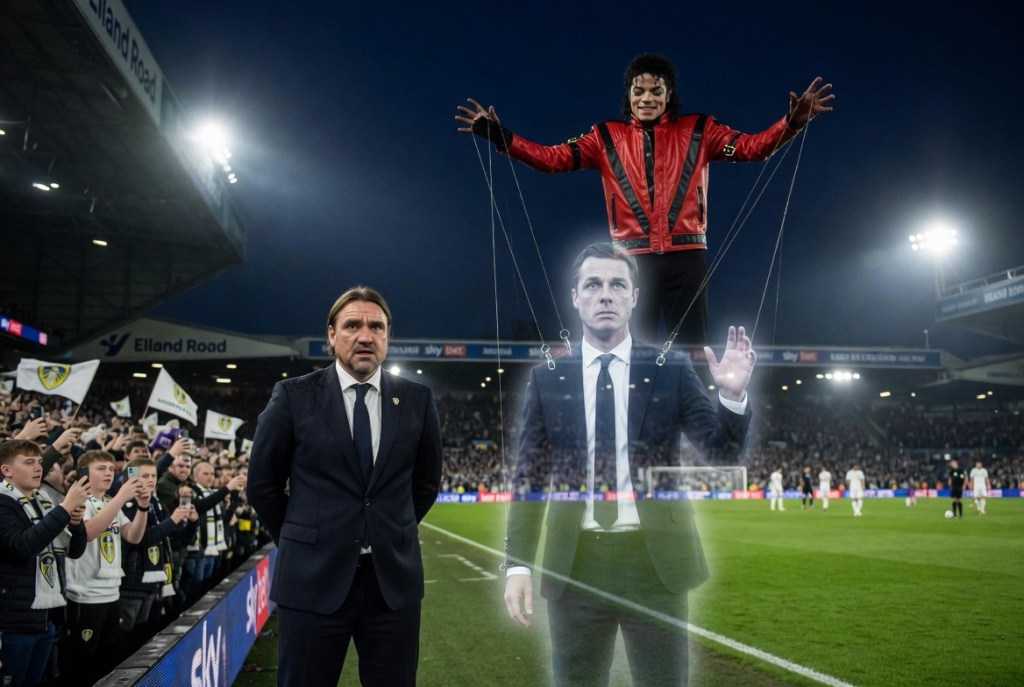
Instead, they will now be led by… Michael Jackson. A man who has continually been in a SEO war with the pop star by the same name.
The Danger of Nothing to Lose… Again
There was already a warning embedded in this game.
Relegated teams don’t simplify fixtures. They loosen them.
Now that looseness has doubled.
No pressure. No consequence. No permanent manager.
Michael Jackson’s interim voice in the dugout, players operating in that strange space between frustration and freedom, where the season has ended but the careers haven’t.
Could it be a Thriller?
No it’s more likely to be Bad.
This is where football becomes unpredictable in small ways.
A full-back pushes five yards higher than he should. A midfielder takes a risk that wasn’t there last week. A defensive line holds for a second too long because nobody has quite told it where to sit.
Minor shifts.
Which are usually where games tilt.
Farke vs Parker… Without Parker
There was a neat tension in the original framing.
Farke pushing forward, trying to break a pattern.
Parker standing in the way, quietly reinforcing it. Until the Burnley hierarchy said: Beat It.
Now it’s just Farke.
The pattern hasn’t been broken. It’s been removed from the equation.
Which sounds like progress. It might not be.
Because what replaces a pattern isn’t always clarity. Sometimes it’s just noise.
Leeds: Still Carrying Yesterday
Nothing about Leeds has changed.
That’s the important part.
The Wembley residue is still there. That quiet, draining 1–0 loss that didn’t explode into anger or collapse into chaos. It just… lingered. The kind of defeat that leaves something behind without announcing it.
Farke says it’s been parked.
Managers always say that. Especially when they see The Man in the Mirror.
The question remains the same: does it still exist in the legs?
Because if Burnley arrive without structure, Leeds still arrive with memory.
And memory, in these games, can be heavier than tactics.
The Turf Moor Verdict: When the Noise Stops
It didn’t end with anger.
That part came first. The boos, the chants, the familiar rhythm of a crowd turning on something it no longer recognises. “You’re getting sacked in the morning” felt less like protest and more like procedure. A step that had to happen.
What followed was quieter.
Empty seats. Early exits. A kind of absence that carries more weight than noise ever does. Burnley supporters didn’t just reject Scott Parker. They drifted away from him.
That’s harder to fix.
Because this wasn’t about defensive football. They’ve lived with that before. Under Sean Dyche, it had purpose. It knew what it was. Ugly, maybe, but honest.
This felt different.
Passive. Tentative. As if the team had arrived without fully deciding what it wanted to be. One supporter called Parker “the Audley Harrison of managers.” It lingered because it felt precise.
Even promotion hadn’t convinced them. The results held, but the joy never quite followed.
By relegation, the anger had already burned out.
What remained was indifference.
And in football, that’s usually the final stage.
By the time Parker left, the relationship hadn’t broken.
It had already gone quiet.
Tactics: From Structure to Suggestion
Yesterday, this looked like a clear tactical contrast.
Leeds pushing high, Burnley sitting deep, a game of pressure versus resistance.
Now it feels less fixed.
Leeds will still try to impose something structured. The three at the back, the wing-backs, the territorial push. That’s their identity now, fragile as it might be without Gudmundsson.
Burnley, though, are no longer obliged to respond in the same way.
They might sit in.
They might not.
They might press in moments, retreat in others, operate in something that resembles a system but doesn’t fully commit to it.
This is what happens when a team loses its reference point.
The system doesn’t disappear.
It becomes optional.
The Atmosphere: Expectation Meets Uncertainty
Elland Road hasn’t changed either.
The noise will still arrive early. The expectation will still be there. Finish this. End this. Make it real.
That pressure hasn’t softened.
If anything, it sharpens now.
Because what looked like a defined opponent has become something less predictable. And unpredictability, under expectation, tends to tighten everything.
Every pass. Every decision. Every small mistake.
The crowd will feel it and they’ll Wanna Be Startin’ Something.
So will the players.
Burnley: From Structure to Ruins
There was a line in the original piece about Burnley playing for nothing but fractured pride.
That still applies.
But now the fracture is visible.
No manager. No clear direction. Just a group of players moving through the final weeks of a season that has already judged them.
That can go one of two ways.
Collapse.
Or freedom.
And football has a habit of choosing the second option just when you expect the first.
Final Word: The Game That Changed Before It Began
Yesterday, this was a game about breaking something.
Farke breaking a record. Leeds breaking free. Parker holding onto a small, stubborn thread.
Today, it’s something else.
The thread is gone.
And what’s left is less tidy.
Leeds still have the same path. Win, and survival becomes real rather than calculated. The equation hasn’t changed.
But the environment around that equation has.
Because the opponent is no longer fixed.
And games like that… they rarely behave the way they’re supposed to.
Update summary, if you prefer it simple:
Leeds still need one win.
Burnley no longer have a manager.
And the game you thought you understood yesterday…well football is never Black or White.






One response to “Leeds United vs Burnley: Friday Night, Survival Theatre at Elland Road (Update)”
[…] Rather read in English? […]
LikeLike