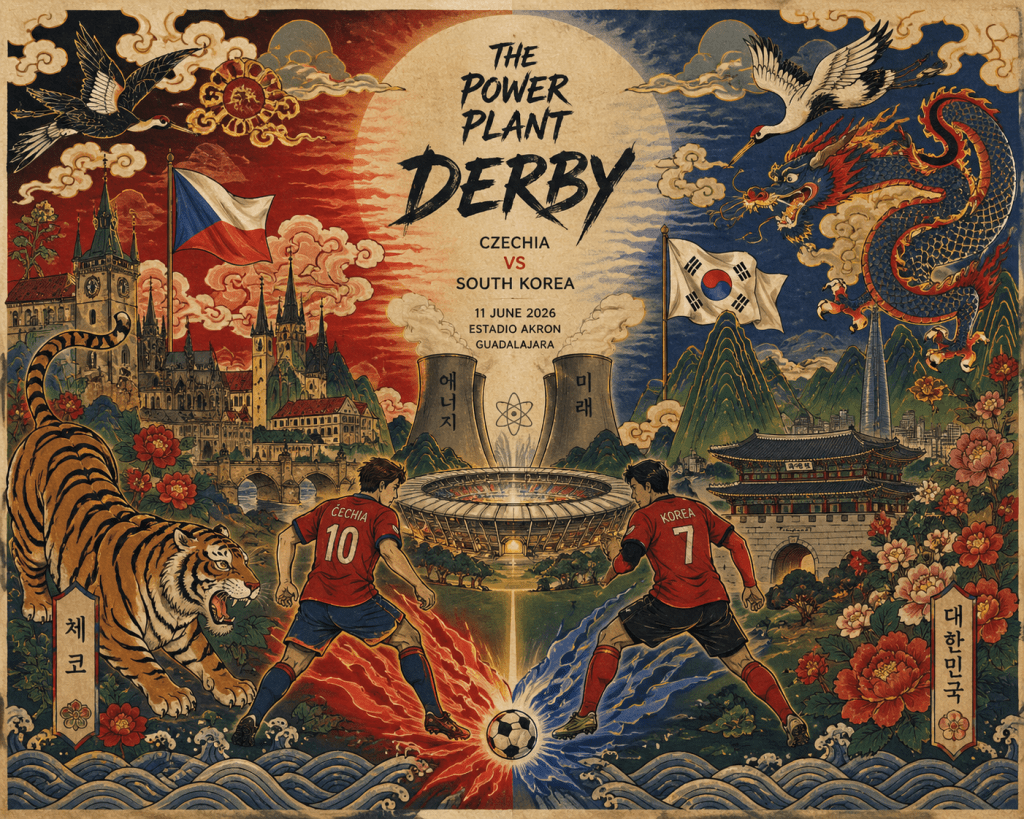
There are matches that feel scheduled.
And then there are matches that feel… summoned.
June 11, 2026, doesn’t just open a group. It opens a fault line. Kicking off a little bit after Mexico and South Africa. Inside Estadio Akron, under the thin, deceptive air of Zapopan, two national stories arrive at completely different chapters and are forced to read from the same page.
For the Czech Republic, this is not an opening game. It’s a return from exile. Twenty years removed from their last World Cup appearance, they don’t step onto the pitch lightly. They carry the weight of absence, the ache of irrelevance, the quiet humiliation of watching generations come and go without touching the game’s biggest stage. And yet, stitched into their shirt is something older than that absence. The echo of the Czechoslovakia national football team, a ghost that reached two World Cup finals and still whispers of what this region once meant to global football.
Across from them, South Korea arrive with none of that fragility. This is their eleventh consecutive World Cup. Not a return. Not a redemption arc. A continuation. A rhythm so consistent it almost feels industrial. Qualification is not the story anymore. Evolution is.
So what happens when a nation gasping for relevance collides with one that has made relevance routine?
It becomes something bigger than football.
It becomes a question.
The Connection (or the Absence of One)
If you trace the lines between Czechia and South Korea through football history, you don’t find a map.
You find scattered footprints.
A few players. A few experiments. The occasional transfer that felt more like curiosity than strategy.
Kim Seung-bin is the closest thing to a real bridge. A player who didn’t just pass through Czech football but absorbed it. Developed within its structures, sharpened by its discipline, and then emerged as something hybrid. His success at Slovácko wasn’t just personal. It was symbolic. Proof that the corridor exists, even if it’s rarely used.
Then there are the others.
František Koubek, Jan Kraus. Names that flicker briefly in Korean football records before disappearing again. Not failures. Not successes. Just… moments.
And that’s the point.
There is no shared tactical language between these nations. No inherited rivalry. No recycled talking points for a grammaticaster to lean on. No comforting archive of past battles to draw from.
They are strangers.
And because they are strangers, this match cannot lean on nostalgia. It has to build meaning from scratch. Every duel, every run, every mistake becomes part of a story that didn’t exist before kickoff.
2016: The Night Prague Tilted
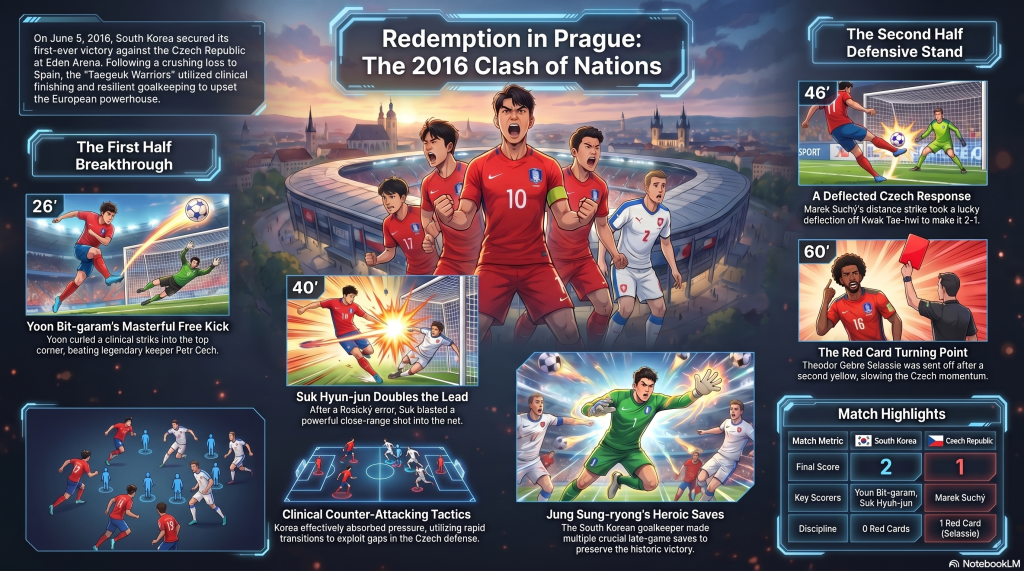
One night, these two worlds collided and left a mark.
June 5, 2016. Eden Arena.
It was supposed to be routine. A warm-up. A controlled environment where Czech Republic could fine-tune itself before heading to Euro 2016. They were ranked higher. More stable. More composed.
South Korea arrived fractured. Days earlier, Spain had dismantled them 6–1. Confidence wasn’t just shaken. It had been dragged through something brutal.
But football has a habit of rejecting neat narratives.
In the 26th minute, Yoon Bit-garam stepped up over a free-kick. The strike was clean. Precise. Unforgiving. It curled into the top corner, beyond the reach of Petr Čech, a goalkeeper who built his reputation on denying moments like this. For a split second, Prague didn’t react. It just… paused.
Then came the second rupture.
Tomáš Rosický, the orchestrator, the technician, the calm centre of Czech football, slipped. A small moment. A human moment. But at this level, small moments become openings. The ball spilled. South Korea surged. Suk Hyun-jun finished with force.
2–0.
Not a fluke. Not a blip. A shift.
The second half tried to correct the narrative. Marek Suchý pulled one back through a deflected strike that felt more like persistence than design. The crowd leaned forward again. The story tried to reset.
And then it snapped.
Theodor Gebre Selassie was sent off. A second yellow. A moment of misjudgment that collapsed Czech momentum entirely.
They pushed. They hit the post. They tried to force something back into place.
But South Korea held.
And what mattered most wasn’t the scoreline. It was the feeling it left behind.
Czechia walked away unsettled. Not defeated in the traditional sense, but exposed. Slightly disorganised. Slightly unsure.
South Korea walked away alive again.
살아있네.
Not just a phrase. A state of being.
Parallel Histories & Political Undercurrents
Zoom out, and the connection between these nations becomes less about football and more about formation.
The Czech Republic emerged from controlled collapse. The Velvet Revolution didn’t explode. It transitioned. Quietly. Precisely. Then came the division of Czechoslovakia, another clean break that reshaped identity without tearing it apart.
South Korea’s path was harsher. War. Division. A border that still feels temporary, even decades later.
Different histories. Same outcome.
Nations forced to rebuild quickly. To define themselves under pressure. To grow in the shadow of something unresolved.
That tension seeps into football.
Czechia plays like a system designed to hold. Structured. Measured. Resistant.
South Korea plays like a system designed to move. Relentless. Energetic. Expansive.
One absorbs pressure.
The other generates it.
Economic & Structural Parallels: The Nuclear Derby
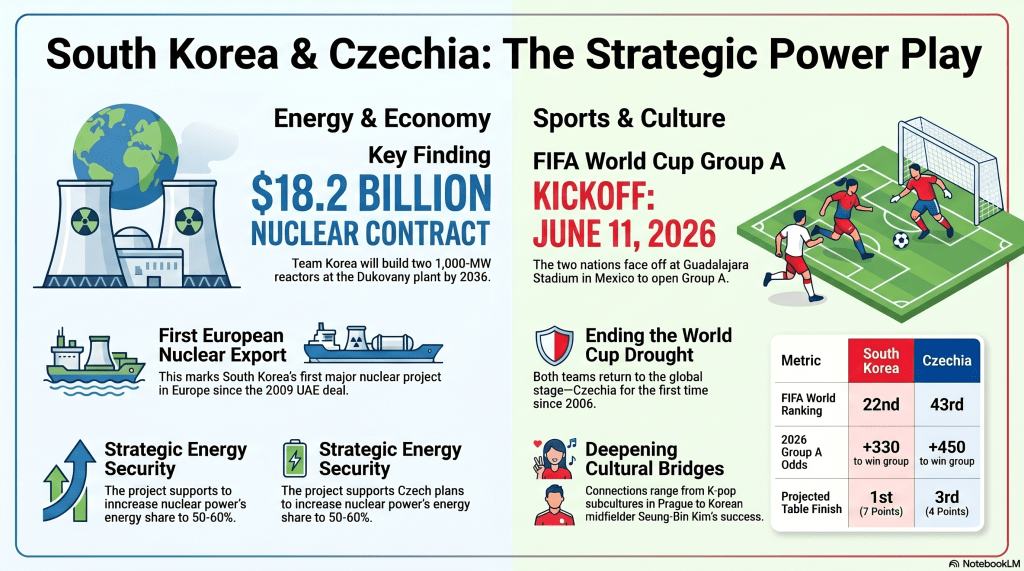
And then there’s the layer that changes everything.
Because while these nations barely intersect on the pitch, they are now deeply intertwined beneath it.
The so-called “Nuclear Derby” isn’t metaphor. It’s infrastructure.
In mid-2025, South Korea’s Korea Hydro & Nuclear Power secured a monumental contract worth $18–$19 billion to construct two new reactors at the Dukovany Nuclear Power Station.
This wasn’t a routine deal. It was a geopolitical contest.
France’s EDF. America’s Westinghouse. Established giants with decades of influence. All competing. All expecting to win.
And yet South Korea emerged on top.
Not without resistance.
Legal challenges. Accusations of unfair state backing. Attempts to block the deal through injunctions. At one point, it looked like the entire project might stall under the weight of litigation.
But the Czech Supreme Administrative Court dismissed those challenges.
Public interest. Energy security. Future demand.
The project moved forward.
And what’s being built isn’t just another plant. It’s a system.
South Korea will deploy its APR1000 reactors, precision-engineered and adapted specifically for Czech conditions. Construction is set to begin in 2029. The first reactor is expected to come online by 2036.
But the real story sits beneath the numbers.
This is not a simple export. It’s integration.
Czechia has mandated that around 60% of the work be handled domestically. Nearly 160 Czech companies have already entered the supply chain. Local industry doesn’t just support the project. It becomes part of it.
Take Doosan Enerbility and its Czech counterpart Doosan Škoda Power. Together, they are producing turbines for the plant. Not as separate entities. As a combined operation.
There’s even a joint ministerial steering committee overseeing the project. Shared risk. Shared direction. Shared outcome.
And it might not stop at Dukovany.
The Czech government is now considering expanding nuclear capacity at Temelín Nuclear Power Station. If South Korea secures that deal too, the total economic impact could exceed $36 billion.
At that point, this isn’t cooperation.
It’s alignment.
A decades-long partnership built not on culture or sport, but on energy, technology, and necessity.
Cultural Identity: Neon on the Vltava
And yet, while billion-dollar reactors rise quietly, culture flows in a completely different direction.
South Korea doesn’t arrive in Prague through policy.
It arrives through rhythm.
Through BTS, whose presence in the Czech Republic is no longer niche curiosity but measurable influence.
“Dynamite” breaking into the Czech Top 10.
Songs hitting number one on iTunes years after release.
Live performances ranking among the most-watched digital content in 2026.
That’s not accidental.
That’s penetration.
Walk through Prague and you might not hear K-pop everywhere. But you’ll find it where it matters. In communities. In rehearsals. In headphones. In language learning apps where lyrics become vocabulary.
It’s not overwhelming.
It’s persistent.
And that persistence shows up on matchday.
Korean fans arrive with choreography. Rhythm. Collective identity.
Czech fans arrive with weight. Voice. Raw, unfiltered presence.
Two different expressions of support.
Two different interpretations of belonging.
Footballing Identity & Tactical War
Eventually, everything compresses into the game itself.
Czechia build vertically. They trust the air. They trust structure. Tomáš Souček dominates space like a gravitational force. Patrik Schick converts pressure into goals.
South Korea operate differently. They invite pressure, then break it. Son Heung-min stretches defences. Lee Kang-in reshapes them. Kim Min-jae anchors everything behind.
This is not a stylistic clash.
It’s a structural contradiction.
Height versus speed.
Control versus disruption.
And somewhere in that contradiction, the match will find its truth.




One response to “The Power Plant Derby: Czechia and South Korea Meet in Guadalajara”
[…] Rather read in English? […]
LikeLike