
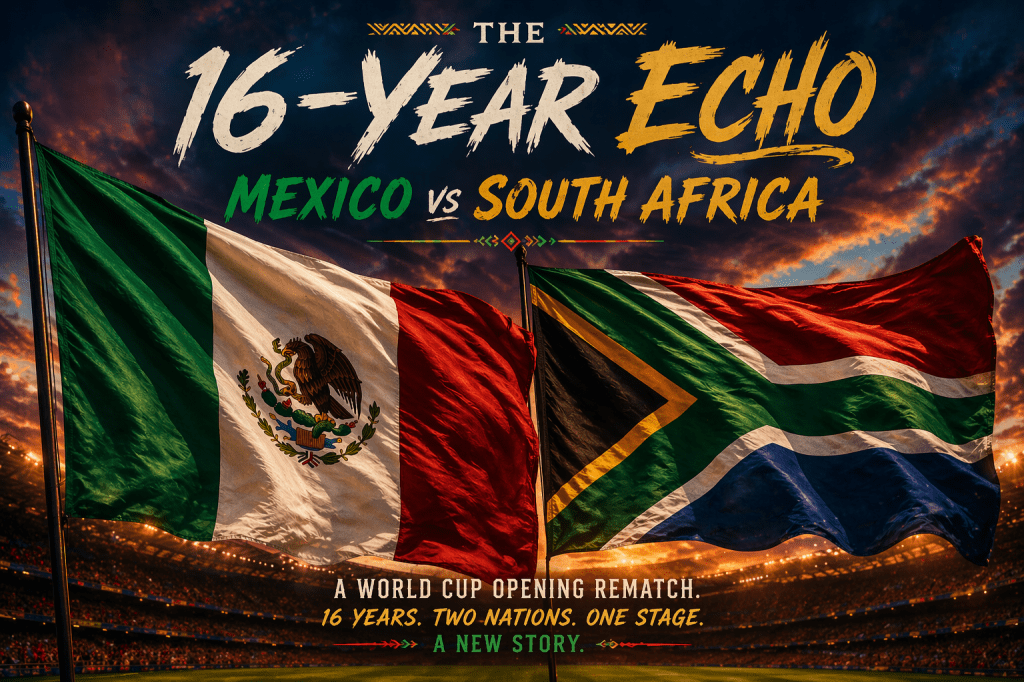
Some fixtures arrive like routine.
Names on a board. Kickoff times. A quiet acceptance that football will happen, and then it will move on.
この記事を日本語で読みたいですか?こちらをクリックしてください!
This one doesn’t behave like that.
On June 11, 2026, inside Estadio Azteca, the world is not just watching a football match. It is watching a memory return, altered but recognisable, like a story told again by someone who lived it the first time and still isn’t sure how it ended.
Sixteen years earlier, on the same date, Mexico and South Africa opened the 2010 FIFA World Cup. A continent held its breath—a stadium pulsed like something alive. The noise was not background, it was substance.
Now the stage flips.
South Africa arrives not as a host, but as a witness.
Mexico stand where South Africa once stood, carrying the same weight, dressed in a different colour.
And somewhere in the background, football smiles at its own symmetry.
A Fixture Built on Absence
Most international matchups come with history. Threads that can be pulled. Old arguments that never quite ended.
This one doesn’t.
No shared players.
No coaching lineage crossing borders.
No club pipelines connecting leagues.
You search for links and find almost nothing. A near-mention here. A speculative transfer there. Then silence.
But silence, in this case, is not emptiness. It is architecture.
These are two footballing ecosystems that grew inward. Self-sustaining, univorous in their appetite for identity, feeding from their own leagues, their own cultures, their own expectations. Liga MX holds its stars close. The South African PSL does the same. There is no need to leave when home already provides.
So they never learned from each other.
Until the World Cup forces them to.
“A lo que nos truje, Chencha.”
Let’s get to it.
This is not a rivalry being renewed.
It is a relationship being introduced.
Nations Carrying Their Own Weight
To understand what happens on the pitch, you have to understand what arrives with the players.
Mexico is a country built on reinvention. The revolution of the early 20th century did not just reshape politics; it reshaped identity. Pride sits at the centre of everything. Football becomes a mirror for that pride, sometimes a celebration, sometimes a burden.
South Africa carries something heavier.
The end of apartheid in 1994 did not erase the past; it reframed it. The country learned to exist again before the world, negotiating identity in real time, building something new while standing on ground that remembers everything.
Different histories. Same tension.
Inequality that refuses to disappear.
Cities that shine while edges struggle.
A constant balancing act between growth and fairness.
Football becomes the release valve.
For ninety minutes, everyone gets the same voice.
There is a Setswana phrase that lingers here:
“Lefufa le ja mong wa lona.”
Jealousy eats its owner.
In football terms, it translates differently. Pressure, expectation, the weight of what should be achieved rather than what is. It is not the opponent that consumes you. It is the demand you place on yourself.
Mexico knows this feeling intimately.
South Africa has lived it before.
Now the roles reverse.
The Memory of 2010
June 11, 2010 felt less like the start of a tournament and more like the world stepping into a living drumbeat. Inside the calabash-shaped Soccer City in Johannesburg, nearly 85,000 voices fused into a single, unrelenting hum, carried on the sharp, buzzing cry of vuvuzelas. It was football wrapped in ceremony, colour, and expectation. Yet beneath the celebration, there was a quiet shadow. Nelson Mandela, the symbolic heartbeat of the nation, was absent after the tragic loss of his 13-year-old great-granddaughter the night before. His presence came only through a recorded message, a reminder that even on football’s grandest stage, life doesn’t pause for the spectacle.
When the match began, Mexico national football team took control with the confidence of a side determined to impose itself early. Their attacking shape stretched South Africa national football team, probing, pressing, and circulating the ball with precision. The hosts, carrying the weight of being the first African nation to stage a World Cup, looked tense in those opening exchanges. Goalkeeper Itumeleng Khune became the early anchor, repelling wave after wave of Mexican pressure. A disallowed goal for Carlos Vela just before halftime only added to the sense that Mexico were knocking, but not yet allowed through the door.
Then came the moment that still echoes. In the 55th minute, South Africa broke forward with sudden clarity, a counter-attack that cut through the tension like a blade. Siphiwe Tshabalala received the ball on the left, looked up once, and struck it with venom. The shot flew, rising, bending, and smashing into the top corner beyond Óscar Pérez. It wasn’t just a goal. It was ignition. The stadium erupted, the noise somehow climbing higher, as Tshabalala wheeled away into a celebration that felt choreographed by history itself, a dance of pride, relief, and unfiltered joy.
Mexico, jolted awake, turned to experience and youth in equal measure. Cuauhtémoc Blanco brought calm, while Javier Hernández stretched the game with restless movement. Their response came in the 79th minute. From a short corner, the ball was worked wide before Andrés Guardado delivered a delicate cross to the far post. There, unmarked, Rafael Márquez took a touch and finished with authority, silencing the roar just enough to remind everyone that this contest still had two voices.
And then, almost as if scripted for heartbreak, South Africa came within inches of a perfect ending. In the dying seconds, Katlego Mphela slipped through, one-on-one, the stadium holding its breath in a single, fragile moment. His shot beat the keeper but struck the post, the sound ringing out like a closing bell. It was the kind of chance that lingers, replayed endlessly in the minds of those who witnessed it.
The 1-1 draw that followed felt right, even if it didn’t feel complete. Mexico’s control and craft balanced against South Africa’s resilience and bursts of brilliance. But more than that, it was a match that carried something larger than tactics or scorelines. It was the opening note of a World Cup that belonged to a continent, a game where joy, grief, pressure, and pride all shared the same pitch.
The Azteca Watches
The Estadio Azteca does not simply host football. It absorbs it.
It has seen triumph, collapse, brilliance that flickered too briefly, and expectation that never quite found its release. It is heavy with memory. It does not forget.
For Mexico, playing here is not a comfort. It is exposure.
Every pass is judged.
Every hesitation amplified.
¡Aguas!
Be careful.
Because when expectation turns, it does not whisper. It roars. And if the performance falters, the reaction is immediate.
¡Que chafa!
What a disappointment.
South Africa steps into this without that burden. They are not expected to dominate. They are not required to control. Their role is simpler, and therefore more dangerous.
Disrupt.
Interrupt.
Unsettle.
There is freedom in that.
Football as Language
Mexico play in sentences.
Quick, technical, fluid. The ball moves like conversation, one idea flowing into the next, always searching for space, always inviting the next response. It is a style built on rhythm and trust, where hesitation feels like an error.
South Africa plays in music.
“Shoe-shine and piano.”
A phrase that sounds playful until you see the discipline beneath it. Movement layered with structure. Expression supported by shape. A team that can improvise without losing form.
They are not opposites.
They are translations.
And like all translations, something is always lost, something misunderstood, something exploited.
Economies Reflected in Football
Both nations exist in that global middle ground.
Powerful enough to matter.
Inconsistent enough to be questioned.
Emerging economies. Industrial anchors. Resource-backed systems layered with modern industry. Mexico has oil and silver. South Africa has gold and platinum. Both are acting as manufacturing centres for their regions.
This structure is reflected in their football.
Domestic leagues are strong enough to retain talent. Systems designed to build inward rather than export outward—a resistance to becoming feeders for Europe.
It creates something rare.
Two football cultures that grow independently, without needing validation from outside.
So when they meet, it feels unfamiliar.
Like two mirrors facing each other for the first time.
Where They Actually Connect
Step away from tactics, from history, from structure, and something changes.
Mexico City at night.
Johannesburg in the evening.
The air fills with smoke from grills. Music spills into the street. Conversations overlap, rise, fall. Life refuses to stay contained.
Carne asada. Braai.
Different words. Same ritual.
Football lives here, not in analysis, but in feeling.
In the moment a pass cuts through a defence and everyone reacts at once. In the shared intake of breath before a shot. In the collective noise that follows.
This is where Mexico and South Africa understand each other.
Not through players.
Not through systems.
Through experience.
When Johannesburg Reached Mexico: The Quiet Journey of District 9
There’s even a strange cinematic bridge between the two, flickering far from the pitch. District 9, born out of Johannesburg’s fractured landscape, found a surprisingly strong audience in Mexico, not just as spectacle, but as something uncomfortably familiar. Its themes of segregation, displacement, and the quiet brutality of systems landed with weight in a country that understands borders not as lines on a map, but as lived reality.
In Mexico, the film wasn’t just consumed, it was recognised. A story about outsiders, told through aliens and concrete, that echoed human truths both nations carry in different forms. It becomes another subtle thread in this fixture. Not a loud connection, not a shared tradition, but a moment where one country’s story travelled across an ocean and was understood without needing translation.
The Reversal
In 2010, South Africa carried the burden of hosting.
The expectation. The attention. The need to prove something beyond football.
Now Mexico carries it.
And that changes the emotional gravity of the match.
South Africa knows what it feels like when the world arrives and expects you to perform. They remember the tension, the release, the way a single goal can redefine everything.
Mexico now stands inside that same moment.
And moments like that are unpredictable.
The Axiom of New History
There is a simple truth in football.
When there is no history, the game creates one.
Mexico vs South Africa exists almost entirely in that space. One shared memory in 2010, and now this deliberate return. Same date. Same role. Different setting.
It feels intentional.
As if football itself is curious to see what changes, and what doesn’t.
Final Note
This is not a match defined by rivalry.
It is defined by reflection.
Two nations shaped by struggle.
Two football cultures built on identity.
Two systems that rarely interact.
Now placed together again, not because of history, but because of timing.
And when the whistle goes, none of that absence will matter.
Because for ninety minutes, they will finally learn from each other.
And whatever happens next will not be an echo.
It will be something entirely new.



3 responses to “The 16-Year Echo: Mexico vs South Africa’s World Cup Opening Rematch”
[…] Rather read in English? […]
LikeLike
[…] 11, 2026, doesn’t just open a group. It opens a fault line. Kicking off a little bit after Mexico and South Africa. Inside Estadio Akron, under the thin, deceptive air of Zapopan, two national stories arrive at […]
LikeLike
[…] sudden Falcon Arrow like a Lucha from Mexico, executed with more urgency than elegance, landed with the kind of impact that doesn’t just […]
LikeLike