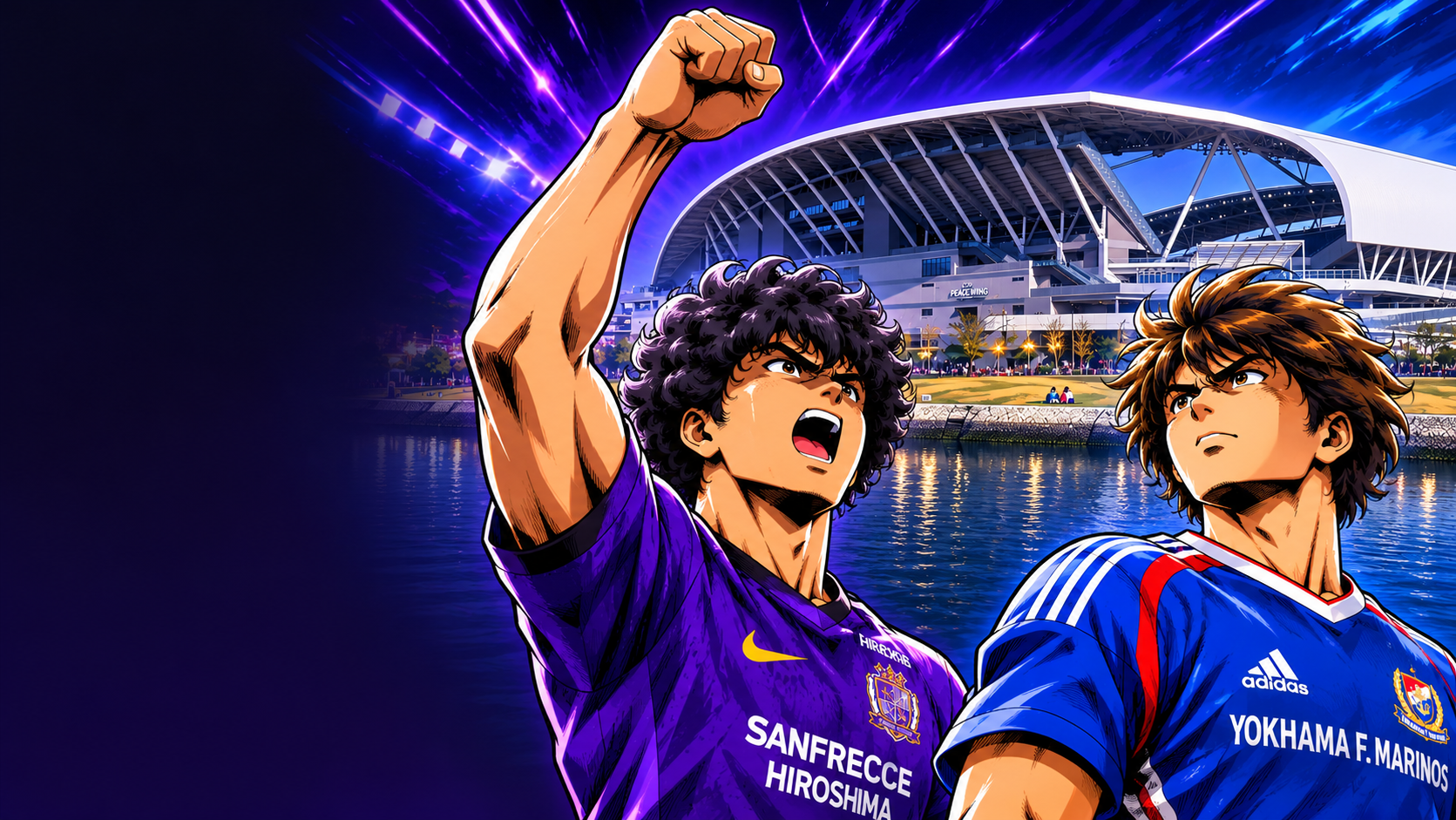
Just 24 days after Yokohama F. Marinos edged Sanfrecce Hiroshima in a seven-goal cup thriller, the two Japanese heavyweights meet again. This time, Hiroshima have home advantage, a formidable defensive record and a rather unusual Christmas celebration to protect. But can they finally get one over on the visitors?
There are few things more frustrating in football than losing a seven-goal thriller. Well, perhaps having to wait almost a month to put things right.

On Saturday, 21 November, Sanfrecce Hiroshima welcome Yokohama F. Marinos to the Edion Peace Wing Hiroshima for a J1 League fixture that promises plenty of goals, a fascinating tactical battle and a little festive cheer.
The two clubs last met on 28 October, when Yokohama emerged 4–3 winners in the J.League Cup. Daiya Tono’s stoppage-time winner delivered the final blow in a contest that must have left Hiroshima wondering quite how they had allowed their opponents to escape with victory.
Now comes the opportunity for revenge.
And plenty suggests that Hiroshima should fancy their chances.
Sitting third in the J1 League with 30 points from 14 matches, Sanfrecce have established themselves as genuine championship contenders. Their 32 goals scored and just 10 conceded represent an impressive balance between attacking ambition and defensive discipline.
Yokohama, meanwhile, occupy seventh with 22 points. They have lost just twice, the same number as Hiroshima, but have drawn seven of their 14 league fixtures.
That is the problem with Marinos. They are difficult to beat, but they have been equally difficult to back for three points.
And yet, when these sides meet, form and league position often become secondary considerations.
Sanfrecce Hiroshima vs Yokohama F. Marinos Head-to-Head Record
Yokohama F. Marinos hold a narrow advantage over Sanfrecce Hiroshima across their last eight competitive meetings, winning four to Hiroshima’s three, with one draw. Their most recent encounter ended 4–3 to Yokohama in October 2026, continuing a remarkably entertaining rivalry that has produced 29 goals across those eight matches.
Can Sanfrecce Hiroshima avenge their 4–3 cup defeat?
There is something gloriously unpredictable about this fixture.
In September 2024, Hiroshima demolished Yokohama 6–2, a result that showed how devastating Sanfrecce can be when their attacking combinations come alive.
Yokohama responded by winning their October 2025 league encounter 3–0 before claiming that extraordinary 4–3 cup victory last month.
In fact, the last four meetings have produced 19 goals, averaging 4.75 per match.
It is difficult to imagine either manager being particularly enthusiastic about another seven-goal encounter, especially with championship points at stake.
But for the neutral, there is plenty to be excited about.
The question is whether Hiroshima can control the contest without sacrificing the attacking intensity that has made them one of Japan’s most dangerous teams.
Two Teams That Rarely Lose, but Only One That Regularly Wins
At first glance, the eight-point gap separating these sides suggests Hiroshima have been comfortably superior.
Look a little closer, however, and the difference becomes more interesting.
Both teams have lost just twice in 14 league matches. Yokohama have demonstrated enough resilience to remain competitive against almost everyone they have faced.
Unfortunately, resilience does not always translate into success.
Marinos have drawn half their league matches, including four of their previous five. Their 4–2 victory over Kawasaki Frontale showed what this team can achieve when its attacking players find their rhythm, but successive stalemates have repeatedly interrupted their momentum.
Hiroshima have been far more ruthless.
They have won nine matches, including emphatic 3–0 victories over Kyoto Sanga and Mito HollyHock and a 4–0 demolition of Shimizu S-Pulse.
Their only defeat across their previous five league outings was a rather spectacular 4–0 collapse against V-Varen Nagasaki.
And that result is worth remembering.
For all Hiroshima’s attacking quality and defensive strength, they are not invulnerable. When their pressing structure breaks down and opponents exploit the space behind their advanced players, even this formidable side can be punished.
Nevertheless, five victories and a draw from six home league matches make Edion Peace Wing a particularly daunting destination.
Yokohama will need more than another respectable performance.
They need a victory.
Akito Suzuki and Kaina Tanimura: Two Strikers Carrying Championship Ambitions

If this match turns into another goalfest, two players should find themselves at the centre of proceedings.
For Hiroshima, Akito Suzuki has been sensational.
The 23-year-old has scored 10 league goals in 14 matches, accounting for 31.3% of his team’s attacking output.
His finishing is particularly impressive because he needs little time or space. Suzuki constantly assesses defenders’ positioning, searching for the smallest opportunity to turn and shoot.
His October Monthly Best Goal award against Shimizu and spectacular volley against Mito illustrate the confidence of a forward operating at the top of his game.
Yokohama have their own answer in Kaina Tanimura.
The 26-year-old has scored seven goals, including braces against Kashima Antlers and Urawa Red Diamonds, and is responsible for one-third of Marinos’ league goals.
However, the distinction between these two forwards is the support they receive.
Hiroshima have scored 22 goals through players other than Suzuki, while Yokohama rely heavily on Tanimura and the creative influence of Kosuke Matsumura, who has supplied five assists.
That does not necessarily make Hiroshima more dangerous in every attacking situation, but it does suggest their opponents have more problems to solve.
Stop Suzuki, and somebody else might punish you.
Stop Tanimura, and Yokohama may find their attacking options considerably more limited.
Takuma Asano’s Return Has Given Hiroshima Something Beyond Goals
There are few footballing stories quite as satisfying as a returning hero rediscovering his confidence.
Takuma Asano’s return to Sanfrecce Hiroshima this summer was always going to be emotional.
After years overseas and a difficult period punctuated by injuries, the former Hiroshima favourite returned to the club where he first established himself.
His home league comeback arrived on Matchday 10.
Then, against Shimizu on Matchday 12, Asano scored his first Hiroshima league goal in 3,759 days.
More than a decade.
There is something rather beautiful about that.
But Asano’s contribution extends beyond the scoresheet. His experience, movement and willingness to run the channels provide Hiroshima with another dimension, particularly when opponents attempt to restrict Suzuki.
The flip side is that Hiroshima’s squad has recently suffered two significant setbacks.
Takumu Kawamura and Mutsuki Kato both sustained medial collateral ligament injuries against Shimizu on 24 October.
For Kawamura, the timing was particularly cruel. Having already endured a lengthy absence, he had returned to competitive action earlier this campaign and scored against Chiba.
Now Hiroshima must navigate another period without two influential players.
And that brings us to the wider question surrounding their championship challenge.
Can their impressive tactical system withstand the loss of important individuals?
The emergence of youngsters such as Yotaro Nakashima and Shimon Kobayashi suggests there is considerable talent waiting to make the leap.
But potential and proven consistency are not quite the same thing.
Hiroshima’s High Press Against Yokohama’s High Defensive Line
This is where Saturday’s match becomes particularly fascinating.
Hiroshima generally operate with a 3-4-2-1 formation, using aggressive wingbacks and overlapping centre-backs to create numerical advantages in wide areas.
Shuto Nakano has become especially important.
Recently called into Japan’s senior national team, Nakano offers extraordinary attacking ambition for a player who can operate in the back three. His combinations with Naoto Arai allow Hiroshima to overload opponents before delivering dangerous balls into central areas.
Yokohama, meanwhile, favour a 4-2-3-1 built around aggressive fullbacks, direct wingers and rapid transitions.
The good news for Marinos is that players such as Ryo Miyaichi, Tomoki Kondo and Daiya Tono possess the pace and technical ability to exploit Hiroshima’s advanced defensive structure.
The bad news?
Yokohama’s own defensive line frequently leaves enormous spaces behind it.
Defeats against Kashima and Urawa demonstrated how quickly promising performances can unravel when opponents attack those spaces.
Hiroshima have the personnel to exploit precisely that weakness.
Suzuki’s movement, Asano’s direct running and the creative passing of Nakashima could all cause problems for Jason Quiñones and the visiting defence.
Yet Hiroshima must also protect themselves against Matsumura’s incisive passing and Tanimura’s intelligent movement inside the penalty area.
Neither side can afford to become reckless.
And considering their recent meetings, that might be easier said than done.
Keisuke Osako Could Be Hiroshima’s Most Important Player
For all the attention surrounding Hiroshima’s attacking players, goalkeeper Keisuke Osako deserves considerable credit.
Following uncertainty over a possible overseas move, Osako temporarily surrendered his starting position to Issei Ouchi before returning to the side on Matchday 7.
Rather than allowing the situation to become disruptive, he continued supporting his teammate before reclaiming his place.
His outstanding reflex save against Kyoto subsequently earned him the J1 October Monthly Best Save award.
It is precisely the kind of contribution Hiroshima might need against Yokohama.
Marinos have demonstrated that they can create opportunities against even the strongest opponents. Their problem has been maintaining control once they establish an advantage.
For Hiroshima, Osako provides reassurance behind an adventurous defensive system.
For Yokohama, veteran Daiki Iikura must deliver similar composure at the opposite end.
Both goalkeepers could be rather busy.
Violet Christmas Brings a Different Kind of Atmosphere to Hiroshima
Saturday’s fixture launches Hiroshima’s VIOLET CHRISTMAS 2026 celebrations, a winter festival spanning five home matches across the men’s team and Sanfrecce Hiroshima Regina.
A towering purple Christmas tree will greet supporters near Gate F1, while festive decorations, special player photographs and 25,000 commemorative greeting cards will help transform the stadium into a celebration of the club.
There will even be opportunities to win local Hiroshima delicacies, including maple-flavoured momiji treats and oyster gratin buns.
Football and Christmas food. Not a bad combination.
That sense of community will be reflected in the pre-match Welcome Kids initiative, with local children greeting travelling Yokohama supporters before the players emerge.
It is a lovely gesture.
There is no reason why fierce competition and mutual respect cannot coexist, particularly in a city whose history gives the idea of peace such profound meaning.
Of course, once the whistle blows, Hiroshima’s supporters will be considerably less interested in extending hospitality to their opponents.
They have a cup defeat to avenge.
Sanfrecce Hiroshima vs Yokohama F. Marinos Prediction: Can the Hosts Keep Their Unbeaten Home Record?
There is a compelling argument for both teams.
Yokohama have already beaten Hiroshima twice in their previous two meetings, possess dangerous attacking players and have lost just twice in the league this season.
They also have the psychological advantage of knowing they can hurt this particular opponent.
And yet, Hiroshima’s overall performances have been significantly more convincing.
Their home record is outstanding, their attacking production is superior, and their defensive numbers suggest they are better equipped to manage the difficult moments that inevitably arrive in matches of this magnitude.
In fact, Hiroshima have kept four clean sheets across their previous five league fixtures.
Yokohama have managed just one.
That difference matters.
The visitors will almost certainly create opportunities, particularly if Hiroshima commit too many players forward. However, their recurring difficulty protecting leads and turning draws into victories makes them difficult to trust against such formidable opposition.
I expect goals, intensity and another fascinating contest between two teams who know each other rather well.