There was a week in April 2023 when Styve Ngono Essono barely left his house.
He had just suffered his first professional MMA defeat, losing a unanimous decision to Rodrigue Divina. The Cameroonian was exhausted, frustrated by the judging and beginning to wonder whether the sport that had already demanded so much from him was worth another sacrifice.
For seven days, he withdrew from the world.
Then his mother called.
She reminded him that defeat was part of the game. Losing did not mean his ambitions were finished. It meant there was something new to learn.
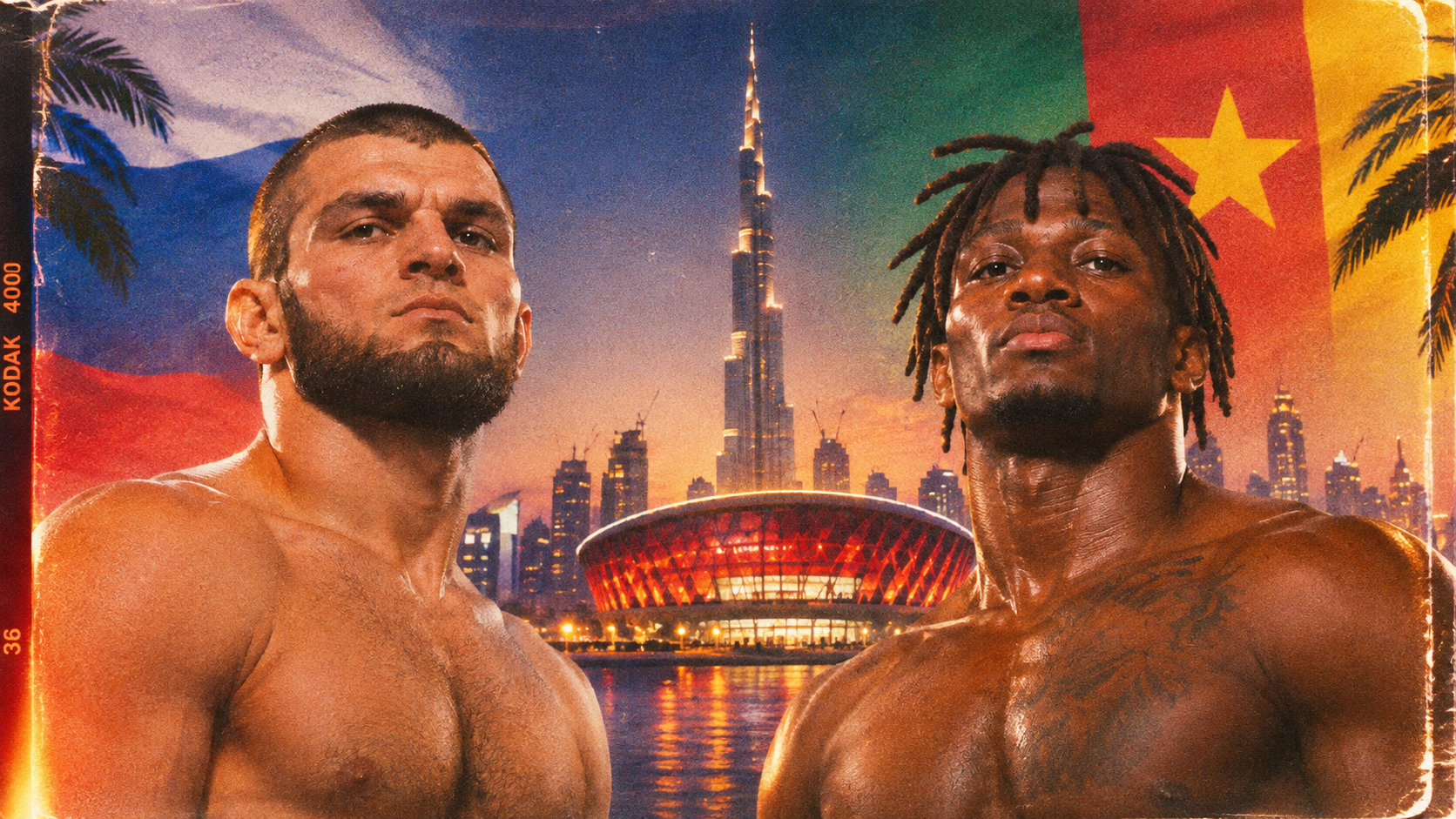
Three years later, Ngono is preparing to enter the Coca-Cola Arena in Dubai on Saturday, November 14, to face Khabib Nabiev, an undefeated Dagestani light heavyweight whose surname carries one of MMA’s most formidable reputations.
Ngono has won six consecutive fights since that miserable afternoon in 2023. Nabiev has never experienced professional defeat at all.
One fighter comes from an established wrestling dynasty. The other has crossed deserts, endured homelessness and fought to build a career in circumstances where even getting paid was uncertain.
Their three-round contest on the preliminary card of PFL Dubai: Nemkov vs Bilostenniy is ostensibly another opportunity for two ambitious light heavyweights to advance their careers.
Yet there is considerably more separating these men than the distance between Cameroon and Dagestan.
Styve Ngono Essono: The Long Road Through the Desert
Ngono’s journey to Dubai did not begin in an expensive training facility or with the backing of a major international promotion.
It began in Cameroon, where he watched Francis Ngannou transform himself from a struggling young man into one of the world’s most recognisable combat sports athletes.
Ngannou’s achievements offered something more tangible than inspiration. They provided evidence that a Cameroonian fighter could escape difficult circumstances and reach the summit of MMA.
Ngono wanted to follow him.
The problem was finding somewhere that would allow him to develop.
He recalled competing in Cameroon without meaningful financial compensation or adequate medical support. Fighters were expected to absorb the consequences of their injuries while receiving little in return.
Eventually, he left.
His journey took him overland through Nigeria, Niger and Algeria before he reached Morocco. It was a remarkable undertaking, although arriving at his destination hardly solved his problems.
His uncle, his only family contact in Morocco, was imprisoned. Without the necessary documentation, Ngono could not legally compete. He found himself homeless, training discreetly at Gym Factory under Coach Sami while relying on the kindness of others.
A Moroccan friend named Amen eventually helped him return to Cameroon, purchasing the plane ticket that allowed him to rebuild his career.
During his time in Morocco, however, something important happened.
Ngono met Senegalese heavyweight Abdoulaye Kane. The two trained together, shared accommodation and wrestled on the beaches.
For a fighter whose early success had largely depended on kickboxing, those sessions helped develop another dimension to his game.
The transformation would become essential.
Ngono subsequently became a Cameroon national Sambo champion, developing the wrestling skills that have characterised his recent victories.
He also carries responsibilities beyond fighting. Following his father’s death, he became the head of his household, with relatives depending on him financially and emotionally.
For Ngono, the prospect of winning in Dubai is not simply another professional milestone.
It represents the possibility of making an extraordinarily difficult journey worthwhile.
Khabib Nabiev: A Famous Name and an Unforgiving Education
Khabib Nabiev has travelled a rather different road.
The 12-0 light heavyweight trains at the Abdulmanap Nurmagomedov School in Makhachkala, an institution whose influence on modern MMA hardly requires an introduction.
His cousin, Khabib Nurmagomedov, retired undefeated at 29-0 after establishing himself as one of the UFC’s most dominant champions.
The family’s wrestling philosophy has become familiar to anybody who has watched its fighters compete.
Pressure. Control. Relentless positional improvement.
Opponents are pushed towards the fence, forced to defend repeated takedown attempts and gradually deprived of the space necessary to mount meaningful offence.
It is a particularly unpleasant experience when the person implementing that strategy weighs 205 pounds.
Nabiev has spent his professional career developing within that system, competing across Russian regional promotions, Eagle FC and UAE Warriors before joining the PFL.
His record contains five knockout or technical knockout victories, five submissions and just two decisions.
That finishing variety is significant.
Although his wrestling credentials naturally attract attention, Nabiev is comfortable inflicting damage from the clinch, particularly through short knees and uppercuts.
Once he establishes top position, he combines wrist control with heavy elbows, often working from half-guard before advancing towards submissions.
His PFL debut against Ahmed Sami in February demonstrated the consequences.
Returning to the same Dubai arena he will enter on Saturday, Nabiev finished Sami by second-round TKO after opening a significant cut with an elbow from top control.
Khabib Nurmagomedov was present in his corner.
There is an obvious temptation to portray Nabiev as the next version of his famous relative.
That would be unnecessarily reductive.
He is a naturally larger athlete, operating in a division where physical strength and leverage create different problems. His aggressive finishing instincts also deserve recognition independently of the family connection.
At 12-0, he has already established that he can defeat professional opponents.
The next question concerns the quality of opposition he can consistently overcome.
Ngono should provide a useful answer.
Two Wrestlers, One Very Uncomfortable Problem
The most intriguing aspect of Saturday’s contest is that Ngono might voluntarily enter the positions in which Nabiev is most dangerous.
Both fighters favour wrestling.
Both are comfortable controlling opponents against the fence.
Both have demonstrated an ability to dominate from top position.
However, the routes they take towards establishing that control are different.
Ngono frequently pressures forward, attacks the legs and looks to secure body-lock takedowns. Once on the canvas, he can maintain heavy pressure while landing knees to the body from side control.
Against Richard Muzaan in June, this approach helped him earn a comprehensive unanimous decision, winning all three rounds on every judge’s scorecard.
He absorbed some dangerous strikes but recovered, imposed his wrestling and controlled proceedings.
Nabiev presents a different challenge.
He actively welcomes clinch exchanges, using underhooks, trips and body positioning to turn apparently neutral engagements into opportunities for takedowns.
If Ngono rushes into a body lock without establishing superior positioning, he could find himself defending rather than attacking.
That is particularly dangerous against someone who has finished ten of his twelve professional victories.
There is another possibility, though.
Nabiev’s striking defence remains relatively untested against sustained pressure. Analysts have identified his occasionally upright entries and limited head movement when throwing powerful punches.
Ahmed Sami briefly troubled him during their February encounter.
Ngono possesses the striking volume, leg kicks and overhand-right counters to exploit those openings, provided he can maintain distance and avoid becoming trapped against the SmartCage.
His reported 100% takedown defence is encouraging, although that figure comes from limited logged data and should not be mistaken for proof that Nabiev cannot take him down.
The first successful wrestling exchange could reveal considerably more than the pre-fight statistics.
Khabib Nabiev vs Styve Ngono Essono: Tale of the Tape

The numbers suggest Ngono throws more frequently, while Nabiev absorbs considerably less damage.
They also highlight the distinction between their recent performances.
Nabiev has stopped each of his last six opponents. Ngono has increasingly favoured measured, disciplined performances, taking three of his last four victories by decision.
That difference may become important if their wrestling exchanges are closely contested.
Nabiev is generally looking to turn control into a finish.
Ngono has shown that he is comfortable allowing control itself to secure victory.
Neither approach is inherently superior.
But against an opponent capable of delivering fight-ending damage from seemingly secure positions, patience can become a dangerous luxury.
What Does Victory Mean for PFL’s Light Heavyweight Future?
Saturday’s fight also offers an interesting examination of the PFL’s developing international structure.
Ngono arrives having competed successfully within PFL Africa, a regional platform designed to identify and develop talent capable of progressing towards the promotion’s wider international opportunities.
His appearance in Dubai offers a chance to demonstrate that the pathway can produce competitive fighters beyond its immediate regional environment.
Nabiev represents an established MMA production system whose reputation was forged long before his own professional debut.
It would be simplistic to describe this as African athleticism against Dagestani technique.
Ngono is a national Sambo champion, after all.
Nevertheless, the contrast between their developmental environments is difficult to ignore.
For Nabiev, another victory would strengthen his claim to greater opportunities in the light heavyweight division, potentially including any tournament structure the PFL introduces in 2027.
For Ngono, defeating an undefeated member of the Nurmagomedov training circle would immediately change perceptions of his ceiling.