
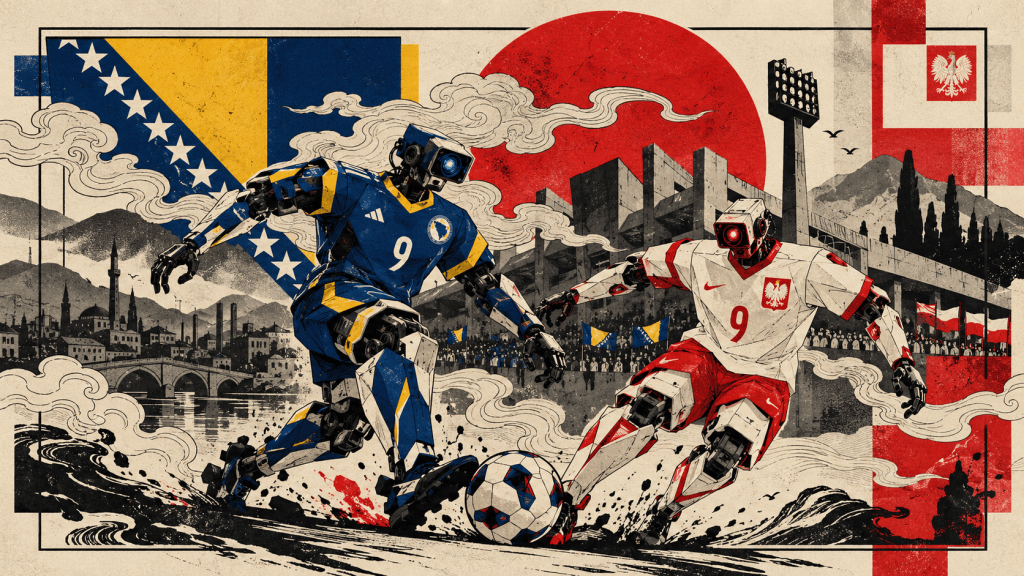
There will be no Edin Džeko at Bilino Polje on Monday night. There will be no Robert Lewandowski either.
Which feels slightly inconsiderate.
Bosnia and Herzegovina against Poland has spent years being accompanied by those two names, two enormous centre-forwards hanging over their respective national teams like permanent pieces of stadium architecture. Between them are hundreds of international appearances, a frankly unreasonable number of goals and enough accumulated importance that removing both at once makes this Nations League meeting feel like somebody has quietly changed the cast halfway through the play.
For Bosnia, the change is permanent. Džeko retired from international football following Friday’s 1-1 draw with Sweden, leaving as his country’s captain, record goalscorer and probably the closest thing Bosnian football has had to a default setting.
Poland’s problem is temporary but inconvenient. Lewandowski scored a hat-trick in the 6-0 demolition of Romania, collected his second yellow card of the Nations League campaign and is suspended.
So, naturally, Bosnia vs Poland has become a match about what happens when the two people everyone usually looks towards aren’t there.
Bosnia vs Poland Nations League preview: suddenly, this matters quite a lot
Sweden lead League B Group 4 with seven points. Bosnia have five. Poland have four.
Nobody needs a UEFA flowchart yet.
A Bosnia victory would move Sergej Barbarez’s team onto eight points and strengthen their position in the promotion race. Poland can leapfrog them with an away victory. Finish first and promotion to League A is automatic. Second and third bring play-offs. Finish bottom and League C awaits.
Bosnia, amusingly, have developed a particular relationship with this competition. Whenever they find themselves in League B, they get promoted. Whenever they reach League A, they finish bottom and return.
They are essentially football’s lift button.
Up. Down. Up. Down.
Another promotion would therefore be both an achievement and, based on available evidence, the beginning of another problem.
Before any of that comes Monday night in Zenica, at a stadium where Bosnia have lost only once in their last eight home matches.
Poland’s away record offers considerably less comfort. They have won two of their previous eight away games, against Malta and Lithuania, while losing five.
The previous meeting between these sides finished 0-0 in Warsaw on 25 September. Across six meetings, Bosnia have never beaten Poland. Four have ended in Polish victories.
There are plenty of reasons for Poland to feel comfortable.
Bilino Polje isn’t particularly interested in comfort.
The strange first night after Edin Džeko
Džeko’s farewell happened here only three days earlier.
Before his final international match, restaurants in Sarajevo and Zenica came up with an appropriately Bosnian tribute. Order the usual ten-piece serving of ćevapi and you received eleven instead, commemorating Džeko’s shirt number.
This may be a better retirement ceremony than most footballers receive.
No interminable montage. No executive presenting a glass ornament nobody really wants. Just additional grilled meat.
Džeko described Bilino Polje as having “that magic” when saying goodbye. The ground itself has been staging important Bosnian football occasions for decades, despite holding only around 14,000 people. Its stands sit close to the pitch, squeezed into an industrial city whose steelworks helped fund the stadium’s construction in 1972.
Even its name has history attached. Bilino Polje means “White Field” and the area was the site of the Bilino Polje Abjuration in 1203.
On Monday it hosts something considerably less medieval, although Sead Kolašinac chasing Matty Cash towards the touchline might briefly blur the distinction.
The more interesting question is what Bosnia actually look like without Džeko.
Ermedin Demirović and Haris Tabaković now inherit the responsibility up front. Barbarez has talked about Džeko finally putting down the “backpack” he carried for twenty years.
It is a good description of being the defining footballer of a small nation.
It also means somebody else has to pick the thing up.
Poland without Lewandowski might tell us more
Lewandowski’s absence creates a different experiment.
His Robert Lewandowski stats remain faintly absurd: 92 international goals in 170 appearances, with another three arriving against Romania on Friday.
Then he got booked.
Lewandowski has already returned to Chicago rather than travelling to Bosnia while suspended, explaining reasonably enough that there wasn’t much point sitting around watching a match he couldn’t play.
Karol Świderski is expected to replace him.
The temptation after Poland’s 6-0 victory over Romania will be to declare that Jan Urban has transformed the team. Football loves declaring transformations after one good evening. Three consecutive matches without defeat becomes a renaissance. A couple of overlapping wing-backs becomes a tactical revolution.
Monday should provide a more useful examination.
Poland want Matty Cash and Nicola Zalewski high and wide, stretching the pitch while Piotr Zieliński operates centrally and the attacking players move into the channels. When it works, the shape can begin resembling a five-lane motorway.
When possession disappears, however, somebody has left the wing-backs forty yards up that motorway.
Bosnia have precisely the sort of players who might enjoy the resulting space.
Ajdin Hasić is particularly intriguing. The 24-year-old only made his senior international debut against Romania in September and now faces the country where he plays his club football with Cracovia.
After an ACL injury disrupted his time at Beşiktaş, Hasić rebuilt his career through Sarajevo and Kraków. Cracovia reportedly rejected substantial offers for him during the summer.
Now he gets to run at defenders who know exactly what he does.
Convenient for everyone.
And yes, who is better: Ronaldo or Lewandowski?
Since people continue asking this question, presumably until one of them finally retires at the age of 63, it is worth briefly addressing.
If the question is who has had the greater career, Cristiano Ronaldo or Robert Lewandowski?, Ronaldo’s extraordinary body of work makes that a different and much larger conversation.
If the question is who is better right now?, there is a compelling argument for Lewandowski.
At 38, he has just scored three times for Poland against Romania and remains the central reference point for a national side playing competitive European opposition. The more interesting aspect of Monday’s game is that Poland must now demonstrate they can function without him.
Lewandowski’s continued relevance isn’t nostalgia. He is still influencing matches.
Which makes his yellow card rather annoying.
Kerim Alajbegović could be the new problem
Bosnia’s transition away from Džeko becomes considerably more interesting if Kerim Alajbegović is fit.
The Juventus teenager scored the late equaliser against Sweden before leaving the game with what appeared to be cramp or a muscular concern.
He is 18.
International football loves doing this. One icon leaves and everybody immediately looks around the dressing room for the next one, preferably before the departing player has finished packing his boots.
Alajbegović doesn’t need to become Džeko. He merely needs to be Alajbegović, which already appears quite useful.
If fit, his direct running alongside Hasić could attack the space behind Poland’s adventurous wing-backs. Bosnia are generally happier defending in a low or medium block before progressing quickly towards physical forwards.
Think less elaborate possession carousel, more Mechagodzilla: heavy, functional, not especially interested in winning points for elegance, then suddenly firing something unpleasant through the middle of you.
That could suit this match.
Poland have generated plenty of shots without consistently generating excellent chances. Fifteen efforts against Sweden produced only 0.97 xG, while another 15 against Albania returned 0.89.
Territory is not the same thing as danger.
Managers occasionally talk about controlling matches because admitting that twenty-two adults spent ninety minutes improvising under pressure doesn’t sound sufficiently professional.
How can I watch Bosnia-Herzegovina vs Poland in the UK?

For viewers searching for Bosnia vs Poland on TV in the UK, the match kicks off at 7.45pm BST on Monday, 5 October, and is available through Amazon Prime PPV.
The game takes place at Bilino Polje Stadium in Zenica, with French referee Jérémie Pignard in charge.
There should be enough happening without him becoming a major character.
Ideally.
Bosnia vs Poland prediction
This feels awkwardly balanced.
Poland probably possess the greater technical quality through Zieliński, Zalewski and Cash, while the modelled xG forecast favours them 1.45 to Bosnia’s 1.05.
But Bosnia are difficult to beat in Zenica, Poland have struggled away from home and neither team has its usual gravitational centre at striker.
That changes things.
A 1-1 draw feels plausible, perhaps almost suspiciously plausible. Poland having more possession, Bosnia producing the more uncomfortable moments, somebody spending the final ten minutes protecting a point while everyone publicly insists they are trying to win.
Then the Nations League table will be inspected, permutations calculated and narratives manufactured before anyone has reached the dressing room.
Football carries on.
Džeko does not.
Lewandowski returns next time.
And for one chilly evening in Zenica, Bosnia and Poland have to discover what remains when the familiar giants disappear.