
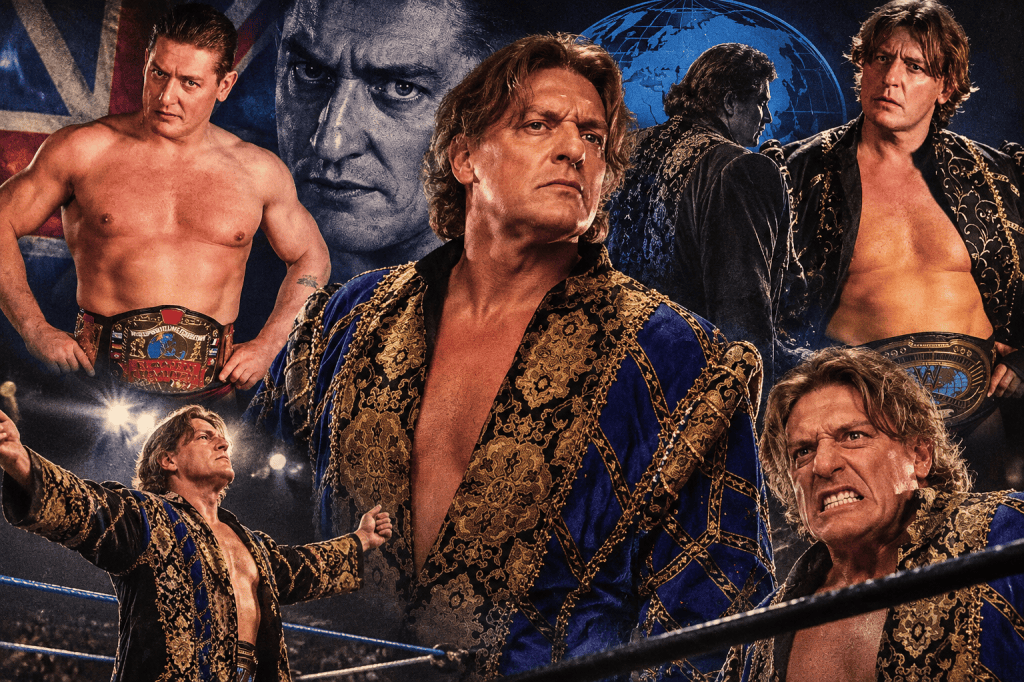
William Regal has spent more than four decades making professional wrestling look considerably more unpleasant than most people involved would presumably prefer.
There are wrestlers who make everything look effortless. Regal often did the opposite. He made wristlocks look inconvenient. Uppercuts looked horrible. A forearm across somebody’s nose appeared less like a wrestling move and more like something that should result in paperwork.
That was the point.
Regal never became WWE Champion. He never received the prolonged main-event run his ability suggested might have been possible, and his own struggles outside the ring are an important part of understanding why. Regal himself has never been particularly interested in pretending otherwise.
His best matches therefore exist in strange places.
Some happened in New Japan. Some happened on WCW television while the commentators were busy discussing the nWo. One took place in developmental. Another lasted seven minutes.
8. William Regal vs. Brian Kendrick
WWE SmackDown, 24 November 2006
Seven minutes should not really be enough.
Modern wrestling occasionally treats twenty minutes as the minimum amount of time required before everyone is allowed to start looking meaningfully exhausted. Regal and Brian Kendrick required roughly the length of a reasonably inconvenient supermarket queue.
Kendrick was one half of the WWE Tag Team Champions alongside Paul London. Regal, recently removed from King Booker’s court and paired with Dave Taylor, was being reintroduced as something considerably more dangerous than the wonderfully ridiculous character he had become.
The size difference did most of the storytelling for them.
When Kendrick’s speed frustrated him, Regal simply started hitting him harder. Forearms, throws and a particularly unpleasant uranage transformed what could have been routine television into something increasingly hostile.
Then Regal was cut around the eye.
It helped.
Blood has an unfortunate habit of making wrestling seem more important than it actually is, but here it complemented what was already happening. Regal suddenly looked less like a television antagonist and more like somebody Kendrick should probably stop irritating.
Kendrick eventually hit Sliced Bread #2, but Dave Taylor intervened. Kendrick dealt with him, returned to the ring and walked directly into Regal’s knee.
Done.
Seven minutes.
7. William Regal & Kurt Angle vs. Steve Austin & The Rock
WWF SmackDown, December 2000
There are more technically accomplished William Regal matches.
Few better demonstrate why he was so useful.
Across the ring were Stone Cold Steve Austin and The Rock, approximately as much professional wrestling star power as could legally be assembled in one tag team in December 2000.
Regal’s job was therefore quite straightforward.
Get battered entertainingly.
He and Kurt Angle were magnificent at it.
Beforehand, Angle had attempted to bond with his English partner by explaining that, although his ancestors had slaughtered Regal’s during the American Revolution, they should put history aside.
Diplomacy.
The match lasted less than eight minutes and contained Kane interfering, Earl Hebner being dragged from the ring, Austin fighting everybody and Regal receiving two Stone Cold Stunners before taking the pin.
It was peak Attitude Era television: several storylines thrown into a tumble dryer and switched to maximum.
Regal understood his place within it perfectly.
Great wrestling careers are not built exclusively from winning important matches. Sometimes greatness is knowing exactly how to lose one.
6. Lord Steven Regal vs. Psychosis
WCW Monday Nitro, 16 December 1996
WCW had other things to discuss.
The nWo were busy occupying the commentary booth, because WCW in 1996 increasingly existed in two parallel dimensions: whatever Hulk Hogan and his associates were doing, and some excellent wrestling happening underneath it.
Regal and Psychosis belonged firmly to the latter.
The appeal was wonderfully straightforward.
Psychosis wanted to fly.
Regal wanted him to stop.
The WCW Television Champion used wristlocks, leverage and joint manipulation to drag the luchador into his world. Psychosis repeatedly escaped it, accelerating through spinning kicks, a top-rope hurricanrana and a topé con hilo.
Regal answered with suplexes.
There is something satisfying about watching two completely different wrestling traditions discover that they are compatible largely because both participants are willing to be hit very hard.
Psychosis nearly stole the championship through increasingly frantic pinning combinations before attempting a victory roll.
Regal blocked it.
Regal Stretch.
Submission.
All in 10:37, while WCW’s wider storyline machinery clattered around them.
Sometimes the best wrestling on a wrestling programme was treated as an administrative inconvenience.
5. Lord Steven Regal vs. Ric Flair
WCW Worldwide, Marquis of Queensbury Cup, 1994
Only professional wrestling could invent something called the Marquis of Queensbury Cup, vaguely gesture towards British sporting tradition and then decide the appropriate people to contest it were Ric Flair and Lord Steven Regal.
Naturally, it was excellent.
Their series was divided into five-minute rounds and presented with ringside judges, borrowing heavily from the old British World of Sport structure.
For Regal, it was ideal.
For Flair, it was unusual.
That is what makes it fascinating.
Instead of simply dropping Regal into the familiar Ric Flair main-event match, the WCW World Heavyweight Champion entered Regal’s environment. They wrestled. Properly. Wristlocks, armbars, leg attacks and grappling exchanges became the point rather than the bit everyone endured before Flair started chopping people.
Regal even won the opening round by split decision.
That mattered.
Here was the Television Champion being presented as technically capable of troubling the World Heavyweight Champion, not because somebody interfered or Flair slipped on a banana skin, but because Regal could wrestle.
The series eventually required sudden-death overtime after Sir William’s umbrella-based intervention complicated the scoring. Flair ultimately won.
Of course there was an umbrella involved.
This was still WCW.
4. Lord Steven Regal vs. Ultimo Dragon
WCW Slamboree 1997
At one point Ultimo Dragon attempted to dive onto Regal.
Regal moved.
Not dramatically. He simply walked away.
There are entire wrestling philosophies contained within that decision.
Dragon’s solution to problems was movement. Regal’s was frequently to make movement as irritating as possible.
Their Television Championship match at Slamboree was therefore beautifully constructed around frustration.
Regal repeatedly hunted the Regal Stretch. Dragon repeatedly escaped. At one point, he became so desperate that biting Regal’s wrist seemed like a reasonable technical counter.
It probably was.
The Charlotte crowd gradually began supporting Regal, which was inconvenient because he wasn’t particularly interested in behaving heroically. He ground knees into faces, stepped on limbs and generally wrestled with the bedside manner of Victorian surgery.
Dragon responded with kicks and an Asai moonsault.
Then Sonny Onoo interfered against his own wrestler, kicking Dragon as he returned to the ring.
Regal required no written invitation.
Reverse suplex. Regal Stretch. Submission.
His fourth WCW Television Championship.
The championship suited Regal because it existed in the peculiar WCW ecosystem where somebody could wrestle an outstanding sixteen-minute match and then television would immediately return to men in leather waistcoats discussing corporate warfare.
Regal just kept wrestling.
3. Keiji Muto vs. Lord Steven Regal
NJPW, 13 November 1995
There is a version of Regal’s career that could have unfolded almost entirely in Japan.
Matches like this explain why.
This wasn’t Great Muta with face paint, mist and supernatural theatre. This was Keiji Muto, one of the world’s finest pure athletes, wrestling Regal in Tokyo.
The contrast was subtle rather than theatrical.
Regal wanted joints.
Muto wanted space.
Regal used hammerlocks, wrist control and neck manipulation to slow him down. Muto answered with quicker transitions, elbows and dropkicks, constantly forcing Regal to adjust.
Most importantly, the match had a proper conclusion.
Cross-promotional wrestling has historically produced enough political non-finishes to sustain several United Nations inquiries, but Regal was allowed to compete seriously with the IWGP Heavyweight Champion and lose cleanly.
After 16 minutes, Muto hit the moonsault.
That was enough.
Regal lost, but the match reinforced something that became increasingly obvious during his Japanese appearances.
Put him against almost any wrestling style and he could find a language they both understood.
2. Shinya Hashimoto vs. Lord Steven Regal
NJPW, 16 April 1995
Then there was Hashimoto.
Regal entered Hiroshima challenging for the IWGP Heavyweight Championship against the man carrying New Japan as its ace.
What followed was less an exhibition of contrasting wrestling traditions than an increasingly unpleasant negotiation between them.
Regal brought British catch wrestling.
Hashimoto brought kicks.
Neither appeared interested in compromise.
When Hashimoto suffered a bloody nose, Regal immediately recognised the opportunity. The technical wrestler became a predator, grinding his forearm across the damaged bridge of the champion’s nose and digging his knuckles into pressure points.
Small things.
Horrible things.
The sort of details Regal understood better than almost anybody.
Hashimoto, supposedly the dominant champion, was forced to survive Regal rather than merely defeat him.
Eventually the champion fought through it.
Heavy strikes staggered Regal before Hashimoto planted him with an elevated DDT and immediately trapped him in the juji-gatame.
Regal submitted after 19:03.
Then came the handshake.
Regal offered it.
Hashimoto accepted it.
Regal punched him.
Hashimoto responded by knocking him from the ring.
Sportsmanship had lasted several seconds, which was probably above average for professional wrestling in 1995.
1. Antonio Cesaro vs. William Regal
WWE NXT, December 2013
Regal knew. The former King of the Ring, knew.
That is what makes this difficult to beat.
Before facing Antonio Cesaro, Regal spoke openly about the career behind him. Thirty years of wrestling. Opportunities wasted. Mistakes made. A World Championship never won.
There was no attempt to rewrite the past into something prettier.
Then he described Cesaro as the superior wrestler and superior man.
Most retiring wrestlers are given ceremonies.
Regal gave himself an execution.
The match began in the language he understood best: wrists, fingers, leverage and tiny adjustments invisible to anyone who thinks wrestling begins when somebody jumps from the top rope.
Cesaro attacked Regal’s knee.
Not casually.
He removed the brace and repeatedly damaged the joint, including smashing the leg against the edge of the ring.
Regal retaliated by attacking Cesaro’s arms, attempting to remove the strength required for the Neutraliser.
Eventually Regal tried his butterfly suplex.
His knee collapsed.
That was essentially the match.
The body could no longer perform what the mind had asked of it thousands of times before.
Cesaro eventually prepared the Neutralizer and hesitated.
Regal did not want sympathy.
He dragged himself upwards.
Finish it.
Cesaro did.
It became William Regal’s final official match.
No championship. No triumphant retirement tour. No elaborate farewell.
Just an old wrestler discovering that the younger wrestler had become better than him.
For Regal, it was perfect.
William Regal vs. Dean Ambrose
FCW, 2012
One exception to the ranking is needed.
Because calling this merely another great William Regal match feels slightly inadequate.
Dean Ambrose had already wrestled Regal in 2011 and been systematically dismantled, particularly through attacks on his left arm. Instead of accepting the defeat, Ambrose became obsessed with him.
He stole Regal’s moves.
The Regal Stretch.
The Knee Trembler.
Regal watched him developing and recognised something unpleasantly familiar.
He called Ambrose a kindred spirit and, wonderfully, his own “electric chair”: the man who might eventually finish him.
Their rematch became the final main event in FCW history.
Jim Ross and Dusty Rhodes were on commentary.
Regal immediately attacked the arm again.
Ambrose remembered.
So did everyone watching.
At one point Ambrose deliberately trapped his damaged arm against the steel steps and ring post to force his shoulder back into position.
Then the student stopped trying to survive the teacher.
He attacked him.
Ambrose exposed the metal beneath a turnbuckle and repeatedly drove Regal’s head into it. Regal began bleeding from the ear, selling the damage as something considerably more frightening than standard professional wrestling violence.
Eventually he could no longer intelligently defend himself.
The referee stopped it.
No contest.
Ambrose still wasn’t finished.
Regal slowly stood, looked at the man who had spent a year trying to become him and applauded.
Then he effectively offered himself up.
Ambrose put Regal into the Regal Stretch and hit him with Regal’s own Knee Trembler before the FCW locker room flooded the ring to stop him.
Five months later, Dean Ambrose appeared on WWE television with The Shield.
Years later, now Jon Moxley, he encountered Regal again in AEW. Their history became part of the foundations of the Blackpool Combat Club.
Wrestling has a long memory when it bothers to use it.
This time it did.

 doragon sports