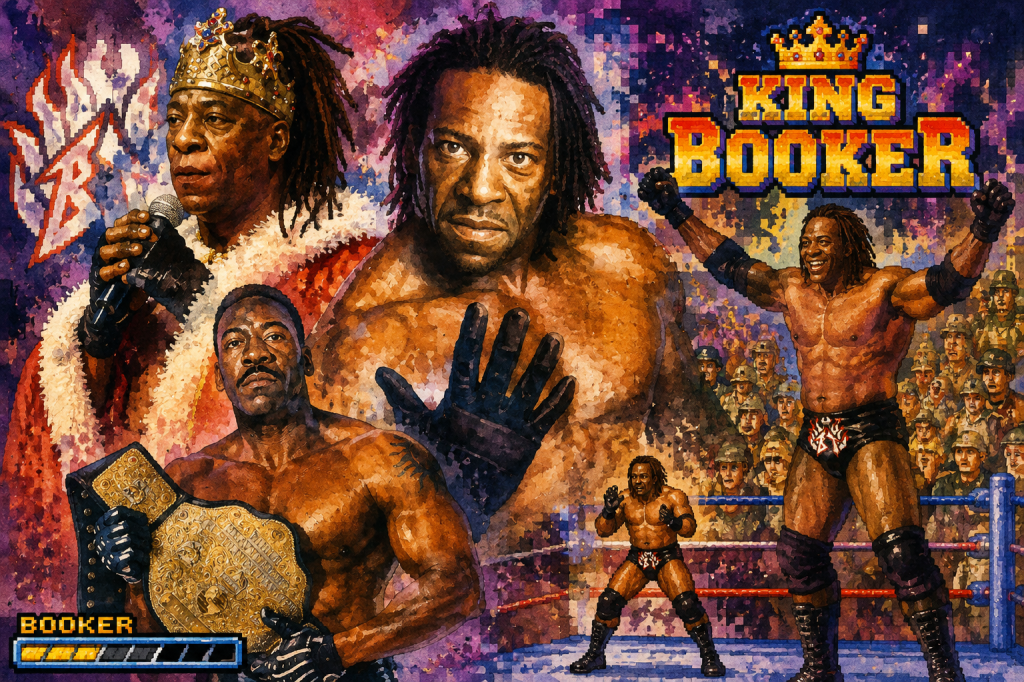
Booker T was lying flat on his back.
Not beaten. Not injured. Champion.
The Scissors Kick had connected with Christian for the final time inside Montreal’s Bell Centre, the referee had counted three, and after all the false finishes, attempted escapes and administrative nonsense required to actually get there, Booker simply collapsed onto the canvas with the Intercontinental Championship beside him.
There was something wonderfully Booker T about it.
For a wrestler whose career eventually accumulated world championships, Hall of Fame inductions, a crown, a throne and enough catchphrases to sustain several lesser careers, many of his best matches were not really about dominance. They were about getting somewhere.
More than three decades after beginning his career, Booker is now largely removed from regular competition and yet is still part of WWE’s wider ecosystem, having returned to the NXT commentary desk in 2022 and subsequently appeared as a coach on WWE LFG.
It is quite a distance from the wrestler who arrived in WCW with Stevie Ray in 1993. Harlem Heat became 10-time WCW Tag Team Champions before Booker’s singles career produced the Television, United States and eventually WCW World Heavyweight Championships. When WCW disappeared in 2001, he entered WWE rather than sitting out his contract, later adding another world championship, King of the Ring and two WWE Hall of Fame inductions to the collection.
But championships only tell us where somebody ended up.
Matches show us how they got there.
Here are Booker T’s eight best career matches from this selection, ranked from good to essential.
8. Booker T vs. AJ Styles vs. Christian Cage
TNA Bound for Glory IV, October 12, 2008
This is the strangest match on the list because part of what makes it interesting is watching Booker T not be the Booker T of 1998.
AJ Styles is everywhere.
Christian Cage is calculating.
Booker is… conserving energy.
At Bound for Glory IV, TNA accidentally produced a rather useful physical representation of its impending civil war. Styles was the homegrown wrestler throwing himself into everything. Booker was the decorated outsider who had already experienced bigger buildings and bigger promotions. Christian occupied the uncomfortable space between them, a former WWE wrestler who had nevertheless become enormously important to TNA.
Styles supplies much of the match’s urgency. He counters Christian’s Unprettier into an inverted DDT, flies around the ring and attempts the Spiral Tap. Christian works neatly around him.
Booker chooses his moments.
Sometimes literally.
After hitting the Book End on Styles, Booker could simply cover him. Instead he performs the Spinarooni and gives Christian enough time to recover and attack.
Sharmell passes Booker a steel briefcase. Booker uses it. Later he catches both opponents with an Axe Kick. Then, with Christian seemingly in control after an Unprettier from the second rope, Booker descends with another Axe Kick and steals the pin.
Why it was good
Because the three wrestlers feel completely different.
It is not Booker’s best athletic performance. The information surrounding the match is considerably less flattering than that, including his later admission that he treated his TNA period almost like a vacation.
But within the emerging veterans-versus-originals story, his slower and more entitled presence almost works.
7. Randy Orton vs. Rob Van Dam vs. Booker T
WWE Raw, February 9, 2004
Randy Orton’s smartest move happens near the beginning.
He leaves the ring.
Orton simply rolls outside and allows Rob Van Dam and Booker T to start hitting one another.
Why exhaust yourself defending the Intercontinental Championship when two extremely enthusiastic challengers are prepared to do it for you?
That basic idea gives this 10-minute sprint its personality.
RVD supplies the strange geometry, landing Rolling Thunder and a handspring moonsault. Booker supplies the force, eventually landing an Axe Kick on both opponents. Orton keeps appearing whenever somebody else has done the difficult part.
Then RVD hits the Five-Star Frog Splash on Booker.
Except Orton throws Van Dam outside, covers the already flattened Booker and retains his championship.
Perfect.
Why it was good
Triple threats can become collections of moves interrupted by the third wrestler returning exactly when required.
This one has a clearer character structure.
RVD and Booker are trying to win. Orton is trying to survive.
6. JBL vs. Eddie Guerrero vs. The Undertaker vs. Booker T
WWE Armageddon, December 12, 2004
At one point, JBL attempts to powerbomb Booker T through the Spanish announce table.
It does not quite work.
So JBL finds a chair, stands on it and launches an elbow down through Booker and the table instead.
This is an excellent summary of Armageddon 2004’s main event.
Something is always going wrong.
Somebody responds by doing something more ridiculous.
For 25 minutes, JBL, Eddie Guerrero, Undertaker and Booker operate inside barely controlled demolition.
Eddie and Booker temporarily cooperate to remove Undertaker. Undertaker responds by Last Riding JBL through another announce table. Eddie hits Undertaker with two Frog Splashes and watches him sit up. So he finds a ladder and delivers a third.
Undertaker still refuses to disappear.
Eventually he chokeslams everybody and appears ready to finally take the WWE Championship from JBL.
Then Heidenreich arrives.
Of course he does.
He attacks Undertaker, removes him from the equation and allows JBL to turn around and nearly decapitate Booker with a Clothesline From Hell.
One, two, three.
JBL survives again.
A few years earlier, WCW occasionally seemed uncertain whether Booker belonged at that level.
5. Booker T vs. Christian
WWE Raw, July 7, 2003
Christian wanted to leave.
That is where this gets good.
He was Intercontinental Champion and had discovered the wonderful coward’s loophole that a championship could not change hands through count-out. Booker was becoming uncomfortable. Christian started walking.
Unfortunately for him, Stone Cold Steve Austin was running Raw.
Austin brought him back, removed count-outs and then removed disqualifications too.
Christian’s escape hatch slammed shut.
From there, the match becomes a prolonged exercise in denying Booker his moment.
Booker lands the Scissors Kick and gets three.
Champion.
Except Christian’s leg had been resting on the bottom rope.
Restart.
Booker later attempts another Scissors Kick. Christian pulls the referee into its path, lands a low blow and nearly steals the match.
Still no.
Eventually Christian grabs the championship itself.
Booker ducks the belt shot, kicks him in the stomach and delivers one final Scissors Kick.
This one counts.
Why it was good
Because Christian’s cowardice gives Booker’s victory friction.
Booker is not simply wrestling an opponent. He is wrestling somebody constantly changing the terms under which defeat can occur.
Every escape makes the eventual pin feel slightly bigger.
And this one mattered.
For all Booker had accomplished, this was his first and only WWE Intercontinental Championship. After the difficulties of transitioning from WCW into WWE and his enormously popular partnership with Goldust, the belt felt like acknowledgement that Booker could now stand alone as one of Raw’s major babyfaces.
Then reality intervened.
Thirty-four days later, a back injury forced him to return the championship to Christian at a house show in Iowa.
The reign barely existed.
The victory still does.
4. Booker T vs. Psychosis
WCW Monday Nitro, April 20, 1998
Psychosis looked at Booker T and attacked the knee.
Simple.
Smart.
Booker was bigger, stronger and producing increasingly explosive offense as WCW Television Champion. So rather than trying to outrun him indefinitely, Psychosis started dismantling the mechanism responsible for most of that explosion.
This is where 1998 Booker becomes particularly interesting.
He sells.
The damaged leg does not disappear because it is time for the comeback. Psychosis keeps dragging the match back towards it, forcing Booker to produce offense while carrying the accumulated damage.
Eventually Booker catches him.
Missile dropkick.
Three.
Seven minutes and 52 seconds. Done.
Why it was good
Because this is the match on the list that best captures how ridiculously useful Booker T had become.
He had wrestled Chris Benoit in a gruelling match on pay-per-view the previous night.
Then he turned up on Nitro and had another fast, coherent title match against a completely different opponent.
Psychosis was smaller and faster. Booker adapted without making him look insignificant.
That mattered because the Television Championship was effectively becoming Booker’s laboratory.
Harlem Heat had already established him.
The TV title allowed him to discover what Booker T looked like alone.
Years later, Booker would identify the championship as the title that meant the most to him because it represented that transition.
Watching him work Psychosis, it is easy to understand why.
World championships made Booker famous.
This period made him ready for them.
3. Booker T vs. Kurt Angle
WWF SmackDown, July 24, 2001
Booker T performs the Spinarooni.
This is normally where everybody smiles.
Not in Pittsburgh.
Kurt Angle is lying behind him having already been attacked with a steel chair by Chris Kanyon and hit with a Stunner by Steve Austin. The Alliance has interfered. The WWF locker room has fought back. Booker is still WCW Champion and, apparently, everything has worked.
So he spins.
Behind him, Angle gets up.
There are few wrestling pleasures more reliable than watching somebody become catastrophically pleased with themselves one second too early.
Angle grabs Booker’s leg.
Ankle Lock.
Booker taps.
Pittsburgh erupts.
Why it was good
The atmosphere changes everything.
Angle is wrestling in his hometown as the WWF loyalist attempting to take WCW’s championship away from the invading Alliance. Booker, meanwhile, had arrived carrying the enormous burden of being presented as WCW’s leading active star.
Their styles work beautifully against one another.
Angle throws people.
Booker kicks them.
Angle’s intensity makes every comeback feel desperate. Booker’s swagger makes Pittsburgh want the comeback slightly more.
Then there is the history.
The WCW World Heavyweight Championship had existed through another promotion, another television network and another wrestling universe.
Here, for the first time, it changed hands on WWF television.
Angle’s reign lasted six days before Booker reclaimed it.
Almost irrelevant.
For one night, the invasion actually felt enormous.
There’s also the match from the time when both were in TNA.
2. Booker T & Goldust vs. Chris Jericho & Christian
WWE Raw, December 23, 2002
Goldust was the weak link.
Chris Jericho had kindly explained this to him.
Not just a weak wrestler either. Jericho’s pre-match attack wandered into his career, his marriage and his worth as a human being because professional wrestling in 2002 did not always believe in moderation.
The important thing is that Goldust believed some of it.
That transforms what could have been an ordinary tag-title defence.
Jericho and Christian isolate him. They attack his back. They prevent him reaching Booker. Every minute Goldust spends getting beaten reinforces precisely what Jericho told him before the bell.
Then Goldust starts surviving.
A double backdrop becomes a double DDT.
Christian receives what commentary delicately dubbed “Shattered Nuts.”
Jericho applies the Walls of Jericho and Booker has to rescue his partner with a kick.
Goldust is still there.
Jericho eventually attempts the Lionsault.
Knees.
Then Goldust grabs the tights and rolls him up.
Three.
The supposed weak link has retained the championships.
Why it was good
Because Booker T barely needs to be the protagonist for this to become one of the best matches of his WWE career.
That was one of the quiet strengths of Booker and Goldust.
Booker did not swallow his partner.
He made him matter.
The structure is classical tag wrestling. Goldust suffers. Jericho and Christian control. Booker waits on the apron, making the crowd increasingly desperate for the tag. When it arrives, his speed changes the temperature of the match.
But the finish belongs to Goldust.
It had to.
Booker and Goldust are remembered primarily because they were funny together, two characters who should not have fit but somehow did.
This match demonstrated why the partnership survived beyond the joke.
There was affection underneath it.
Goldust needed to prove something.
Booker let him.
1. Booker T vs. Bret Hart
WCW Monday Nitro, February 22, 1999
WCW briefly interrupts one of the most important matches of Booker T’s development so viewers can watch Disco Inferno trying to pirate a television signal.
There may be no more authentic sentence about late-1990s WCW.
Booker T is wrestling Bret Hart.
Bret Hart.
National television. Main event. United States Championship number-one-contender match.
And somebody decides we desperately need two minutes of Disco Inferno.
Fortunately, the wrestlers survive the company around them.
Hart wrestles Booker the way Bret Hart tended to wrestle people he wanted audiences to take seriously. He grounds him. Slows him. Makes Booker fight for momentum rather than simply granting him opportunities to demonstrate athleticism.
Booker catches him with an Axe Kick.
Two.
Hart applies the Figure Four.
Booker reverses the pressure.
Hart reaches the ropes.
Hart then launches Booker from the top with a huge superplex. Booker responds with his forearm and spinning heel kick.
Then comes the finish.
Hart attempts a sunset flip.
Booker sits down.
One.
Two.
Three.
No interference.
No disqualification.
No faction arriving.
No veteran immediately recovering and destroying him afterwards.
Booker T simply pins Bret Hart.
Why it was Booker’s best
Because sometimes wrestling’s most powerful statement is also its simplest.
Booker did not need Bret to pass out, get distracted or be attacked by somebody else.
Hart lost to him.
Clean.
That distinction becomes even more important with the knowledge that Hart respected Booker and wanted to put him over. The finish itself carried a lovely historical wrinkle, echoing the ending Hart had used with the British Bulldog at SummerSlam 1992, except this time Bret was the wrestler being caught.
Booker was no longer merely the spectacular half of Harlem Heat.
He was not merely a Television Champion who could have excellent eight-minute matches.
He could wrestle Bret Hart for almost 18 minutes and beat him.
The frustrating part is what happened afterwards.
Essentially nothing.
WCW did not build a great Booker T ascension around the victory. Hart was being positioned elsewhere. Booker moved elsewhere. Another potentially transformative result became another Monday night happening.
But history has the useful ability to remove bad booking from the immediate vicinity.
Watch the match now and the message is considerably clearer than WCW’s follow-up ever managed to make it.
Booker belonged.
The Strange Thing About Booker T’s Best Matches
Booker T’s career is often remembered through images.
Five fingers raised for five world championships.
The Spinarooni.
Harlem Heat.
King Booker’s crown.
The supermarket fight with Steve Austin.
Those things are enormously memorable, but they can flatten the wrestler underneath them.
These eight matches show somebody considerably more adaptable.
Booker could work underneath Psychosis attacking his knee. He could absorb Bret Hart’s methodical pacing. He could provide the explosive release in a traditional tag match. He could become the arrogant WCW champion facing hometown hero Kurt Angle. He could operate inside the wreckage of a four-way WWE main event or play the experienced opportunist years later in TNA.
Sometimes he carried the match.
Sometimes he carried the story.
That might be the thread connecting the best of Booker T.