
Transfer deadline day has an extraordinary ability to make otherwise sensible adults develop strong opinions about footballers they had barely considered 48 hours earlier.
Melvin Bard is now one of them.
The 25-year-old left-back has swapped Nice for Leeds United, initially on loan for a reported €1 million, with a €5 million option to make the move permanent. West Ham were interested. Leeds got him. Within the peculiar accounting system of modern football, where perfectly serviceable Premier League players can cost £25 million because somebody once completed six dribbles against Bournemouth, €6 million feels almost suspiciously reasonable.
That naturally raises the question behind most Leeds United transfers: what exactly have they bought?
Or borrowed, technically.
The encouraging answer is that Bard brings something Leeds have occasionally lacked in their recruitment. He is not really a project, an intriguing collection of underlying numbers or somebody whose best football currently exists inside a PowerPoint presentation.
He is a 25-year-old with more than 150 senior appearances who has spent five seasons being repeatedly challenged for his position at Nice and repeatedly refusing to disappear.
There is something reassuringly uncomplicated about that.
Leeds United New Signings 2026: Bard Fills an Actual Need
The most immediate benefit is obvious enough.
Bard is left-footed.
That shouldn’t require its own paragraph, but anyone following Leeds United news during Gabriel Gudmundsson’s hamstring problems will understand why it does.
James Justin has provided cover on the left, but asking a naturally right-footed defender to repeatedly operate there changes the geometry of possession. The body opens differently. The first touch naturally comes inside. Passes down the line become slightly less instinctive.
None of this makes Justin a bad footballer. It simply makes him a footballer being asked to perform a slightly unnatural task.
Bard removes that problem.
He can receive on his left foot and immediately threaten the space outside. He can overlap, play vertically or step into midfield without first having to rearrange himself like somebody carrying a sofa through a narrow doorway.
That matters to Daniel Farke because Leeds’ width often stretches the pitch enough to create the central spaces his midfielders and attackers want.
In theory, Bard simply gives Leeds a proper left-back. Another great defensive addition.
Football has reached the point where this is apparently considered tactical sophistication.
The Defender Nice Couldn’t Quite Replace
Bard’s route here is arguably more interesting than the transfer itself.
He came through Lyon’s academy but was never really given a clear path into their senior side. He moved to Nice in 2021 and scored his first professional goal against Brest that October.
Then came the competition.
Jordan Amavi arrived. Romain Perraud arrived. Ali Abdi arrived. Different managers came with different ideas about what a full-back should actually be.
Bard remained.
Christophe Galtier drilled the defensive side of his game. Francesco Farioli demanded composure in a higher defensive structure. Franck Haise found another use for him entirely, occasionally shifting him inside as the left-sided centre-back in a back three.
This is where the signing becomes more interesting for Leeds.
Bard isn’t merely cover for Gudmundsson. He gives Farke another structural option.
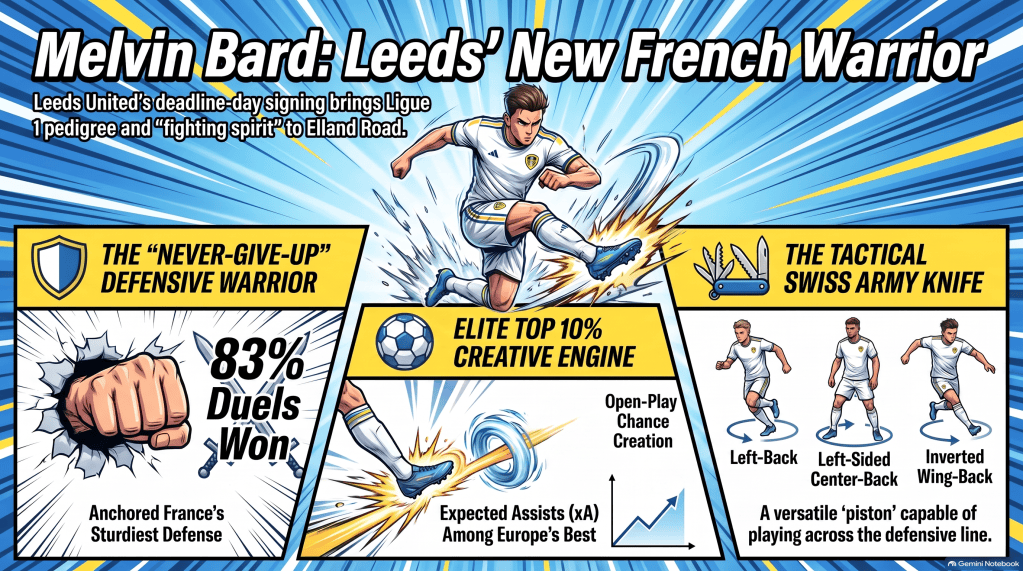
At Nice he has operated as a conventional left-back, wing-back and left-sided central defender. He can stay wide or move into narrower positions during possession.
Modern football likes calling this versatility. Twenty years ago somebody would probably have said he could play in a few positions and left it there.
Either way, Leeds can use it.
Melvin Bard’s Numbers Explain Part of the Appeal
There is substance underneath the versatility.
During 2023/24, Bard made 162 tackles as part of a Nice defence that became one of France’s most difficult units to break down.
His attacking contribution subsequently developed too. In his final full season before moving to Leeds, he ranked among the top 10 per cent of Ligue 1 full-backs for open-play expected assists and key passes.
That combination matters.
Leeds haven’t signed a flying winger who happens to begin matches beside the centre-backs. Bard’s reputation was built primarily through defending, positioning, and aggression before his creative numbers began to climb.
Look through his Leeds United match stats in the months ahead and the useful numbers might therefore be less glamorous than goals.
Touches in the opposition half. Progressive passes. Tackles. Recoveries. Chances created from open play.
Most importantly, perhaps, how often Leeds can progress down the left without their attacks being funnelled back towards midfield.
Those are the small things that alter a team without necessarily producing a compilation accompanied by dreadful electronic music.
The Marseille Goal Helps, Mind
There have been spectacular moments.
Away at Marseille in April 2024, Bard arrived outside the penalty area late and drove a low strike into the net to rescue Nice a point at the Vélodrome.
It was precisely the sort of goal supporters use as evidence that a new defender possesses previously undiscovered attacking powers.
He probably doesn’t.
Bard has never been a prolific scorer, and Leeds shouldn’t expect him to become one simply because someone will inevitably upload that Marseille strike with the title MELVIN BARD | WELCOME TO LEEDS | SKILLS & GOALS before he has found somewhere to live.
The goal is useful for another reason.
It demonstrates that he isn’t frightened of important moments.
His Nice career included European football, hostile away grounds and two Coupe de France final defeats, against Nantes in 2022 and Lens in 2026.
He knows what disappointment looks like.
Useful experience around here.
The Freiburg Apology Tells Us More
Perhaps the most revealing episode came on Bard’s 25th birthday.
Against Freiburg, two of his mistakes contributed directly to goals. Nice lost, and Bard fronted up afterwards, publicly apologising to supporters.
Footballers apologising after defeats has become a slightly strange modern ritual. A bad pass is made on Saturday and by Sunday somebody has posted a monochrome photograph accompanied by not the result we wanted, we go again.
Bard’s response felt different because accountability has been a recurring feature of his career.
He has rarely been guaranteed anything.
At Lyon he had to fight for recognition. At Nice, new competition continually arrived. Under different managers, his role changed. When Haise needed him inside, he went inside. When Nice wanted width, he provided it.
That adaptability may matter almost as much as his left foot at Leeds.
Farke has generally valued footballers who accept responsibility, understand tactical instructions and don’t require the entire dressing room to orbit around them.
Bard’s career suggests he fits reasonably comfortably into that category.
From the Côte d’Azur to Elland Road
There is also something pleasingly absurd about the geographical move.
Nice offers the Mediterranean, palm trees and the Promenade des Anglais.
Leeds offers the M621.
Yet Bard has spoken about wanting the challenge of English football, and there is logic behind the decision. At 25, he is entering what should be the strongest years of his career. He has already established himself in Ligue 1. Remaining comfortable would have been perfectly understandable.
Instead, he has chosen the Premier League.
That means dealing with quicker transitions, more physical forwards and the weekly hysteria surrounding the world’s most heavily analysed domestic competition.
At Nice, a misplaced pass could irritate a few thousand people.
At Elland Road, roughly 36,000 people can simultaneously tell you that you should have played it down the line.
Those searching for Leeds United tickets will presumably consider this part of the entertainment package.
Nice’s Reaction Might Be the Best Recommendation
Perhaps the most encouraging thing about the transfer is that Nice supporters apparently didn’t particularly want it.
Bard had developed into something approaching a cult figure, eventually winning the fan-voted Gymto d’Or Player of the Season award.
Cult heroes are difficult to manufacture because they generally emerge from repetition rather than marketing.
Supporters see somebody make the same recovery run enough times. They notice who keeps playing after taking a knock. They remember who walks towards the away end after a horrible defeat rather than disappearing down the tunnel.
Eventually affection accumulates.
Bard’s relationship with Nice appears to have been built that way.
Which also explains the frustration surrounding the fee.
If Leeds eventually pay the full €5 million option after the initial loan, Nice supporters may reasonably wonder how a player they valued so highly was allowed to leave for comparatively little.
He was also widely well regarded by the whole Ligue 1 community.
Leeds supporters should probably avoid asking too many questions.
Sometimes you simply accept the suspiciously cheap sandwich and don’t inspect the kitchen.
Bard Gives Farke Something Leeds Needed
The tactical case ultimately remains the strongest one.
Gudmundsson now has genuine competition.
Justin no longer needs to be the default emergency left-back.
Farke has another wing-back if Leeds use three centre-backs, another orthodox full-back if they return to four, and somebody capable of becoming the outside centre-back if the shape changes during matches.
Bard’s ability to move between those responsibilities could make Leeds less predictable in possession.
The Premier League will determine whether those Ligue 1 qualities translate.
There will be difficult afternoons. Bard is aggressive enough that quicker attackers will occasionally exploit the space behind him, and English football has a habit of transforming minor defensive errors into three-day national enquiries.
But Leeds haven’t bought perfection.
For potentially €6 million, they don’t need it.
They need a natural left-footer who can defend, progress possession, create chances, survive different systems and compete with Gudmundsson rather than merely replace him when required.
They have found one with considerable experience who is still only 25.
Among all the noise surrounding Leeds’ new signings in 2026, that might make Bard one of the more sensible additions of the window.
There is temptation to make more of the surname, of course. The Bard arriving in West Yorkshire, ready to compose something poetic down the left flank. Football transfer announcements have been built from considerably worse material.
But his career suggests something less romantic and probably more useful.
Melvin Bard fights for his place. Then, usually, he keeps it.