

Kayla Harrison and Mikaela Mayer were both members of the United States Olympic team in Rio in 2016. Ten years later, they occupy almost opposite ends of the combat-sports spectrum.
Mayer became one of her generation’s outstanding professional boxers, winning world championships across multiple weight classes and developing into a high-volume technician comfortable fighting at range or turning championship fights into wars. Harrison took an Olympic judo game already operating at historically elite levels and rebuilt it for MMA, eventually becoming UFC women’s bantamweight champion.
That’s what makes Kayla Harrison vs Mikaela Mayer such an interesting crossover fight. This isn’t really boxer versus MMA fighter. It’s two elite American Olympians whose careers branched in radically different directions.
There is also enough overlap in weight to make the thought experiment work. Harrison currently competes at 135 pounds but spent much of her MMA career considerably heavier. Mayer has boxed from lightweight through welterweight and into the 154-pound super-welterweight division.
Put them somewhere around 145-147 pounds and neither woman is being teleported into a completely alien bodyweight.
Everything that follows, however, is entirely hypothetical.
Mikaela Mayer: An Elite Boxer Who Kept Moving Up
Mikaela Mayer’s professional record now stands at 22-3 with five knockouts, following her August 2026 defeat to Chantelle Cameron.
That number doesn’t quite explain the career.
Mayer represented the United States at the 2016 Olympics before turning professional and becoming a unified champion at junior lightweight. Her 2021 fight with Maïva Hamadouche was particularly important in establishing what kind of professional she would become: not merely a long-range amateur-style boxer, but someone perfectly willing to maintain a ferocious work rate in prolonged exchanges.
She subsequently moved through lightweight and into welterweight, where she defeated Sandy Ryan twice, before eventually campaigning at super-welterweight.
Her latest chapter came against Cameron in Birmingham on August 29. Mayer entered holding the WBA and WBC super-welterweight championships, while Cameron brought the WBO belt. Cameron won an excellent, high-tempo fight by unanimous decision, 97-93, 97-93 and 96-94, leaving Mayer at 22-3.
She’s tall, experienced and extremely comfortable behind the jab, but the volume behind it is perhaps more important. Mayer doesn’t simply throw individual technically correct punches. She connects phases together. Jab becomes right hand, becomes another jab, becomes an exchange on the inside, followed by the footwork necessary to start again.
She’s also much more comfortable fighting physically than the stereotype of the rangy Olympic boxer might suggest.
And there is a small crossover wrinkle in her background. Mayer initially trained in Muay Thai before committing herself fully to boxing.
That certainly doesn’t make her an MMA fighter, and years spent specialising in boxing mean those old instincts shouldn’t be exaggerated. But she’s at least encountered kicking mechanics and a different striking posture before.
In 2026, Mayer finds herself in an interesting position. She has just lost her super-welterweight titles, but losing a competitive unification fight to somebody of Cameron’s calibre hardly erases everything that came before it. If anything, she’s now one of the rare elite boxers whose career has genuinely travelled through enough divisions to make a 147-pound crossover scenario imaginable.
Kayla Harrison: From Olympic Judo to UFC Champion
If Mayer represents extreme specialisation in punching, Harrison represents one of the most successful examples of an Olympic grappling base being reconstructed for MMA.
Harrison won Olympic judo gold at London 2012 and Rio 2016. Her second triumph made her the first American judoka to successfully defend an Olympic title.
Then she essentially started again.
Harrison began incorporating Brazilian jiu-jitsu and boxing while considering an MMA career after Rio. She eventually debuted professionally in 2018 and became a two-time PFL tournament champion before moving to the UFC.
So, what is Kayla Harrison’s MMA record? It is 19 wins and one defeat.
That solitary defeat came against Larissa Pacheco in their third meeting in 2022. Harrison had already defeated Pacheco twice.
Her UFC run has been remarkably efficient. Harrison submitted former champion Holly Holm at UFC 300, defeated Ketlen Vieira and then submitted Julianna Peña with a kimura in June 2025 to become UFC women’s bantamweight champion.
The frightening element isn’t simply that Harrison can take somebody down.
It’s how many problems begin once she makes physical contact.
Traditional judo becomes considerably different when transferred into MMA because jackets disappear, punches arrive and the cage changes the geometry. Harrison nevertheless possesses decades of instinctive understanding of balance, leverage, hip position and weight transfer. Against the fence, an opponent isn’t merely defending a conventional double-leg. She’s dealing with trips, body locks, foot sweeps and throws while simultaneously worrying about knees and punches.
Once Harrison establishes top position, her striking becomes another component of the grappling system.
Her boxing has improved enormously since those first crossover sessions, but there is an important distinction here: Harrison developed boxing to make her MMA better. Mayer developed boxing because boxing itself is the entire game.
Harrison’s planned January 2026 title defence against Amanda Nunes was postponed after Harrison required neck surgery. She remains UFC women’s bantamweight champion, with the enormous Nunes fight still hanging over her comeback.
That injury also matters to our imaginary matchmaking. This hypothetical assumes a healthy Harrison rather than asking a recovering athlete to immediately participate in the combat-sports equivalent of a laboratory accident.
What Happens If Kayla Harrison vs Mikaela Mayer Is a Boxing Match?
Under conventional boxing rules, Mayer should be a substantial favourite.
The first problem for Harrison is the jab.
Mayer isn’t facing an MMA fighter who can threaten her lead leg or change levels underneath it. Every time Harrison enters, she has to cross Mayer’s preferred punching distance without possessing the weapon that normally makes opponents hesitate.
That’s enormous.
Harrison’s southpaw stance creates the familiar open-stance battle, but simply being southpaw doesn’t compensate for the difference in boxing experience. Mayer can feint, draw Harrison’s lead, step outside the front foot and build combinations rather than loading up on single shots.
Harrison would still be dangerous.
She’s extraordinarily strong, accustomed to being hit with small gloves and capable of turning the clinch into an exhausting physical battle even without being allowed to throw Mayer. Making things ugly would be sensible. Don’t contest a fencing match with Mayer. Crowd her, disrupt her rhythm, work the body and force the referee to repeatedly separate them.
But boxing referees eventually will separate them.
And that’s the killer.
Every reset returns Harrison to Mayer’s world.
Over ten rounds, Mayer’s accumulated advantages in timing, punch selection, defence and combination building become increasingly difficult to overcome.
Prediction: Mikaela Mayer by wide unanimous decision.
What Happens Under MMA Rules?
Now flip practically everything.
Mayer remains extremely dangerous with her hands. In fact, 4oz gloves potentially make clean punches even more consequential. Harrison cannot casually march through the combinations of a world-class boxer.
But Mayer’s biggest problem is that her preferred stance starts generating vulnerabilities everywhere else.
Harrison can kick the lead leg. She can feint the level change. She can punch into the clinch. She can force Mayer toward the fence.
Most importantly, Mayer can’t concentrate entirely on Harrison’s hands.
Watch what the threat of wrestling does to even accomplished MMA strikers. Their posture changes. Combinations shorten. Feet become reluctant to cross. Every punch carries the question: what happens if she goes underneath this?
For Mayer, that effect would be magnified enormously.
She would need to hurt Harrison during the initial striking exchanges while maintaining enough distance to avoid the clinch. That’s a very narrow route.
Once Harrison gets chest-to-chest contact against the cage, Mayer would suddenly be solving a physical problem she’s never encountered professionally.
And if Harrison gets her down, we’re approaching checkmate rather than simply another phase of the fight.
Prediction: Kayla Harrison by first-round submission.
What Happens If Kayla Harrison vs Mikaela Mayer Is a Muay Thai Fight?
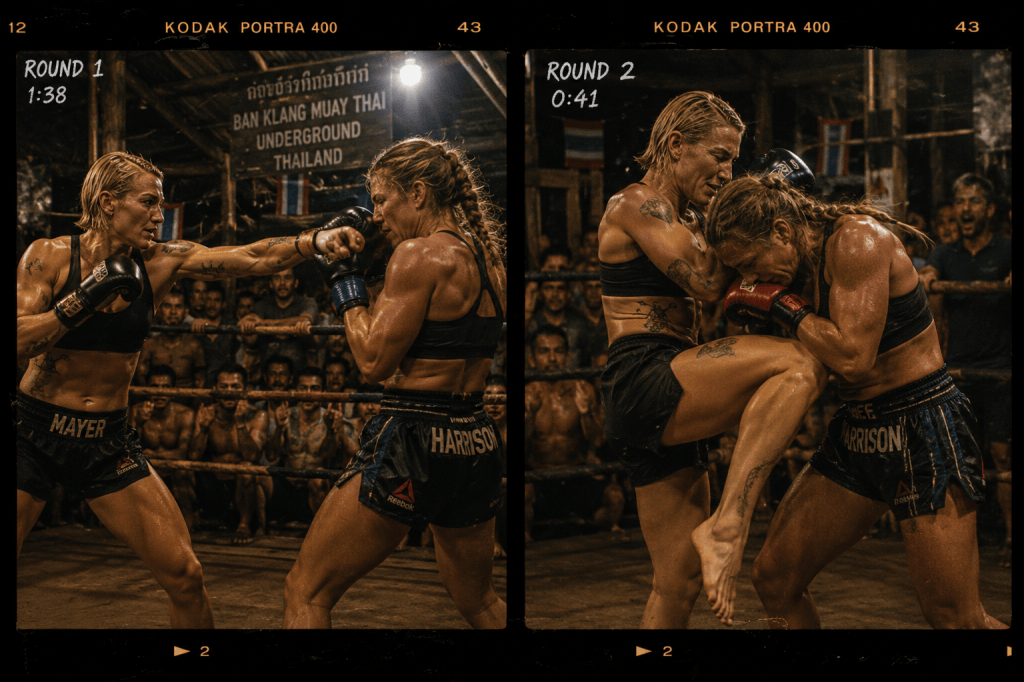
Muay Thai might be the most fascinating version of Harrison vs Mayer because, unexpectedly, neither woman would be entering completely unfamiliar territory.
Long before Mayer became an Olympian and multi-weight boxing world champion, her combat-sports education actually began with Muay Thai.
At 17, Mayer walked into a martial arts gym and became obsessed with it, training six days a week and reportedly competing in around 10 smoker fights during her first year. Boxing initially entered the picture almost accidentally. A back injury prevented Mayer from kicking, so her coach suggested boxing as a way of sharpening her hands while she recovered.
Instead, Mayer fell in love with boxing. With women’s boxing entering the Olympics, the temporary detour became her career.
Nearly two decades later, those old Muay Thai rounds suddenly become extremely relevant.
This wouldn’t make Mayer an elite contemporary Muay Thai fighter. Her stance, reactions and distance management have subsequently been moulded by thousands of rounds of specialist boxing. But she wouldn’t be learning the language from scratch either. She already understands kicks, knees and the basic mechanics of the Muay Thai clinch.
And that’s important because Mayer should comfortably win the punching battle.
Harrison trains Muay Thai as part of her MMA striking development, but her striking exists within a much larger system. Mayer has spent her professional life turning her hands into specialist weapons. Give her smaller gloves and allow extended combinations without the threat of an MMA takedown and Harrison has a serious problem at boxing range.
Harrison’s answer would be to make sure they don’t stay there.
Attack Mayer’s legs. Kick the body. Force her backwards. Most importantly, clinch.
That’s where Harrison’s Olympic judo background creates a fascinating technical crossover. Judo and Muay Thai clinching aren’t interchangeable, and many judo throws would be illegal, but Harrison’s understanding of balance, posture, grips and weight transfer is operating at an extraordinary level. Add her physical strength and MMA clinch experience and Mayer would be dealing with something considerably nastier than a boxing tie-up.
Mayer therefore wants a mobile kickboxing fight. Harrison wants an ugly Muay Thai fight.
There are echoes here of crossover striking bouts throughout K-1 history. The specialist boxer can have visibly superior hands and still lose because low kicks steadily dismantle the platform those hands operate from. Mayer’s old Muay Thai experience should make her considerably better equipped to recognise that danger than the average boxer, but recognising a low kick and dealing with one from a powerful elite combat athlete are different propositions.
The longer Harrison can keep Mayer in the clinch, the better her chances become. The more often the referee returns them to punching range, the more Mayer’s technical superiority with her hands begins accumulating.
This is therefore far closer than the MMA fight.
Mayer has the sharper hands and, crucially, enough genuine Muay Thai history that she isn’t walking blindly into the Art of Eight Limbs. Harrison has the stronger contemporary clinch game, greater physicality and far more recent experience combining punches with kicks and knees.
Over five rounds, that probably just tips it.
What Happens If Harrison vs Mayer Uses Alternating Boxing and MMA Rules?
Now we get to the beautifully strange version.
Five rounds:
Round 1: Boxing Round 2: MMA Round 3: Boxing Round 4: MMA Round 5: Boxing
The crucial condition is that damage and fatigue carry between rounds.
Round 1: Boxing
Mayer needs to bank damage immediately.
She doesn’t waste time trying to knock Harrison unconscious. Instead, she makes Harrison process information at a speed she doesn’t encounter in MMA: double jabs, changes of level, combinations ending downstairs, lateral exits.
Mayer wins the round clearly.
Round 2: MMA
Now Harrison’s forward movement has consequences attached to it.
Mayer’s jab remains dangerous, but she can’t sit down on combinations in the same fashion because Harrison can level-change underneath them.
Harrison attacks the legs, closes distance and gets Mayer against the fence.
This is where damage carries over in the opposite direction. Mayer might have spent Round 1 peppering Harrison’s face, but she’s now burning enormous amounts of energy simply trying to remain upright.
Eventually Harrison gets the takedown.
Mayer survives, but Harrison wins the round overwhelmingly.
Round 3: Boxing
This is much more interesting than Round 1.
Harrison has absorbed punches. Mayer has been wrestled, squeezed and forced to carry Harrison’s weight.
Now Mayer has her weapons back, but perhaps not her legs.
Harrison should deliberately make this ugly. Walk Mayer backwards, clinch whenever combinations begin and force physical exchanges.
Mayer still wins the boxing, but not as comfortably.
Round 4: MMA
This is the danger round.
Mayer has now accumulated fatigue from both disciplines while Harrison has essentially been given another opportunity to use her strongest weapons.
Harrison doesn’t need to prove anything standing.
Pressure. Fence. Clinch. Throw.
If Mayer reaches the ground exhausted, her ability to defend submissions deteriorates rapidly.
This is where the experiment probably ends.
Prediction: Kayla Harrison by submission in Round 4.
If Mayer somehow survives, Round 5 becomes fascinating because Harrison would then have to box an elite boxer while carrying four rounds of accumulated damage and fatigue. Mayer could absolutely dominate those final minutes.
But she has to reach them first.
Kayla Harrison vs Mikaela Mayer: Who Ultimately Wins?
There isn’t really one winner because changing the rules changes what constitutes good fighting.
Boxing: Mikaela Mayer by decision.
Give Mayer ten rounds, boxing gloves and boxing’s restrictions on clinching and Harrison loses most of the mechanisms she normally uses to solve distance.
MMA: Kayla Harrison by submission.
Mayer’s hands give her a genuine puncher’s opportunity, but she would have to learn defensive grappling quickly enough to survive against a woman who won two Olympic judo gold medals before she even began her 19-1 MMA career.
Alternating rules: Kayla Harrison, probably by Round 4 submission.
That’s the most interesting result.
Mayer is arguably further ahead of Harrison in pure punching than Harrison could ever bridge through a boxing camp. But Harrison possesses more ways to impose her speciality once the restrictions disappear.
And that’s why this isn’t evidence that MMA is “better” than boxing.
It’s evidence that specialisation is extraordinary.
Mayer has spent years reducing punching, positioning and distance into tiny fractions of seconds. Harrison has spent decades learning how human balance can be manipulated until another elite athlete suddenly discovers the floor isn’t where she remembered leaving it.
Ten years after sharing the 2016 US Olympic team, they’ve ended up becoming almost perfect opposites.
Put them in a boxing ring and Mayer probably gives Harrison a ten-round education.
Lock the cage behind them and Harrison probably returns the favour much faster.
Alternate the rules?
Then you’ve essentially created the world’s most violent game of “your turn, my turn”, except Harrison’s turn unfortunately includes Olympic judo.
Outside the Ring: Glam Rock and Farm Life
Their differences continue well beyond fighting.
Mikaela Mayer brings a distinctly glamorous, rock-and-roll personality to boxing. Before boxing took over her life, she played bass in the all-female band Lia Fail, and that musical background still fits her image: fashionable and comfortable in front of the cameras, but with an alternative streak beneath the polish.
Kayla Harrison’s life away from the UFC is considerably more rural. She has embraced farm life, swapping Olympic mats and the Octagon for animals, land and the outdoors.
It’s another neat contrast between two women who shared Team USA at Rio 2016 before taking wildly different paths.
Mayer brought the bass guitar. Harrison brought the farm.