
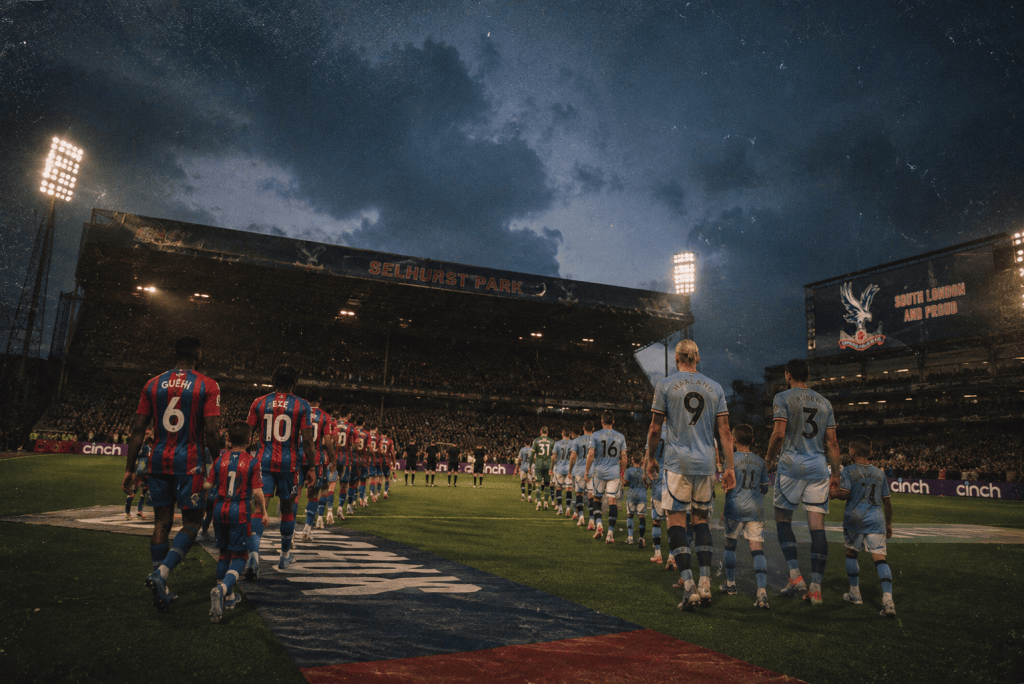
Manchester City won their opening Premier League match of the season.
Crystal Palace lost theirs.
Ordinarily, that should make Friday night at Selhurst Park reasonably easy to categorise. One side arrives with three points, the other with none. City remain Manchester City, Erling Haaland remains Erling Haaland, and plenty of supporters wearing a Manchester City jersey will arrive in South London expecting the natural order to take care of itself.
Except there is already something slightly awkward about the natural order.
City needed two late goals to escape Bournemouth with a 2-1 victory after spending 84 minutes behind. Palace lost 2-0 at Everton despite having 58 per cent of possession. Both have new managers trying to establish new ideas, both have squads undergoing fairly substantial reconstruction, and both discovered on the opening weekend that possession can occasionally amount to little more than having custody of the football.
This wasn’t quite the start either side wanted.
For Enzo Maresca, at least, it came with three points attached.
What is the chance of Man City winning the Premier League?
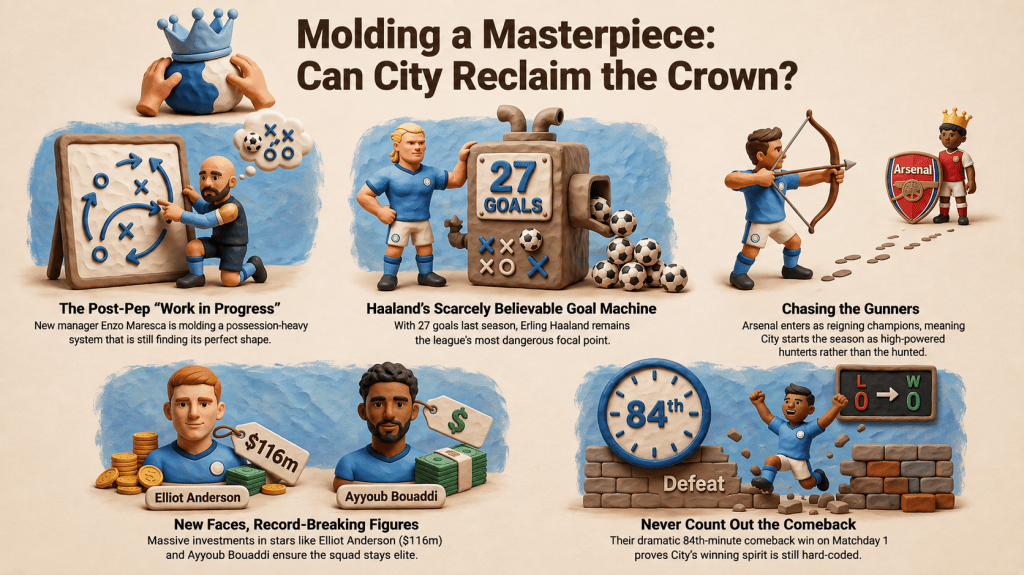
It is far too early to answer what the chance of Man City winning the Premier League is with anything approaching certainty.
That, perhaps, is precisely why Friday matters.
Maresca inherited a club accustomed to being judged against the almost indecent standards of Pep Guardiola’s Manchester City. Winning matches is expected. Controlling them is expected. Looking vaguely inconvenienced while doing both has practically become part of the furniture.
Against Bournemouth, City controlled 65 per cent of possession and still found themselves chasing the match until Marc Guéhi equalised in the 84th minute. Joško Gvardiol then completed the comeback.
A 2-1 victory looks perfectly respectable in the table.
The route there was considerably less reassuring.
There is a case to be made that judging a reconstructed midfield after 90 competitive minutes would be absurd. Rodri has gone to Barcelona, Bernardo Silva to Real Madrid and Tijjani Reijnders to Saudi Arabia. Those are not decorative departures. They remove enormous amounts of intelligence, rhythm and technical security from the centre of the pitch.
Maresca’s solution against Bournemouth was particularly intriguing.
He put Marc Guéhi in midfield.
Marc Guéhi returns to Crystal Palace as something entirely different
Guéhi returning to Selhurst Park was already going to provide the obvious narrative.
He captained Palace. He became an England international there. He subsequently joined Manchester City and now, only months later, must walk back into his old stadium wearing different colours.
Football rather enjoys these little cruelties.
What makes the reunion considerably stranger is that Guéhi may return not as the centre-back Palace supporters remember, but as City’s holding midfielder.
Against Bournemouth, he completed 56 of 59 passes, won all three of his tackles, and won eight of his 11 duels. Then, with City still trailing, he headed in Rayan Cherki’s corner.
Maresca admitted afterwards that Guéhi had never previously played in midfield, but explained that he had long believed the defender possessed the qualities required to do it.
Guéhi was rather less precious about the whole thing.
“Who knows? Maybe up front. We’ll see.”
Something is pleasing about a £multi-million Premier League tactical experiment being explained with approximately the same level of concern as somebody being moved to another table at a wedding.
Yet Selhurst represents a more complicated examination.
Adam Wharton was arguably Palace’s brightest player during their defeat at Everton. His ability to receive on the half-turn and immediately progress possession gives Palace an obvious route through City’s midfield.
City themselves have reportedly enquired about Wharton.
So Guéhi could spend Friday evening trying to stop his former team-mate from demonstrating exactly why his current employers apparently want him.
Football can be unnecessarily neat sometimes.
Is Crystal Palace F.C. a good team?
The question of whether Crystal Palace F.C. is a good team deserves a better answer than their opening result provides.
Yes, Palace can be a good team.
They also arrive at Matchweek Two looking rather less coherent than the side which produced one of the greatest days in Crystal Palace F.C. history only 15 months ago.
On 17 May 2025, Palace beat Manchester City 1-0 at Wembley to win their first major trophy. Eberechi Eze scored after 16 minutes. Dean Henderson saved Omar Marmoush’s penalty. City finished with 77 per cent possession and 23 attempts and still could not score.
That match remains relevant because it provided Palace with something more useful than nostalgia.
It provided proof.
Oh, and even after all that trouble about which UEFA competition they would be allowed to play in, they won the UEFA Europa Conference League.
City can have the ball. City can dominate territory. City can accumulate shots until the statistics resemble a siege report.
Palace can still beat them.
The difficulty is that the Palace attempting to repeat the trick looks rather different.
Pierre Sage’s competitive debut ended in a 2-0 defeat at Everton. Ismaïla Sarr was absent amid a dispute over his future. Jean-Philippe Mateta has his own contractual situation hanging over him. Maxence Lacroix has left for Chelsea, Guéhi has crossed Friday’s dividing line and Chadi Riad was stretchered off at Everton with a knee injury.
It is difficult to build a new tactical system when somebody keeps removing pieces from the board.
Sage may therefore have to decide how romantic he really wants his first competitive home match to become.
Selhurst Park capacity matters less than Selhurst Park noise
The Selhurst Park capacity is around 25,000, making Palace’s home considerably smaller than the enormous modern arenas occupied by several Premier League clubs.
Good.
Not every football stadium requires an airport lounge, enormous touchscreen and enough padded hospitality seating to accommodate a minor royal wedding.
Selhurst Park’s appeal is precisely that it remains tight, loud and slightly inconvenient.
The Holmesdale End sits close enough to the action for the crowd to become part of it. Friday night should exaggerate that effect further.
Maresca has already faced Palace three times as a manager during his spell with Chelsea.
All three ended as draws.
At this moment, one can only assume he would rather not make it four.
There is also the longer historical problem for Palace. They have not beaten Manchester City at Selhurst Park in the Premier League since April 2015.
Eleven years is substantial evidence.
Then again, Palace hadn’t won a major trophy before 2025 either.
Sometimes football history exists right until somebody decides to vandalise it.
City’s possession could become Palace’s opportunity
Perhaps the most interesting feature of the opening Premier League weekend was how frequently possession failed to translate into control.
Palace had 58 per cent at Everton and lost 2-0.
City had 65 per cent against Bournemouth and spent most of the afternoon losing.
Elsewhere, Manchester United controlled 71 per cent of the ball against Hull and lost 2-0, while Tottenham had 60 per cent against Brentford and were beaten 3-0.
Nine matches constitute a trend only if we are feeling particularly impatient, but there is something worth watching.
Premier League sides have become extraordinarily comfortable defending without the ball. The distance between surrendering possession and surrendering control has widened.
For Palace, that presents a choice.
Sage could attempt to establish his own possession game in front of the home support.
Or he could remember Wembley.
Let City advance. Let Guéhi and City’s reconstructed midfield accumulate passes. Keep Wharton positioned for the first transition, and ask Daniel Muñoz, Tyrick Mitchell, and the forwards to attack the spaces that appear behind them.
It isn’t sophisticated in the fashionable sense.
Neither is being eaten by Godzilla, but sophistication becomes rather less important once the enormous problem is already charging towards you.
Haaland represents Palace’s version of that problem.
Haaland remains the problem Palace cannot tactically explain away
Haaland was unusually quiet against Bournemouth.
Unfortunately for Palace, that doesn’t mean very much.
He has scored eight times against them, more than any other Manchester City player.
Palace’s defensive circumstances make that record especially uncomfortable.
Riad’s injury could force Takehiro Tomiyasu into an immediate role alongside Chris Richards in a reshaped defence. Sage may have a workable solution by Friday evening, but workable and comfortable are very different things when Haaland is standing between your centre-backs.
This is where Palace’s wider summer becomes relevant.
Individual departures are manageable. Injuries happen. Transfer disputes happen. Players become unsettled.
Eventually, though, accumulation becomes structure.
Remove Guéhi, Lacroix, and potentially Riad from a single defensive unit, and you’re no longer simply replacing individuals. You are asking new relationships to form immediately against one of the most destructive forwards in European football.
There are gentler ways to spend a Friday evening.
Crystal Palace F.C. gifts City something dangerous: belief

Anyone searching for Crystal Palace F.C. gifts before Friday might find scarves, shirts and various bits of red-and-blue memorabilia.
The rather more important gift Palace possess cannot be bought in the club shop.
Memory.
The players and supporters know what happened at Wembley.
City had the superior squad. City had the ball. City created the chances.
Palace lifted the FA Cup.
That doesn’t mean they will win on Friday. It doesn’t even necessarily make them particularly likely to.
It simply removes one psychological obstacle.
Palace don’t have to imagine beating Manchester City.
And City, inconveniently, remember it too.
Crystal Palace vs Manchester City prediction
Manchester City should be favourites.
Their squad remains stronger, their attacking options are deeper, and Palace enter the match carrying considerably more disruption than anyone would choose for a new manager’s first competitive home fixture.
But this version of City does not yet look like the machine its badge encourages opponents to remember.
They conceded against Bournemouth, have now gone seven competitive matches without a clean sheet, and are rebuilding the most important area of their team while the season is already underway.
Palace have their own problems, arguably more serious ones.
Yet Selhurst Park on a Friday night is precisely the sort of place where those problems can temporarily become somebody else’s.
Prediction: Crystal Palace 1-2 Manchester City.
City probably have enough.
The more interesting question is how much they have to suffer before proving it.
Because Matchweek Two will not decide whether Manchester City can win another Premier League title, nor whether Pierre Sage can rebuild Crystal Palace.
It might, however, tell us considerably more about both than their opening results did.
And if Guéhi walks back out of Selhurst Park having scored another goal from midfield, perhaps we really should start taking his suggestion about playing up front seriously.