
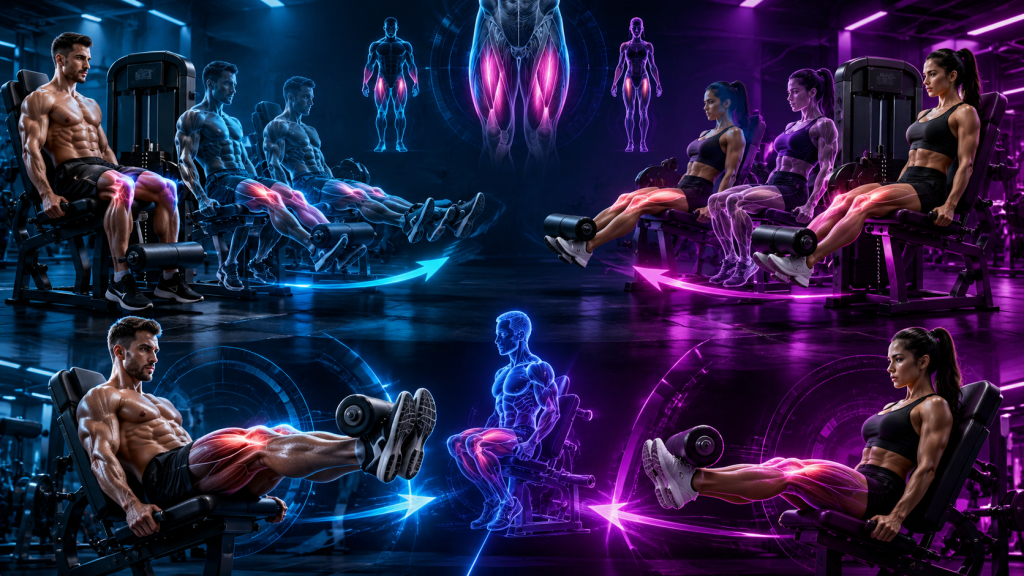
The leg extension might be one of the simplest-looking exercises in the gym. Sit down, straighten your legs, lower the weight, repeat.
Simple does not mean useless.
The leg extension is one of the most effective isolation exercises available for directly training the quadriceps. Unlike squats, lunges and leg presses, there is no need to coordinate your hips, ankles and torso while simultaneously wondering whether the barbell is plotting against you. Your knees extend, your quads work, and that’s largely the deal.
That makes leg extensions useful for everyone from complete beginners to bodybuilders chasing bigger quads and athletes rebuilding strength after injury.
They’re also particularly interesting for developing the rectus femoris, one of the four muscles making up your quadriceps, which isn’t always trained as effectively by compound exercises.
Let’s get those quads cooking.
What Is a Leg Extension?
The leg extension, also called the seated leg extension, machine leg extension or knee extension, is a single-joint isolation exercise.
You normally perform it on a dedicated leg extension machine.
Sitting against the backrest with a padded roller positioned above your ankles, you straighten your knees against resistance before controlling the weight back down.
That’s it.
There are no prizes for turning it into interpretive dance.
Because movement occurs primarily at the knee joint, the exercise allows you to concentrate almost entirely on your quadriceps.
Leg extensions are commonly used by:
- Beginners learning to deliberately contract their quads
- Bodybuilders targeting quadriceps hypertrophy
- Intermediate and advanced lifters adding extra quad volume
- Field-sport athletes developing knee-extension strength
- General gym users wanting stronger legs
- Rehabilitation patients rebuilding quadriceps strength under professional guidance
Their biggest advantage is straightforward: you can hammer your quads without generating the whole-body fatigue associated with heavy compound leg exercises.
Muscles Worked
Primary Muscles
The leg extension primarily trains the quadriceps femoris, the large muscle group covering the front of your thigh.
Your quadriceps contain four muscles:
- Rectus femoris
- Vastus lateralis
- Vastus medialis
- Vastus intermedius
All four contribute to extending your knee.
The rectus femoris is particularly interesting because it crosses both the hip and knee joints.
During exercises such as squats and leg presses, movement occurs simultaneously at both joints. That can limit how much the rectus femoris changes length and therefore how strongly it is stimulated.
During a leg extension, your hip remains relatively stationary while your knee extends.
That makes leg extensions an extremely useful complement to compound exercises rather than simply a watered-down substitute for them.
Secondary Muscles
This is very much a quadriceps-dominated exercise, but smaller contributions can come from the:
- Hip flexors
- Abdominals
- Other muscles surrounding the pelvis
Their involvement becomes more noticeable during less stable variations using resistance bands or free weights.
Why Are Leg Extensions Good?
Excellent Quad Isolation
Few exercises allow you to target your quadriceps quite this directly.
There is minimal contribution from the glutes and hamstrings compared with squats, lunges and leg presses, making leg extensions excellent for adding targeted quadriceps volume.
Muscle-Building Potential
This is where the leg extension really earns its place in the gym.
Research comparing leg extensions with leg presses has found considerably greater rectus femoris development from extensions. One 12-week MRI study reported approximately 13.2% rectus femoris growth from leg extensions compared with just 1.1% from leg presses.
That doesn’t make the leg press bad.
It means the two exercises aren’t interchangeable.
If maximum quadriceps development is your objective, combining compound exercises with leg extensions makes considerably more sense than declaring allegiance to one exercise and starting a gym civil war.
Strength Development
Leg extensions strengthen knee extension, including the final portion approaching lockout.
That can complement compound lower-body exercises and help address quadriceps weakness.
Athletic Carryover
Strong quadriceps play an important role in running, jumping, changing direction and, particularly, decelerating.
Athletes need to absorb considerable forces when slowing down or cutting. Developing strong knee extensors can therefore form part of a broader athletic strength programme.
It shouldn’t replace jumping, sprinting, squatting or sport-specific training, but it can strengthen some of the machinery underneath them.
Functional Benefits
Quadriceps strength matters outside the gym too.
Walking upstairs, standing from a chair and controlling your body while descending steps all require your quads.
This is also why restoring quadriceps strength is such an important component of many knee rehabilitation programmes.
Beginner Friendly
Leg extensions are exceptionally easy to learn.
There is no barbell to balance and relatively little coordination required. Once the machine has been correctly adjusted, beginners can concentrate on actually feeling their quadriceps contract.
That makes them an excellent introduction to resistance training.
How to Do Leg Extensions
Starting Position
Sit on the leg extension machine and place your back firmly against the backrest.
Adjust the machine so that your knee joint lines up with the machine’s rotational pivot point.
This bit matters.
Don’t simply sit on the machine exactly as the previous person left it and hope they happened to possess your skeleton.
Next, position the lower pad just above your ankle rather than halfway up your shin.
Where possible, slightly reclining the backrest can place the rectus femoris into a more lengthened position at the hip.
Grip the handles and keep your hips firmly against the seat.
Execution
Start with your knees comfortably bent.
Extend your knees and raise the pad smoothly over roughly two seconds.
Continue until your legs are straight, but don’t aggressively snap your knees into hyperextension.
Contract your quadriceps hard at the top.
Then lower the resistance under control for approximately two to three seconds.
Once you reach your starting position, begin the next repetition without allowing the weight stack to crash down.
Congratulations. Your quads should now be filing a formal complaint.
Breathing
Exhale while extending your legs.
Inhale as you control the resistance back towards the starting position.
There’s no need to turn blue performing a 12-rep isolation exercise.
Common Leg Extension Mistakes
Using Too Much Weight
This is easily one of the biggest offenders.
If your hips are bouncing out of the seat and you’re launching the pad upwards with momentum, your quads aren’t suddenly superhuman.
The weight is too heavy.
Drop it.
A controlled set with 50 kg is more useful than wrestling 70 kg into the air while your entire body attempts an escape.
Incorrect Knee Alignment
Your knee should align closely with the machine’s pivot.
Poor alignment can make the movement uncomfortable and alter how forces are distributed around the joint.
Take ten seconds to adjust the machine before beginning.
Putting the Pad Too High
The roller should normally sit just above the ankle.
Placing it halfway up your shin changes the leverage of the exercise and can make the movement unnecessarily awkward.
Dropping the Weight
The lowering phase isn’t the boring journey back to the next repetition.
It’s part of the repetition.
Control the eccentric for around two to three seconds rather than allowing gravity to perform half your set.
Slamming the Weight Stack
CLANG.
Everyone heard it.
Control the final few centimetres of the descent and maintain muscular tension rather than allowing the plates to smash together between repetitions.
Potential Drawbacks
Leg extensions aren’t perfect.
Because they’re an open-chain knee-extension exercise, they can produce substantial forces around the knee, particularly around certain joint angles.
That’s not evidence that leg extensions automatically “destroy your knees”, but it does mean load, range of motion and individual circumstances matter.
Leg Extension Variations
Harder Version: Single-Leg Extension
Train one leg at a time.
This removes the possibility of your stronger leg quietly doing extra work for its less enthusiastic neighbour.
Unilateral extensions are particularly useful for identifying and addressing noticeable strength differences between sides.
Slow-Eccentric Leg Extension
Extend normally before taking four to five seconds to lower the weight.
You won’t need enormous loads.
Your quadriceps will understand the assignment soon enough.
Peak-Contraction Repetitions
Pause at the top of each repetition and deliberately squeeze your quadriceps before lowering.
These work particularly well when muscular control and hypertrophy are the priority.
Who Should Use Leg Extensions?
Beginners
Absolutely.
The stable machine makes leg extensions one of the easiest lower-body resistance exercises to learn.
Use moderate resistance, learn to control the movement and leave the ego outside.
Intermediate Lifters
Excellent.
Leg extensions make it easy to add quadriceps volume without adding another exhausting compound exercise to your programme.
Advanced Lifters
They’re particularly valuable for physique athletes trying to maximise quadriceps development.
Techniques including unilateral work, slow eccentrics, pauses and high-repetition sets can squeeze substantial stimulus from relatively modest loads.
Bodybuilders
This is their natural habitat.
If quadriceps hypertrophy is the objective, leg extensions deserve serious consideration alongside squats, hack squats and leg presses.
General Fitness Users
They’re a simple way to strengthen the quadriceps without requiring advanced lifting technique.
Sport-Specific Athletes
Leg extensions can provide useful supplementary knee-extension strength, particularly when developing or restoring quadriceps capacity.
However, athletes still need compound strength work, sprinting, jumping and sport-specific movement where appropriate.
FAQ: 9 Common Leg Extension Questions
1. Are leg extensions bad for your knees?
Not inherently. Healthy lifters can perform leg extensions safely when the machine is correctly adjusted and resistance is controlled. If the exercise causes knee pain, however, don’t simply pile on more plates and hope your knee changes its mind. Reduce the resistance, check your setup and seek professional guidance when appropriate.
2. Can leg extensions replace squats?
No, and they don’t need to.
A leg extension isolates your quadriceps through knee extension. A squat involves your knees and hips while heavily recruiting the quads, glutes, adductors and numerous stabilising muscles.
Asking leg extensions to completely replace squats is a little like asking your goalkeeper to play centre-forward because they’re both technically on the football team.
Use each exercise for what it does well.
3. Do leg extensions build muscle mass?
Absolutely. Leg extensions are one of the strongest isolation choices for quadriceps hypertrophy and appear particularly useful for developing the rectus femoris.
4. Where should the shin pad sit?
Position the roller low on your shin, typically just above the ankle.
Your knee should also align with the rotational axis of the machine.
5. How heavy should I go?
For muscle growth, select a load that allows approximately 8-15 controlled repetitions.
If you’re swinging the weight, lifting your hips or losing control of the eccentric, you’ve gone too heavy.
Nobody cares what number is written on the weight stack.
Your quadriceps certainly can’t read it.
6. What’s the best seat angle for leg extensions?
A somewhat reclined position can increase the stretch placed on the rectus femoris compared with sitting completely upright.
Machine designs differ, however, so prioritise comfortable positioning and correct knee-to-pivot alignment.
7. Should I point my toes in or out?
For general training, keep your feet in a comfortable, mostly neutral position.
Although changing hip and foot position may alter quadriceps activation somewhat, deliberately twisting your legs isn’t necessary for building good quads.
Progressive overload and consistent technique matter considerably more.
8. Why perform single-leg extensions?
Unilateral extensions prevent your stronger leg from compensating for your weaker side.
They’re excellent for identifying strength differences and allowing each leg to work independently.
9. Are leg extensions functional?
Yes, although “functional” doesn’t mean an exercise needs to resemble something you perform while carrying the shopping.
Your quadriceps extend and control your knees during walking, climbing stairs, running and decelerating.
Making those muscles stronger is useful.
Simple as that.
Disclaimer
This article is intended for informational purposes only and does not constitute medical, physiotherapy, coaching, or professional training advice. Always consult a qualified healthcare or fitness professional before beginning a new exercise programme. Complete all workouts and exercises at your own risk.