

There is a tendency in football to assume history guarantees a prosperous future.
Yokohama F. Marinos have spent decades proving that history guarantees nothing.
One of Japanese football’s great institutions stumbled alarmingly close to becoming a cautionary tale, cycling through managers, watching defensive mistakes multiply, and, for the first time in a generation, seeing Nissan Stadium become a place opponents genuinely believed they could win at. For a club that has never been relegated from Japan’s top flight and whose modern identity was forged by fearless attacking football, it was a sobering reminder that prestige alone never earns points.
Can one of Japan’s biggest clubs become itself again?
Yokohama F. Marinos Transfers
Few clubs entered the summer with a clearer understanding of where improvements were required.
The priority was obvious. Stop conceding soft goals.
Corica inherits a squad whose attacking identity has rarely been questioned. Even during disappointing campaigns, Marinos remained capable of producing moments of breathtaking football. The problem came immediately afterwards, when defensive errors repeatedly undid everything good they had created. Last season’s tactical imbalance became impossible to ignore, making this transfer window feel more like structural renovation than cosmetic improvement.
Rubén Blanco could prove to be the defining signing.
The former Girona goalkeeper arrives with more than 120 La Liga appearances, bringing experience that few goalkeepers in Japanese football can match. His shot-stopping will attract attention, but perhaps even more valuable is the calmness expected to spread throughout a defence that too often looked nervous whenever pressure increased. Great goalkeepers rarely make headlines because they prevent panic before it begins. Blanco has the opportunity to become exactly that figure.
Rio Nitta perhaps best symbolises Corica’s intended style.
Fast, direct and constantly threatening the space behind defenders, the former Urawa Red Diamonds forward offers something Marinos occasionally lacked against organised defensive blocks: genuine vertical menace. If opponents push forward, Nitta can punish them immediately. If they sit deep, his movement creates room for others. Either way, his pace fundamentally changes the geometry of Yokohama’s attack.
The arrivals have been balanced by several significant departures.
Kōta Watanabe’s move to Vissel Kobe arguably leaves the biggest tactical question mark. His ability to dictate tempo and recycle possession often went unnoticed until matches became chaotic. Without that calming influence, Marinos may occasionally become overly direct under pressure. Likewise, the departures of Jeison Quiñónes and other squad players demonstrate a willingness to reshape the dressing room rather than merely reduce wages.
Overall, this feels like intelligent recruitment.
Less glamorous than previous transfer windows perhaps. But considerably more necessary.
Yokohama F Marinos Key Players
Rubén Blanco
Every successful rebuild begins somewhere.
For Yokohama F. Marinos, it begins between the posts.
Blanco arrives carrying the expectation of transforming one of the league’s most fragile defensive units into one capable of challenging for continental qualification once again. His experience playing in Spain should translate naturally into Corica’s preference for building attacks from the goalkeeper, while his command of the penalty area could immediately reduce the uncertainty that plagued Marinos throughout 2025.
Success should not necessarily be measured by spectacular saves.
Instead, it should be measured by how rarely those spectacular saves become necessary.
If Blanco finishes the season having quietly become one of the league’s most dependable goalkeepers, Yokohama’s entire campaign may look very different.
Takuya Kida
Every great football club has one player who embodies its values.
For Yokohama F. Marinos, that player remains Takuya Kida.
The club captain is far more than a holding midfielder. He represents continuity between generations, connecting Ange Postecoglou’s exhilarating title-winning side with today’s rebuilding project. His intelligence without possession often allows more adventurous teammates to flourish, while his leadership becomes particularly valuable during difficult moments.
This season demands perhaps his finest campaign yet.
With new teammates settling in, Corica introducing fresh tactical ideas and expectations rising once again, Kida will be asked to provide stability in every sense.
Expectations for Yokohama F. Marinos in 2026/27
Supporters should expect improvement. They should also demand it.
Finishing fifteenth simply cannot become acceptable at a football club with five J1 League titles, one of Japan’s richest histories and ambitions that stretch far beyond survival. This squad is stronger than the one that staggered through 2025, particularly in defensive areas, and Corica appears determined to preserve Yokohama’s attacking identity while eliminating the recklessness that repeatedly undermined it.
A return to the title race may be slightly premature. A return to the top six should not be.
Because this is Yokohama F. Marinos. One difficult chapter should never become the whole story.
How Important Will Nissan Stadium Be?
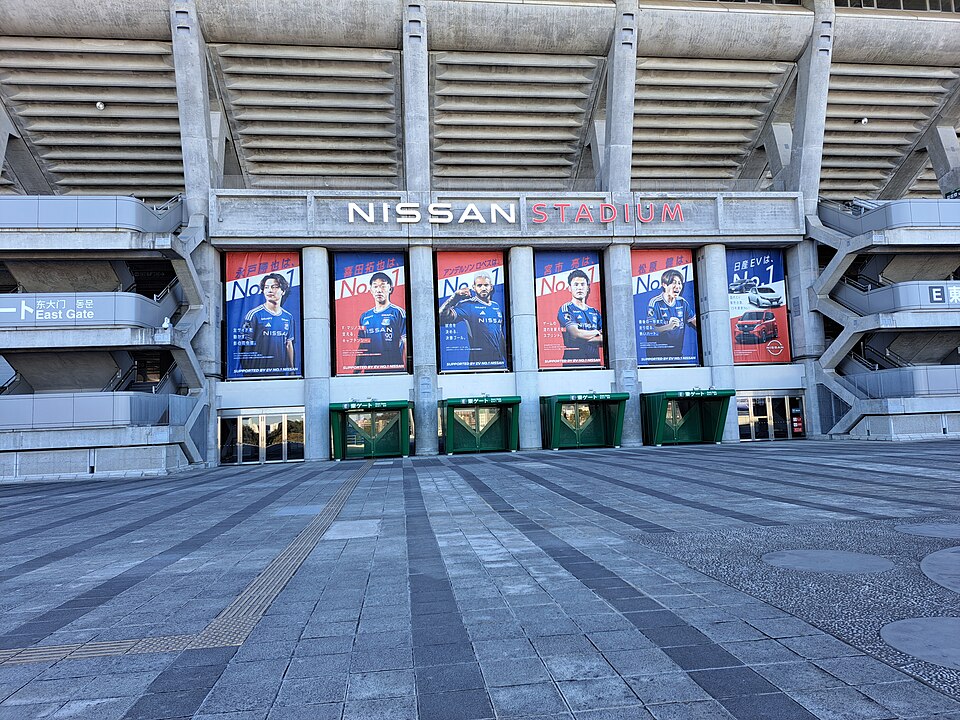
There are bigger stadiums in world football. There are louder stadiums too.
Very few, however, carry quite the same contradiction as Nissan Stadium. (Full Stadium Guide here).
At over 72,000 seats, it is the largest football stadium in Japan and an arena that has hosted World Cup finals, continental showpieces and some of the biggest occasions the country has ever seen. It is a venue built for spectacle. Yet television cameras often do it a disservice. Crowds exceeding 26,000, enough to fill many J.League grounds entirely, can appear strangely sparse simply because of the stadium’s extraordinary scale. It is an illusion that long-time Marinos supporters know all too well.
Spend an evening there instead. The illusion disappears.
When Yokohama F. Marinos score, Nissan Stadium becomes unmistakable.
Thousands of red, white and blue parasols begin spinning almost instantly, transforming one end of the ground into a moving sea of colour. The accompanying chants avoid the slow, repetitive rhythms found elsewhere, instead embracing quicker, melodic songs that feel closer to celebration than intimidation. It is joyful. Distinctive. Entirely Yokohama. The club’s identity is not merely displayed here; it is performed.
Rebuilding that home advantage may become Steve Corica’s single biggest achievement, should that come to pass.
His emphasis on structured pressing and greater positional discipline is designed not only to improve the defence but also to reduce the vulnerability that previously invited counter-attacks. If Marinos begin converting domination into victories once more, Nissan Stadium can quickly become somewhere visiting teams dread rather than target.
Supporters will play their part. They always do.
Yokohama F. Marinos J.League 100 Year Vision League Review
The transitional 2026 J.League 100 Year Vision League was never going to be remembered for silverware.
Instead, it became a period of rebuilding. Alongside that nice 5-0 win against Kawasaki.
With relegation temporarily suspended ahead of the league’s historic move to an August to May calendar, Yokohama F. Marinos were afforded something few clubs ever receive: the opportunity to reset without the immediate fear of the drop. Steve Corica inherited a squad still recovering from the turbulence of 2025, using the competition to begin embedding his tactical ideas and evaluating where the rebuild truly stood.
Results fluctuated, but there were encouraging signs beneath the surface.
Kaina Tanimura increasingly established himself as the focal point of the attack, while Takuya Kida’s midfield leadership continued to provide stability amid significant change. The team began looking more organised without the ball, and although performances still lacked the consistency supporters expect, there was a growing sense that clearer tactical principles were taking shape.
There were still obvious areas requiring attention.
Breaking down compact defensive blocks remained problematic, and the side occasionally looked vulnerable when forced to chase games. Those shortcomings would heavily influence the summer recruitment strategy, with Rubén Blanco, Kei Chinen and Rio Nitta all arriving to address weaknesses identified during the transitional campaign.
Ultimately, the 100 Year Vision League achieved exactly what it was intended to achieve.
Not to define Yokohama F. Marinos.
To prepare them.
Now the safety net has disappeared, relegation has returned, and the real examination of Corica’s rebuild begins.
How to Watch Yokohama F. Marinos in 2026/27
For supporters inside Japan, DAZN remains the primary destination for live J.League coverage throughout the season.
International viewers have more opportunities than ever before to discover Japanese football. Selected fixtures are regularly broadcast free through the official J.League YouTube channel, although availability varies by territory and by the league’s chosen weekly schedule. That accessibility has become one of the league’s greatest strengths, allowing supporters from across Europe, North America and beyond to discover clubs they may never have encountered before.
If you are choosing one club to follow during this historic first autumn-to-spring campaign, Yokohama F. Marinos remain one of the easiest recommendations.
Because they rarely play boring football.
Sometimes that openness costs them. Sometimes it produces moments that stay with you for years.
Watch the movement off the ball. Watch the full-backs arrive where full-backs shouldn’t. Watch the parasols begin spinning after a late winner.
Then try convincing yourself you don’t care about the result next week.
It rarely works.



 doragon sports
One response to “Yokohama F. Marinos: Restoring the Standard | 2026/27 Season”
[…] meetings with Yokohama F. Marinos remain contests between two of the J.League’s founding giants. Encounters with Urawa Red […]
LikeLike