

There are football clubs that celebrate success. Then there is Kashima Antlers.
Success here is not a pleasant surprise. It is the expectation waiting impatiently to be met again. 2025 J1 Champions…that was their 9th title.
No club has won more domestic honours in Japanese football. No club has spent longer teaching the rest of the league what sustained excellence actually looks like. Nine league titles. Twenty major domestic trophies. The first Japanese side to push Real Madrid into extra time in a FIFA Club World Cup Final. The first club to complete a domestic treble. The only team to win three consecutive J1 League championships. History does not merely surround Kashima. It follows them everywhere they go.
Which makes defending the title infinitely harder than winning it.
The 2026/27 season is unlike any before it. For the first time, the J.League abandons its familiar February to December rhythm in favour of an August to May calendar aligned with Europe. It is one of the most significant moments in Japanese football’s modern history, demanding fresh approaches to preparation, squad management, and consistency amid unfamiliar weather, travel, and fixture schedules.
Fortunately for Kashima, Toru Oniki has never looked particularly interested in excuses.
Kashima Antlers Transfers
Champions rarely rebuild. They refine.
That distinction matters. Toru Oniki has responded decisively.
Yan Matheus may prove the headline arrival.
Supporters across Japan already know precisely what the Brazilian offers after his outstanding spell with Yokohama F. Marinos. Direct without becoming predictable, creative without sacrificing work rate, he stretches defensive lines naturally before producing the final pass or cutting inside himself. Few wingers in J1 manipulate one-on-one situations quite so comfortably, and his arrival immediately makes Kashima considerably less dependent on predictable attacking patterns.
Matheus Bueno strengthens midfield options, while Rikuto Hirose returns to replace the influential Kimito Nono following his move to Major League Soccer.
Kashima Antlers Key Players
Yan Matheus
Some signings improve a squad. Others reshape how the entire team approaches the attack.
Yan Matheus belongs firmly in the second category.
Kashima’s championship-winning side occasionally became overly reliant on Yuma Suzuki dropping deep to create. While that movement remains fundamental to Oniki’s tactical blueprint, the arrival of Yan Matheus introduces another player capable of carrying progression himself. His willingness to isolate full-backs, attack space aggressively and deliver quality from wide positions should immediately diversify Kashima’s attacking structure.
Success should not be measured purely through goals and assists.
Instead, watch how many more decisions defenders are forced to make.
The greatest wide players don’t simply beat opponents.
They make everyone around them better.
Yuma Suzuki
There is nobody else quite like him in Japanese football.
Some supporters adore him. Others find him exhausting. Nobody ignores him.
Suzuki has gradually evolved beyond the role of centre-forward into something considerably more complex. Rather than remaining fixed between centre-backs, he drifts into midfield, links play, occupies defenders psychologically as much as physically and creates the spaces Léo Ceará exploits so ruthlessly. Few forwards anywhere in Asia combine tactical intelligence with emotional intensity quite so naturally.
He is Kashima’s heartbeat.
Expectations for Kashima Antlers in 2026/27
Being champions (from the last ‘proper’ season) changes every conversation.
Nobody overlooks you anymore.
Every opponent arrives believing that defeating Kashima somehow validates their own ambitions.
Retaining the title feels entirely realistic.
Not inevitable. Never inevitable. But realistic.
Oniki has inherited perhaps the perfect marriage between tradition and evolution. Kashima still possess the ruthless pragmatism that defined the Zico years, the ability to win uncomfortable matches by a single goal, defend narrow advantages and remain emotionally composed while chaos surrounds them. At the same time, possession has become increasingly important, allowing the champions to dominate games rather than simply surviving them.
There are concerns.
Kimito Nono leaves behind a considerable tactical gap. The squad also feels noticeably thinner beyond the strongest starting eleven, which becomes particularly relevant with the return of AFC Champions League Elite football alongside the demands of an unfamiliar split-year calendar. Injuries to Koki Anzai and Yuta Higuchi before the opening fixture only reinforce that concern.
They are defined by how they respond once those circumstances disappear.
Top two should be the expectation.
Another league title would surprise nobody.
Because this is Kashima Antlers.
For most clubs, success is something they hope eventually arrives.
For Kashima, it remains the standard that everyone else continues to chase.
How Important Will Mercari Stadium Be?
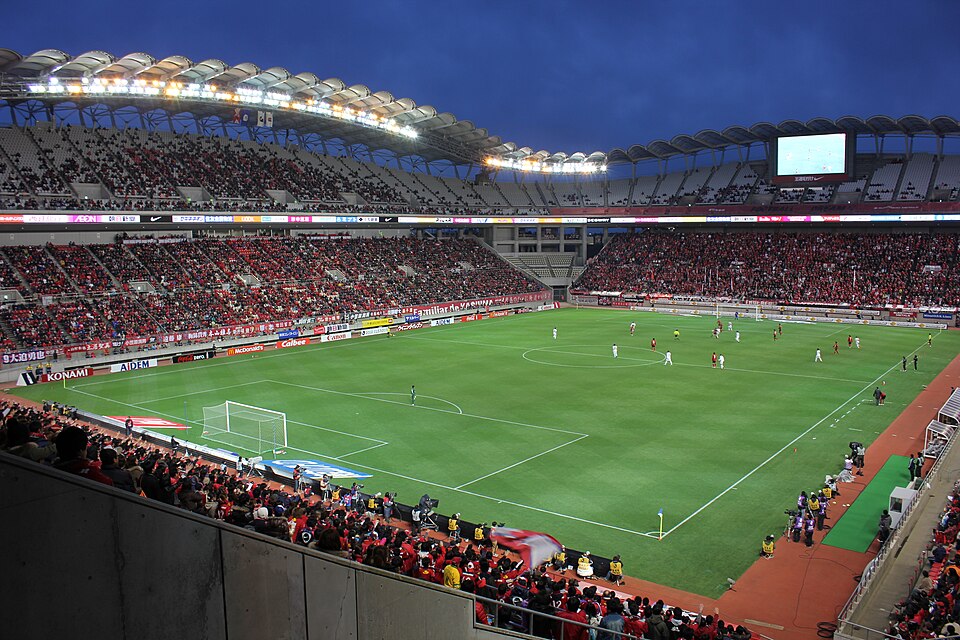
There are football stadiums.
Then there are football homes.
Mercari Stadium belongs firmly in the second category.
Long before Japanese football embraced purpose-built arenas, Kashima had already set the standard. Opened in 1993 as the country’s first dedicated professional football stadium, it helped define what a modern matchday could look like. World Cup football has been played here. Olympic football too. Yet the venue has never lost sight of who it was built for in the first place. The supporters who make the journey every other weekend.
Journey is the appropriate word.
Unlike many of Japan’s biggest clubs, Kashima does not sit inside a sprawling metropolitan area. The city itself has a population of around 60,000. A remarkable percentage of the crowd arrives from elsewhere across Ibaraki Prefecture or travels the ninety minutes from Tokyo, turning every home fixture into something resembling a pilgrimage rather than a routine afternoon out.
Inside, the stadium rewards patience.
The stands sit close enough to the pitch that every tackle carries weight, every defensive clearance earns appreciation and every forward run feels shared between players and supporters. The grass itself has long been regarded as among the finest in Japanese football, maintained to standards that allow Oniki’s increasingly possession-focused football to flourish. A quick passing sequence simply looks different on a surface this immaculate.
Home advantage has become one of Kashima’s defining strengths. With a new August-to-May calendar introducing colder evenings and unfamiliar rhythms, Mercari Stadium may become even more significant.
Championships are often defended at home long before they are won away.
How to Watch Kashima Antlers in 2026/27
Supporters inside Japan can follow Kashima Antlers throughout the season on DAZN, which continues to hold comprehensive live J.League coverage.
International audiences have never enjoyed easier access to Japanese football. Selected fixtures are broadcast free on the official J.League YouTube channel, with matches chosen by the league and availability varying by territory. It has become one of the competition’s greatest strengths, allowing supporters across Europe, North America and beyond to stumble upon clubs they might never otherwise have discovered.
If you are searching for a club that represents everything distinctive about Japanese football, Kashima deserve serious consideration.
Watch the intelligence of Yuma Suzuki dropping thirty yards simply to create space for someone else.
Watch Tomoki Hayakawa somehow turn certain goals into routine saves.
Watch Léo Ceará spend eighty-five minutes waiting before needing one touch to decide everything.
Then watch thirty-nine thousand supporters rise together because they have seen this story unfold before.
Champions never tire of proving themselves again.
What Does Kashima Antlers Mean to Japanese Football?
Some clubs become successful. Others become institutions.
Kashima Antlers crossed that line decades ago.
Everything about modern Japanese football carries traces of their influence.
They were there at the beginning of the professional era, helping transform the J.League from an ambitious idea into sustainable reality. They introduced generations of supporters to what sustained excellence actually looked like, setting standards that rivals have spent more than three decades attempting to match. Even now, no club possesses more domestic trophies. Records exist to be broken.
Nobody has managed this one yet.
The Brazilian connection remains central to that identity.
Zico did not simply arrive as a superstar nearing retirement. He embedded a football culture whose influence still shapes the club today, one built upon technical quality, professionalism and the expectation that winning should become habitual rather than extraordinary. Managers have changed. Players have come and gone. That philosophy continues to run quietly beneath everything Kashima does.
Equally important is where the club belongs.
Kashima succeeds despite representing one of the smallest hometowns in the division, proving that size alone has never dictated ambition. The supporters travelling across Ibaraki and from Tokyo each weekend are not simply watching football. They are participating in a tradition that blends local identity, Shinto heritage and professional sport into something entirely unique within Japanese football.
Their rivalries carry genuine historical weight.
The meetings with Yokohama F. Marinos remain contests between two of the J.League’s founding giants. Encounters with Urawa Red Diamonds rarely lack edge, while the arrival of Mito HollyHock in the top flight finally gives Ibaraki its first J1 derby, introducing an entirely new chapter to the prefecture’s football story.




 doragon sports