
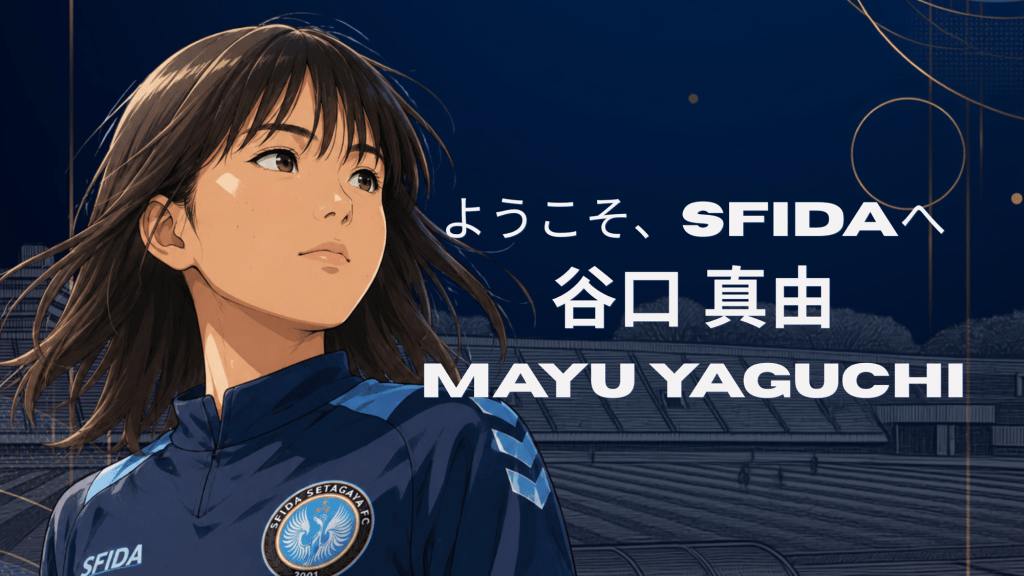
Well, it’s been a while since I wrote about SFIDA. The typhoon called off the last game, and now we’re in the summer break. Some football transfers arrive wrapped in fireworks, polished unveiling videos and declarations about ambition.
Others arrive with a quiet sentence that tells you far more than any promotional campaign ever could.
“I want to work hard so that I can affirm this decision and my past self.”
That was Mayu Yaguchi’s message after leaving JEF United Chiba Ladies for SFIDA Setagaya.
It isn’t the sort of quote agents tend to invent. There is no mention of “the next chapter” or “exciting challenges”. Instead, it reads like someone standing at a crossroads, looking backwards just long enough to make sure they’re walking in the right direction.
At just twenty years old, Yaguchi has made a decision that many young footballers eventually face. She has traded the prestige of belonging to a WE League club for something that can be considerably harder to obtain.
The chance to actually play football.
For players like Yaguchi, that can prove worth far more than the badge stitched onto the front of the shirt.
Six Years Chasing One Dream
Leaving JEF cannot have been easy.
This wasn’t simply another club.
This was home.
Yaguchi spent six years progressing through the JEF academy, developing with the Under-15s before moving into the Under-18 setup and eventually earning promotion into the senior side. For any academy graduate, that promotion represents years of early mornings, muddy pitches, long bus journeys and the quiet belief that one day your name might appear alongside the first team.
She made it.
Technically.
Reality, as football so often demonstrates, is rarely interested in technicalities.
Sometimes the production line works exactly as intended. Sometimes, there are simply too many good players standing in front of you.
That isn’t failure.
It’s football.
Four Appearances Tell You Almost Nothing

Statistics have an unfortunate habit of pretending they explain everything.
Mayu Yaguchi’s first WE League season reads as follows.
Four appearances.
Zero starts.
Fifty minutes.
Zero goals.
Zero assists.
On paper, it barely resembles a season.
In reality, it reflects something increasingly common throughout elite women’s football. Young players break into senior squads only to spend months waiting for opportunities measured not in matches, but in minutes.
Her debut arrived in the harshest possible circumstances.
Thrown into the closing stages against Tokyo Verdy Beleza during a bruising 7-0 defeat, Yaguchi’s first taste of WE League football came inside a game that had already slipped beyond saving. It was less a debut than an introduction to the brutal realities of top-flight football.
One week later, something altogether different came.
JEF protected a narrow 2-1 advantage against AS Elfen Saitama, with Yaguchi entrusted to help close out the victory. Defensive discipline. Positional awareness. Calmness rather than chaos.
Perhaps that was the first glimpse of why the coaching staff valued her.
Her longest appearance followed against title contenders INAC Kobe Leonessa.
Seventeen minutes.
Not ninety.
Seventeen.
Football often describes these cameos as valuable experience.
Players usually describe them as waiting.
More Than Just Another Midfielder
At first glance, Yaguchi doesn’t look like the sort of signing that dominates headlines.
Standing at 155 centimetres, she isn’t going to overpower opponents physically.
She doesn’t need to.
Her own description of her game revolves around intelligence. She speaks about using her head, reading situations and solving problems before they fully develop. There is something quietly refreshing about a player whose greatest strength isn’t pace or power, but thought.
Football increasingly celebrates athletes capable of covering extraordinary distances.
It perhaps spends less time celebrating those capable of making everyone else run slightly less.
That feels closer to Yaguchi’s profile.
She looks for angles.
She keeps possession moving.
She occupies intelligent spaces.
She appears comfortable making simple decisions at exactly the right moment.
Those qualities rarely produce viral highlight compilations.
They often produce very good midfielders.
Why SFIDA Setagaya Makes Sense
Dropping from the WE League to the Nadeshiko League will inevitably be framed by some as a step backwards.
Which is one way of looking at it.
Another is that Japanese women’s football has quietly built one of the healthiest developmental pathways anywhere in the game.
The WE League offers prestige.
The Nadeshiko League offers repetition.
Repetition builds footballers.
You cannot develop decision-making through four substitute appearances spread across an entire campaign.
You develop by making hundreds of decisions every weekend.
By making mistakes.
By correcting them.
By learning when to speed the game up and when to slow it down.
SFIDA Setagaya have long cultivated an identity built around organised football, technical quality and collective discipline. It feels like an environment where a thoughtful young midfielder can actually discover what level she is capable of reaching.
Sometimes careers need oxygen more than status.
A New Midfield Option for SFIDA
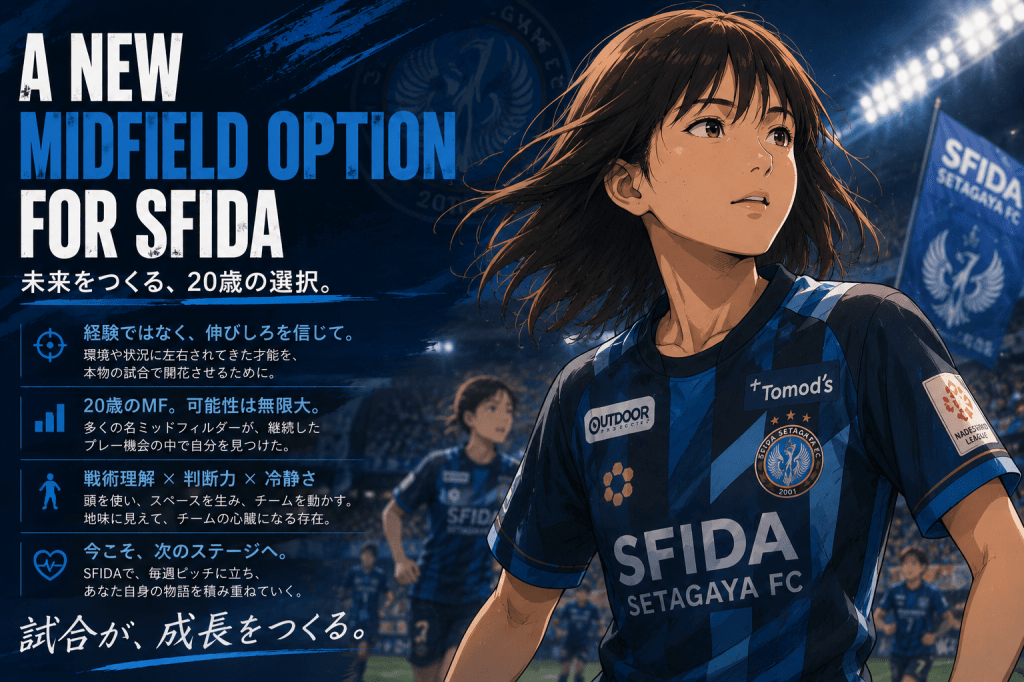
From SFIDA’s perspective, this feels like exactly the sort of recruitment that has served clubs well for years.
Rather than chasing established stars, they’ve identified a player whose development has been delayed more by circumstance than ability.
A twenty-year-old remains exceptionally young for a central midfielder.
Many of Japan’s finest midfield players only truly found themselves after consistent senior football became available.
Yaguchi also arrives carrying an appreciation that cannot really be coached.
Leaving your childhood club changes people.
It strips away comfort.
It forces growth.
Her farewell message thanked supporters, coaches and everyone who helped shape her journey in Chiba. There was no bitterness, no suggestion she had been wronged.
Only gratitude.
That maturity should serve her well in Setagaya.
Sometimes the Best Transfers Are the Quiet Ones
Football has become strangely obsessed with climbing.
Bigger clubs.
Bigger contracts.
Bigger leagues.
Yet careers rarely move in straight lines.
Sometimes progress means stepping sideways.
Sometimes it even means stepping down.
The important part is to continue moving.
Nobody really knows what Mayu Yaguchi will become at SFIDA Setagaya.
That uncertainty is precisely what makes the move exciting.
She arrives not burdened by impossible expectations, but carrying six years of education, fifty minutes of top-flight football, and an opportunity to finally replace potential with experience.
There is something wonderfully honest about that.
Football likes to pretend that reaching the highest division is the destination. It isn’t. Playing football is. Everything else is decoration.
New roads slowly bend
Minutes shape tomorrow’s game
Dreams finally breathe





One response to “Mayu Yaguchi Leaves the Waiting Room Behind”
[…] this fixture was originally scheduled, Mayu Yaguchi wasn’t part of the […]
LikeLike