
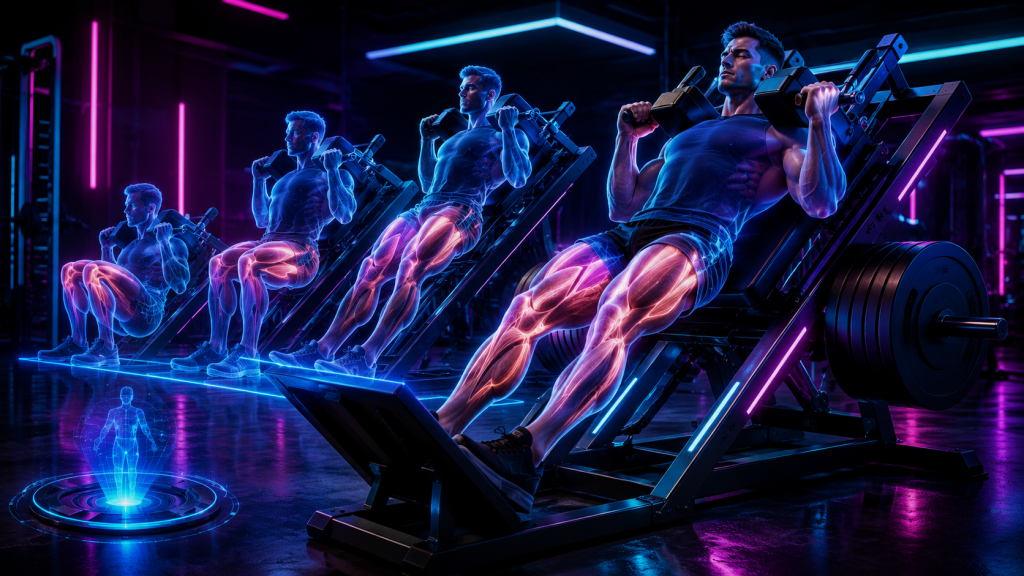
If your goal is bigger quads, stronger legs, and brutal lower-body workouts without loading a barbell onto your back, the hack squat machine deserves a permanent place in your routine.
Sitting somewhere between a traditional squat and a leg press, the hack squat allows you to move serious weight while following a fixed movement path. That means less time worrying about balance and more time focusing on driving your legs through every repetition.
Whether you’re a beginner learning squat mechanics or an experienced lifter chasing tree-trunk thighs, the hack squat is one of the most effective machines you’ll find on the gym floor.
Muscles Worked
Primary Muscle
- Quadriceps
Secondary Muscles
- Gluteus maximus
- Hamstrings
- Adductors
- Calves
Stabilising Muscles
- Core
- Hip stabilisers
- Ankles
- Upper back (maintaining contact with the pad)
Although the machine removes much of the balancing requirement found in barbell squats, your body still works to maintain proper knee tracking and force production throughout the movement.
Why This Exercise Is Good
The hack squat has become one of the most respected lower-body exercises for a reason.
Its biggest advantage is quad development. Because the sled travels on fixed rails while your torso stays upright against the pad, much of the workload shifts directly onto the quadriceps instead of being shared by the lower back and posterior chain. That means more targeted stimulation where many lifters actually want it.
The supported design also dramatically reduces spinal loading. If your lower back becomes the weak link during heavy barbell squats, the hack squat lets your legs continue working long after your back would normally give up.
Another huge benefit is fatigue management. Heavy free-weight squats tax your cardiovascular system, core and nervous system all at once. On a hack squat, you’re able to take your quads much closer to true muscular failure without feeling like you’ve just finished running a marathon.
For beginners, the guided movement provides confidence. You can learn proper squat depth and knee tracking without worrying about balancing a loaded barbell across your shoulders.
Even advanced bodybuilders keep hack squats in their programmes because they’re incredibly easy to progressively overload while maintaining consistent technique.
Technique Breakdown
Position yourself with your shoulders securely underneath the pads and your back completely against the backrest.
Place your feet roughly shoulder-width apart with your toes pointed slightly outward.
For maximum quad emphasis, position your feet slightly lower on the platform.
For greater glute and hamstring involvement, move your feet higher and slightly wider.
Execution
Unlock the safety handles before beginning.
Lower yourself under complete control for two to four seconds.
Continue descending until your thighs reach at least parallel with the platform, or deeper if your mobility comfortably allows.
Drive through your mid-foot and heels while pushing the platform upward.
Stop just before fully locking your knees to maintain constant tension on the quadriceps before beginning the next repetition.
Breathing
Take a deep breath before lowering.
Brace your core throughout the descent.
Exhale as you push the sled back to the starting position.
Coaching Cues
- Keep your entire back glued to the pad.
- Push your knees in line with your toes.
- Drive through your heels.
- Stay smooth rather than bouncing out of the bottom.
- Control every centimetre of the descent.
Common Mistakes
The biggest mistake is cutting the range of motion short. Half reps simply don’t place the quadriceps through the deep stretch that makes the exercise so effective.
Another common issue is letting the heels lift from the platform. This shifts force forward, reduces stability and often limits depth.
Many lifters also allow their knees to collapse inward during the ascent. Keep actively pushing them outward so they remain aligned with your feet.
Using momentum is another problem. Dropping rapidly into the bottom and bouncing upwards reduces muscle tension while increasing unnecessary joint stress.
Finally, avoid locking your knees completely at the top of every repetition. Maintaining a slight bend keeps constant tension where you want it, on the muscles instead of the joints.
Who Should Use This Exercise?
The hack squat is suitable for almost every gym-goer.
Beginners can safely learn squat mechanics with reduced balance demands.
Intermediate lifters can progressively overload their legs while refining technique.
Advanced bodybuilders often rely on hack squats to create extreme quad hypertrophy without excessive spinal fatigue.
Strength athletes can use them as valuable accessory work alongside traditional squats.
General fitness enthusiasts also benefit from stronger legs, healthier knees and improved lower-body endurance.
Frequently Asked Questions
Is the hack squat better than the barbell squat?
Neither is objectively better. Hack squats excel for quad isolation and reduced spinal loading, while barbell squats develop full-body strength and coordination.
How many sets and reps should I do?
Three to four sets of 8 to 15 repetitions works well for most muscle-building goals.
Is the hack squat good for beginners?
Yes. The guided movement makes it much easier to learn proper squat mechanics safely.
Can hack squats build bigger quads?
Absolutely. They’re widely considered one of the best exercises available for quadriceps hypertrophy.
Should I lock my knees at the top?
No. Stopping just short of lockout helps maintain muscle tension while reducing unnecessary stress on the knee joint.
Disclaimer
This article is intended for informational purposes only and does not constitute medical, physiotherapy, coaching, or professional training advice. Always consult a qualified healthcare or fitness professional before beginning a new exercise programme. Complete all workouts and exercises at your own risk.