

The first goal arrived after seven minutes.
A bouncing ball. A split-second decision. A volley hammered into the roof of the net.
The second was calmer. A clipped finish. Less violence, more precision.
By the time New Zealand’s players surrounded Elijah Just beneath the Californian sun, something unusual had happened. The lowest-ranked team at the 2026 FIFA World Cup had just beaten Iran, one of Asia’s strongest footballing nations, and the winger from Motherwell had scored both goals.
Football loves overnight success stories.
This wasn’t one.
This was fifteen years in the making.
From Palmerston North to a Danish Garage
Most football careers are explained backwards.
A player scores at a World Cup and suddenly every setback becomes part of a neat narrative. Every struggle was “character building”. Every rejection was “necessary”.
Reality is usually less elegant.
Elijah Just left his family home in Palmerston North as a teenager to join the Olé Football Academy in Wellington. At fourteen years old, while most teenagers were worrying about homework or weekend plans, he was living away from home and attempting to build a professional football career.
It sounds glamorous until you remember he was fourteen.
Later came Europe.
Not the glamorous Europe of Champions League nights and luxury apartments.
The other Europe.
The one involving second divisions, language barriers and uncertainty.
At one stage Just was living with a Danish host family in what was essentially a converted garage while trying to establish himself professionally. Thousands of young footballers make similar journeys every year. Most return home quietly.
Nobody remembers the players who almost made it.
That possibility hung over Just’s career for years.
The Crossroads
By the summer of 2025, Elijah Just was twenty-five years old and approaching an uncomfortable question.
Had the move been worth it?
He had played in Denmark.
He had played in Austria.
He had accumulated experience.
What he had not accumulated was the sort of career progression people imagined when he left New Zealand as a promising teenager.
Then came Motherwell.
Scottish football is often described as physical, intense and unforgiving. Usually by people who have never attempted to control a football while somebody built like a refrigerator is trying to remove your kneecaps.
For Just, it represented something more important.
A chance.
Not a final chance perhaps, but certainly an important one.
Motherwell manager Jens Berthel Askou already knew him from their time together in Denmark and saw something others perhaps had not.
Game intelligence.
Versatility.
An ability to find space where space did not appear to exist.
Askou effectively rebuilt him.
The Motherwell Renaissance
Just arrived in Scotland as a winger.
He finished the season as something far more complicated.
Sometimes he played wide.
Sometimes as a number ten.
Occasionally as a false nine.
At one point he was effectively helping out in midfield after a red card reduced Motherwell to ten men.
Football analysts enjoy inventing increasingly elaborate terminology for players like this.
The simpler explanation is that he became useful everywhere.
Motherwell finished fourth in the Scottish Premiership and secured European football.
Just contributed seven league goals and eight assists.
Those numbers alone are respectable.
The context makes them more impressive.
Motherwell are not one of Scotland’s financial heavyweights. They operate in a league where the gravitational pull of the two Glasgow giants tends to dominate everything around them.
Finishing fourth felt like somebody had quietly rearranged the furniture while nobody was looking.
Just was central to it.
The Aberdeen victory stood out.
A clever finish.
Four key passes.
The sort of performance that shifts a player from being “good” to becoming somebody opposition managers specifically mention in team meetings.
Then came the battle at Ibrox.
A match that revealed another side of his game.
Five fouls suffered.
Constant physical pressure.
Motherwell reduced to ten men.
Instead of disappearing, Just retreated into midfield and helped drag his team through ninety difficult minutes.
Football supporters often celebrate flair.
Managers tend to notice sacrifice.
The World Cup Shock
Nobody expected much from New Zealand entering the 2026 World Cup.
Why would they?
The All Whites arrived ranked 85th in the FIFA rankings, the lowest-ranked team in the tournament.
Suddenly everyone starts talking about transfer fees.
Their recent preparation had hardly inspired confidence either.
A 4-0 defeat against Haiti.
A narrow 1-0 loss against England.
Reasonable people looked at those results and concluded New Zealand were probably there to make up the numbers.
Which is often where football becomes interesting.
Iran were expected to win.
Iran regularly qualify for World Cups.
Iran possess players operating at a higher level than much of New Zealand’s squad.
Instead, New Zealand won.
And Elijah Just became the first New Zealand player ever to score twice in a single World Cup match.
Not for the first time, football ignored its own script.
The Chris Wood Connection
One detail risks being overlooked.
Chris Wood.
At thirty-four, Wood remains New Zealand’s footballing north star, the reference point against which every attacking player is measured.
Against Iran, his partnership with Just worked beautifully.
Wood occupied defenders.
Held the ball.
Created space.
Just attacked the gaps.
Both goals emerged from that understanding.
There was something pleasingly old-fashioned about it.
A target man and a runner.
Football occasionally spends years searching for innovation before rediscovering ideas that already worked.
Why Celtic and Rangers Are Watching
Scottish football has seen this story before.
A player arrives quietly.
Improves rapidly.
Just still has time remaining on his Motherwell contract, which puts the club in a strong position.
But interest is building.
Celtic have been linked.
Rangers have been linked.
Others will inevitably follow.
A strong season in Scotland is valuable.
A strong World Cup performance multiplies everything.
Motherwell know this.
So does Elijah Just.
How Far Can New Zealand Go?
This is where optimism collides with reality.
New Zealand’s remaining group opponents are Belgium and Egypt.
Belgium remain one of Europe’s strongest footballing nations despite a gradual generational transition.
Egypt possess quality throughout their squad and tournament experience.
On paper, New Zealand remain outsiders.
But they have already collected what many assumed would be their most difficult result.
The victory over Iran changes everything.
A draw against either Belgium or Egypt could suddenly become enough to keep qualification hopes alive heading into the final matchday.
Nobody is suggesting New Zealand are about to win the World Cup.
Football has enough absurdities already.
Yet they no longer look like tourists.
They look competitive.
And if Chris Wood continues creating space while Elijah Just continues finding it, they will trouble teams.
From Garage to Global Stage
There is a temptation to present Elijah Just as a fairy tale.
That would be unfair.
Fairy tales imply inevitability.
Nothing about this career was inevitable.
A teenager leaving home.
Years spent in football’s quieter corners.
Second divisions.
Uncertainty.
The constant possibility of failure.
Then Motherwell.
Then Scotland.
Then the World Cup.
The modern game often resembles Mechagodzilla, a giant machine powered by money, algorithms, scouting databases and transfer models. Players are assessed, measured and categorised with industrial efficiency.
And yet every so often somebody slips through the gears.
A winger from Palmerston North ends up scoring a World Cup brace against Iran.
Nobody’s spreadsheet predicted the feeling of that moment.
Which is precisely why people watch.
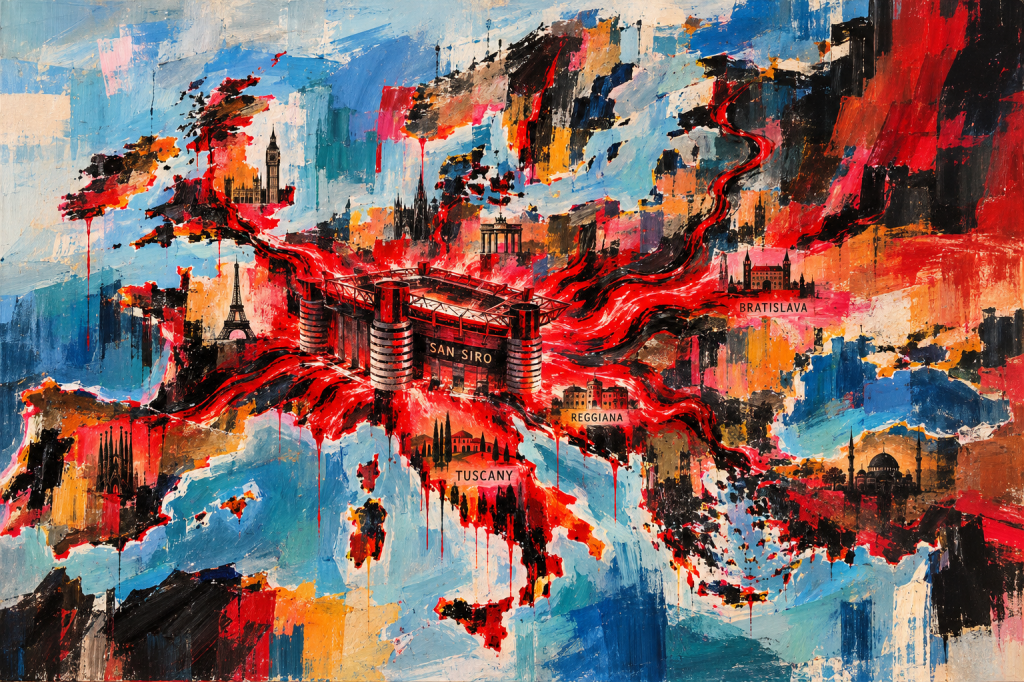
From garage room dreams
To Californian sunlight
The map kept unfolding


 doragon sports