
The ball dropped awkwardly out of the Welsh rain, spun off a defender’s shin, bounced with all the elegance of a microwave falling down stairs, and somehow ended up at Žan Vipotnik’s feet.
Three seconds later, it was in the net.
That became the season, really.
Not the clean finishes. Not the statistics. Not even the Championship Golden Boot. The feeling of him. The sense that while everyone else was trying to play organised football, Vipotnik was thriving inside the collapse itself. Like some Mechagodzilla built specifically for second-ball warfare, stomping through defensive structures that had technically done everything right before discovering that none of it mattered.
Twenty-three league goals for Swansea City. Forty-one per cent of their entire league output. A striker operating in a team that flirted with the play-offs without ever fully convincing anyone they belonged there.
And now comes the awkward modern football ritual where supporters, analysts and recruitment departments all pretend emotion is a spreadsheet.
Should he stay?
Should he go?
Is he “Premier League ready”?
Can Championship form translate upward?
Is this another Joel Piroe situation waiting to happen?
Football loves these conversations because they allow everyone to sound intelligent after the fact.
If he succeeds, people will talk about “elite underlying metrics”.
If he fails, they’ll mention “the physical jump”.
The truth is usually much messier than that.
Because strikers like Vipotnik are ecosystem players. Context matters. Service matters. Emotional tolerance matters. The surroundings either sharpen the knife or leave it rusting in a drawer.
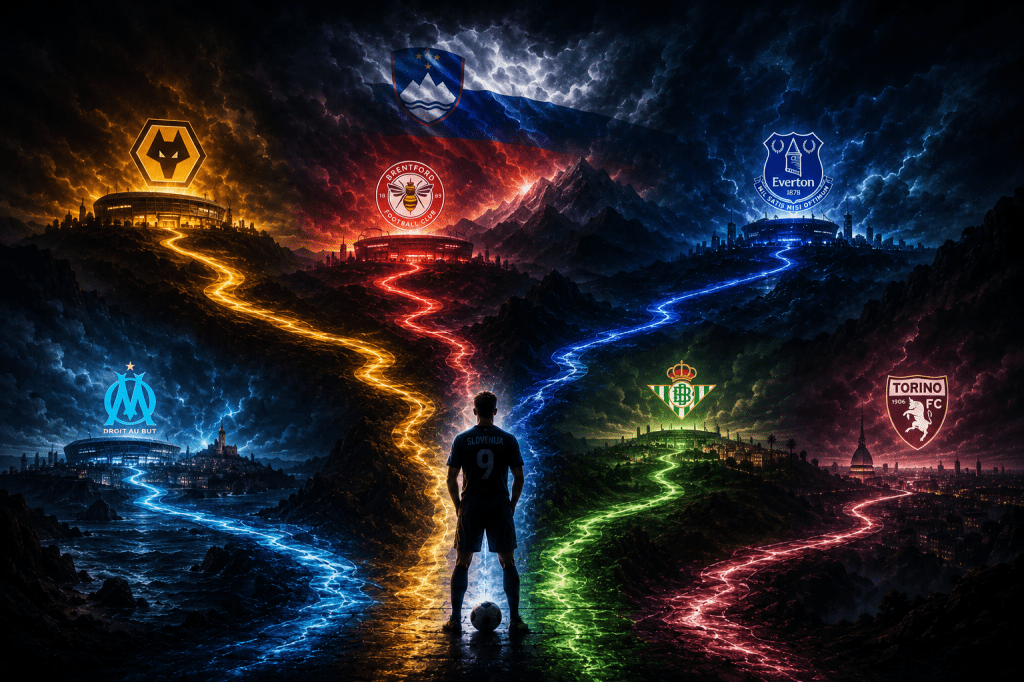
And that is why these six clubs make actual sense.
Not vanity transfers.
Not shirt-sales nonsense.
Not “he could learn from sitting behind a world-class striker”.
Nobody develops from becoming a decorative bench ornament at a Champions League club. That is one of football’s most persistent fairy tales.
These are the places where the Slovenian chaos machine could genuinely breathe.
Wolverhampton Wanderers F.C.
This feels brutally logical.
Even in the Championship, Wolves remain one of the richest and most structurally powerful clubs outside the Premier League aristocracy. Parachute payments have effectively turned relegated clubs into heavily armed submarines drifting through second-tier waters pretending they are normal.
They are not.
And Vipotnik fits the environment beautifully.
Championship football still rewards strikers willing to survive ugliness. Long throws. Wet nights. Defenders are climbing through your back like they’re escaping a prison riot. Half-cleared crosses. Transitional panic.
That is his habitat.
More importantly, Wolves would not buy him as a “developmental project”. He would arrive as the focal point. The promotion battering ram. The striker expected to turn territorial dominance into points.
That matters.
Many forwards fail after promotion because they stop being central to the story. At Swansea City, Vipotnik is the story. Strip that away too early, and suddenly the player starts dissolving into systems built for somebody else.
At Wolves, he stays the reference point.
And honestly, Championship centre-backs trying to handle him for 46 games feels faintly unfair.
Like releasing a bear into a village market and acting surprised when fruit starts flying everywhere.
Brentford F.C.
This is probably the smartest Premier League pathway.
Which immediately makes it less romantic and more believable.
Brentford do not recruit like most clubs. They recruit like an accounting department that accidentally became excellent at football. Players are stripped down into data patterns, psychological durability, physical repeatability and value efficiency.
Normally, this sounds deeply depressing.
Occasionally, it works spectacularly.
Vipotnik’s profile would make Brentford analysts start levitating gently above their desks.
A striker overperforming xG by nearly ten goals while carrying an inconsistent side through sheer finishing violence is the sort of thing their recruitment department probably prints onto ceremonial parchment.
But beyond the numbers, the emotional environment suits him.
No hysteria.
No giant fanbase demanding hat-tricks by September.
No media circus pretending every missed chance is a moral collapse.
Just coaching.
Structure.
Development.
Process.
This tends to matter enormously when bridging the Championship-to-Premier League gap.
Because people forget how psychologically strange that jump can become. One year, you are scoring in front of 18,000 people against Plymouth Argyle. The next time you are being analysed frame by frame by ex-full-backs on television, explaining “body shape”.
Brentford reduce the noise.
And sometimes reducing the noise is half the transfer.
Everton F.C.
This one feels emotionally correct.
Everton supporters would adopt him almost immediately because he looks like the sort of striker who suffers publicly for the cause. Fans at clubs like this tend to value visible struggle almost as much as goals themselves.
Particularly after the last few years.
Goodison Park has often resembled a large communal stress experiment conducted beside the River Mersey. Survival football. Thin margins. Matches where everyone behaves like they’ve collectively consumed six espressos and bad news simultaneously.
Vipotnik suits that atmosphere.
He scores ugly goals.
He survives on a poor supply.
He turns broken moves into something vaguely productive.
That is invaluable outside elite clubs.
There is also something deeply Everton about the idea of signing a striker from Swansea City who arrived there after Bordeaux collapsed financially around him. Football loves damaged histories. Fans especially do. It creates emotional texture. A sense that the player has already been through enough bureaucratic nonsense to understand what pressure actually feels like.
And Everton, not for the first time, are looking for somebody capable of making chaos survivable.
He genuinely might be that player.
Olympique de Marseille
This is the most interesting one.
Possibly the best one.
Possibly the most dangerous one, too.
Marseille does not behave like a normal football club. Very few clubs where fireworks feel like part of the tactical setup ever do. The atmosphere there can elevate players into cult heroes or psychologically vaporise them within six months.
Vipotnik feels weirdly built for it.
Partly because of his style. Partly because of his history.
People forget he already knows French football. Or at least its darker edges. Bordeaux collapsed around him like an institution slowly realising the walls were decorative. He was released into uncertainty, picked up by Swansea City almost accidentally, then rebuilt himself through goals and stubbornness.
That narrative matters in Marseille.
Supporters there adore strikers who feel slightly haunted. Players who carry visible weight. Players who look like football matter to them in unhealthy ways.
Tactically, it fits too.
Near-post aggression.
Transition football.
Crosses arriving early and violently.
Defenders dragged into uncomfortable physical contests.
Pure Marseille.
And unlike certain “bigger” clubs, he would not disappear there.
He would be felt.
Real Betis
This might maximise his actual numbers.
Which is one way of saying the football suits him beautifully.
Betis create chaos naturally. Their matches often feel one tactical adjustment away from becoming street theatre. Crosses, cutbacks, recycled attacks, broken-box situations, second balls dropping awkwardly around panicking defenders.
Perfect.
La Liga also increasingly lacks old-fashioned physical penalty-box forwards. The league has drifted toward mobility and technical elegance, which makes somebody like Vipotnik awkward in the best possible way.
Defenders hate unusual problems.
And he is unusual.
At Betis, he remains emotionally central as well. That matters more than people admit. Strikers are strange creatures psychologically. Luke Williams once described goals as “air in their lungs”, which felt melodramatic until watching enough forwards slowly lose their minds during goal droughts.
Vipotnik looks like a player who needs importance.
Not a celebrity.
Importance.
Betis could give him that.
Torino FC
This feels absurdly believable.
Cold evenings in Turin.
Heavy matches.
Centre-backs are trying to remove his spine for ninety minutes.
That’s him.
Serie A has changed. The old clichés about pure artistry and defensive conservatism miss the point now. Modern Italian football rewards efficiency, movement intelligence and emotional control under pressure.
Small margins become religion there.
This suits a striker who spent the season turning half-chances into survival points for Swansea City.
Torino especially loves forwards who work visibly hard. Not glamorous strikers. Useful strikers. Aggressive strikers. Players are willing to turn matches unpleasant.
And crucially, expectations remain manageable.
At Torino, he could:
- start consistently
- become the attacking reference point
- grow into the league
- fail occasionally without the national media behaving like a state inquiry
That final point matters more than most people realise.
Should He Stay at Swansea City?
Possibly.
This is the uncomfortable answer nobody enjoys, because transfer discourse now treats a player remaining somewhere for another year as a personal failure.
Swansea City gave him oxygen after he collapsed in Bordeaux. The supporters adore him. The tactical setup is built around him. Another Championship season could mean:
- another Golden Boot race
- genuine play-off contention
- refinement rather than acceleration
- avoiding the Joel Piroe trap
Because this is the part people pretend not to notice.
Championship dominance does not guarantee Premier League survival.
Joel Piroe scored goals in the second tier with frightening regularity, yet the Premier League exposed the tiny margins between “excellent Championship striker” and “top-flight forward”. The speed changes. The spaces vanish more quickly. Half-seconds disappear.
Sometimes players adapt.
Sometimes they don’t.
And occasionally, the football world rewrites history afterwards as though the outcome was obvious all along.
It rarely is.





2 responses to “Žan Vipotnik: The Six Clubs That Actually Make Sense in 2026/27 ”
[…] Rather read in English? […]
LikeLike
[…] need someone who scores goals even with poor service behind […]
LikeLike