
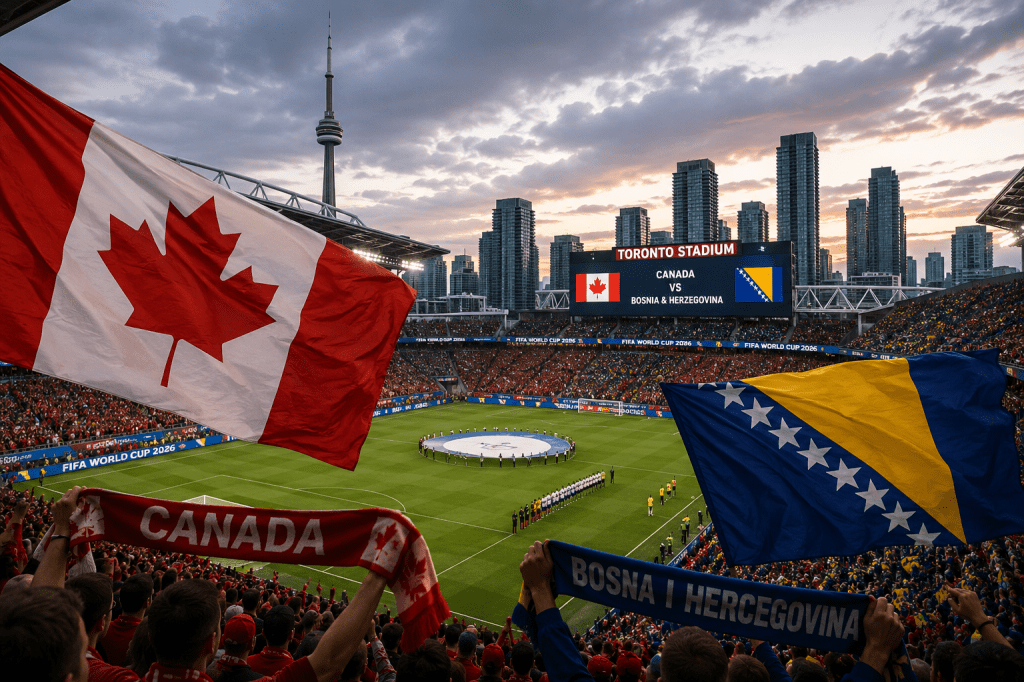
Some matches drift into existence like background noise, politely scheduled, quietly accepted, destined to be consumed and then forgotten in the churn of a long tournament.
This one doesn’t behave like that.
This one feels like it has been waiting, somewhere just beneath the surface of two completely different national stories, for the exact moment when those stories would be forced into the same room, under the same lights, with no way of avoiding each other.
And now, on June 12, 2026, inside a transformed Toronto Stadium, they finally are.
Game Context & Stakes: A Beginning That Feels Like a Verdict Rather Than an Introduction
Competition: FIFA World Cup 2026 – Group B (Opening Fixture)
Date: June 12, 2026
Venue: BMO Field, Toronto (Toronto Stadium for the tournament)
Kickoff: 3:00 p.m. ET
For Canada, this is not simply the first game of a group stage; it is an attempt to rewrite something that has sat unresolved for decades, a historical record that reads less like a statistic and more like an accusation.
Two appearances. No wins. No points. No real imprint left on the global stage.
And now, with the world arriving on their soil, that absence becomes impossible to ignore, impossible to disguise behind progress narratives or long-term development plans, because this is the moment where all of that investment, all of that structural growth, all of that belief in becoming something greater has to translate into something brutally simple.
A result.
Bosnia and Herzegovina, meanwhile, do not arrive with that same emptiness behind them, but with something that is arguably heavier, more complex, and far less predictable.
They arrive having forced their way back into relevance through sheer resistance, through a qualification path that demanded they survive rather than simply perform, that required them to endure penalty shootouts, emotional swings, and the kind of high-stakes moments where identity is tested as much as ability.
Their victory over Italy in the playoff final did not feel like an upset in the traditional sense.
It felt like a declaration that they had remembered who they were.
Which is why this match, positioned at the very beginning of Group B, already carries the emotional weight of something decisive, something that feels less like an opening chapter and more like a turning point, especially when you consider that Switzerland loom as the likely group winners, steady and efficient in a way that suggests they will control their own path.
That leaves Canada and Bosnia staring directly at each other, knowing that this is the moment that will likely define who escapes the group and who is left chasing something that might already be slipping away.
A Connection That Exists Entirely Off the Pitch, and Yet Feels Impossible to Ignore Once You See It
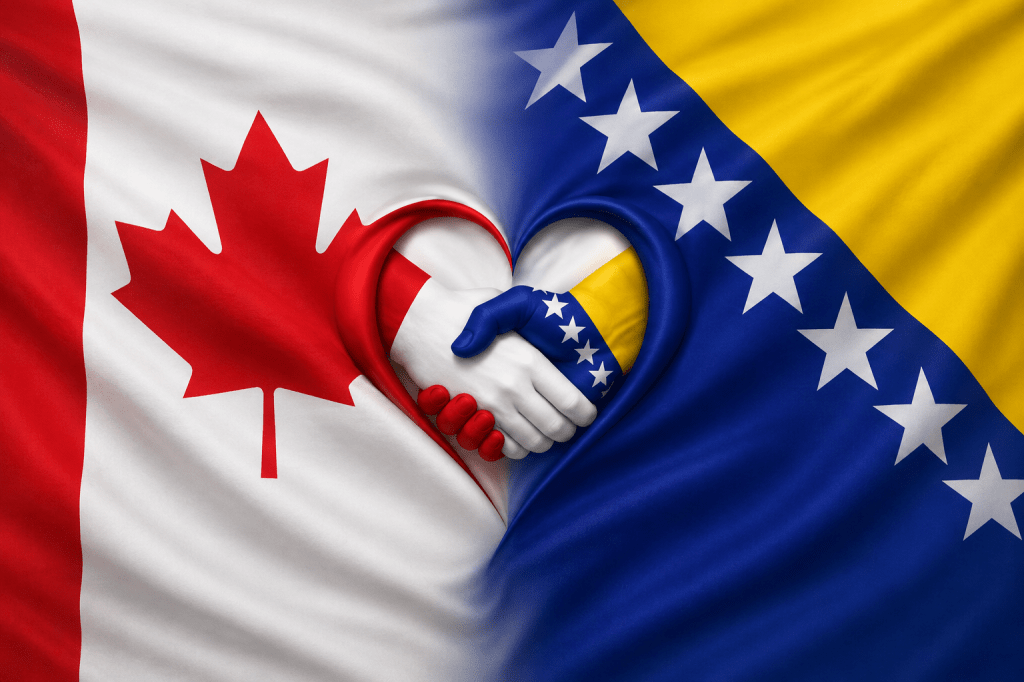
If you were to trace the footballing connections between Canada and Bosnia and Herzegovina, you would find almost nothing of substance, no meaningful player exchanges, no shared coaching philosophies, no overlapping developmental pathways that might suggest a deeper relationship between the two systems.
They have grown in isolation from one another, shaped by entirely different footballing ecosystems that rarely intersect and, until now, have had no real reason to.
Canada’s structure is modern, corporate, deliberately engineered through MLS affiliations, academy systems, and a clear attempt to build a sustainable footballing identity that aligns with global trends.
Bosnia’s pathway is fragmented, scattered across borders, dependent on exporting talent into Europe’s leagues, where players are refined, hardened, and then returned to the national team as finished products forged elsewhere.
On the surface, there is no bridge.
But step away from football, and suddenly the absence disappears.
Because Toronto does not just host this match.
It holds it.
The Bosnian diaspora in the Greater Toronto Area is not a minor subplot or a background detail; it is a central pillar of what this game will feel like, a living, breathing connection between the two nations that transforms the stadium into something far more complex than a simple home venue.
These are families who arrived during the 1990s, not as migrants chasing opportunity, but as refugees fleeing war, carrying with them stories that do not fade, memories that do not soften, and identities that do not neatly dissolve into a new national context.
And now, decades later, their children stand in a space that does not offer easy answers.
They are Canadian in upbringing, in language, in daily life.
But they are Bosnian in memory, in heritage, in the stories that shaped their families long before they were born.
Which means that when this match begins, the question of allegiance becomes something deeply personal, something that cannot be resolved through logic or loyalty alone.
It becomes a matter of identity.
Histories That Refuse to Stay in the Past, and Instead Walk Directly Onto the Pitch
Bosnia and Herzegovina do not arrive at this World Cup as a team detached from their history.
They arrive as a team that carries it, visibly, audibly, and emotionally, in ways that are impossible to separate from their footballing identity.
The war of the 1990s is not a distant chapter; it is a defining force that continues to shape the nation’s sense of self, internal tensions, and external perceptions.
And within that context, players like Edin Džeko become more than just athletes.
They become conduits.
Džeko’s story is not simply one of longevity or technical ability; it is one of survival, of growing up in a city under siege, of losing friends, of carrying those memories into a career that has spanned continents but never fully escaped its origins.
When he dedicated Bosnia’s qualification to those who did not survive, it did not feel like a symbolic gesture.
It felt like a continuation of something unfinished.
Canada’s relationship to that history is different, quieter, but no less significant.
Canadian peacekeepers were present during the conflict, witnessing the reality of what was happening on the ground, and in the years that followed, Canada became a place of refuge, a country that absorbed thousands of Bosnians into its multicultural framework.
The result is a connection that does not exist in footballing records but exists deeply in human terms.
This match, then, becomes something more than a contest between two teams.
It becomes a meeting between a nation that endured trauma and a nation that helped provide escape from it.
Infrastructure vs Instinct: Two Opposing Models of Football Development Colliding in Real Time
The transformation of BMO Field into a World Cup-ready venue is not just a logistical upgrade; it is a statement of intent, a visible demonstration of Canada’s commitment to becoming a serious footballing nation.
The expansion to 45,000 seats, the installation of new technology, the creation of a pristine playing surface, all of it contributes to a sense that Canada is building something deliberately, carefully, and with significant financial backing.
It is the architecture of ambition.
Bosnia, by contrast, operate within a completely different reality.
Their domestic infrastructure lacks the same level of investment, their league does not command global attention, and their development systems are far less centralized.
And yet, despite these limitations, they continue to produce players capable of competing at the highest levels of European football.
This contrast is not simply about money.
It is about philosophy.
Canada is attempting to construct success from the outside in, to build the conditions that will eventually produce consistent results.
Bosnia has developed success from the inside out, relying on individual resilience, cultural identity, and an ingrained understanding of the game that cannot be easily replicated through investment alone.
Toronto on Matchday: A City Split Between Two Rhythms That Refuse to Sync
The atmosphere surrounding this match will not be defined by a single narrative or a unified sense of occasion.
Instead, it will feel like two different energies colliding in the same space, each carrying its own rhythm, its own expectations, and its own understanding of what football means.
For Canadian fans, this is a moment of emergence, a chance to participate in something that feels new, exciting, and full of possibility, a step forward in the evolution of the sport within the country.
The rituals are still forming, the intensity still building, the identity still taking shape.
For Bosnian supporters, particularly those within the diaspora, this is something entirely different.
It is not new.
It is not tentative.
It is deeply ingrained.
The noise will not be polite or measured; it will be relentless, emotional, and often overwhelming, driven by a connection to the team that is rooted in history rather than novelty.
The contrast will be visible in every aspect of the matchday experience, from the streets around the stadium to the stands themselves, where the visual spectacle of a Canadian “Red Out” will be challenged by pockets of Bosnian blue that refuse to be drowned out.
The Cultural Thread That Quietly Connects Them
There is a moment, outside of football, where these two nations have already intersected in a way that feels both subtle and significant.
The Cellist of Sarajevo, a work by a Canadian author, captures the experience of living through the siege of Sarajevo, translating a deeply specific historical event into something universally understood.
It is a reminder that connection does not always require shared systems or direct interaction.
Sometimes it exists through storytelling, through the ability to recognise humanity in experiences that are geographically distant but emotionally familiar.
The Match: Where Narrative Gives Way to Reality
All of the cultural, historical, and emotional context eventually compresses into something far more immediate once the game begins.
And in this case, the football itself presents a fascinating, and potentially volatile, clash of styles and circumstances.
Injury Crisis: A Game That May Be Decided by Who Is Able to Stand, Not Just Who Is Able to Play
Both teams enter this match with significant injury concerns that threaten to reshape their tactical approaches and limit their options in critical areas of the pitch.
Canada’s defensive issues are particularly severe, with Alphonso Davies recovering from a hamstring tear, Moïse Bombito dealing with the aftermath of a fractured tibia, and Alistair Johnston struggling with fitness concerns.
The midfield is also affected, with Stephen Eustáquio not yet fully recovered, creating uncertainty in a system that relies heavily on coordination and intensity.
Bosnia’s situation is more focused but equally impactful.
Džeko’s shoulder injury places their entire attacking structure in doubt, as his presence, even in a limited capacity, fundamentally alters how they approach the game.
If he is unable to start, Bosnia lose their primary outlet, their focal point, and their most experienced figure.
If he plays, he does so under physical constraints that may limit his effectiveness but not his influence.
Form and Function: Momentum That Feels Uneven, and Confidence That Feels Conditional
Canada’s recent performances suggest a team that is still searching for consistency, particularly in attacking situations where their high-energy approach has not consistently translated into clear-cut chances or goals from open play.
Their reliance on penalties, particularly through Jonathan David, highlights a lack of fluidity that could become problematic against a disciplined defensive opponent.
The introduction of Marcelo Flores offers a potential solution, adding creativity and unpredictability to a system that has at times felt overly structured.
Bosnia’s form, meanwhile, is less about consistency and more about resilience.
Their qualification campaign demonstrated an ability to survive difficult situations, to remain composed under pressure, and to capitalise on limited opportunities.
They are comfortable in chaos, a trait that could prove decisive in a match where margins are likely to be extremely fine.
Tactical Clash: When Urgency Meets Patience, and Only One Can Dictate the Tempo
The fundamental tactical dynamic of this match is relatively clear.
Canada will attempt to impose a high-tempo, pressing game, seeking to disrupt Bosnia’s structure early and create scoring opportunities before the match settles into a slower rhythm.
Bosnia will attempt to do the opposite, sitting deep, maintaining defensive discipline, and waiting for moments to exploit space on the counterattack or through set pieces.
This creates a situation where the first goal becomes disproportionately important.
If Canada score early, they can force Bosnia out of their comfort zone, opening spaces and allowing their pace to become a decisive factor.
If Bosnia withstand the initial pressure, the game begins to shift in their favour, as frustration builds and Canada’s attacking patterns become increasingly predictable.
There is a phrase in Bosnian that captures this tension perfectly:
“Prošao zadnji voz.”
The last train has passed.
For Canada, that moment may arrive if they fail to convert early dominance into a tangible advantage.
Džeko: The Constant in a Match Full of Variables
At the centre of Bosnia’s approach, regardless of formation or personnel, remains Edin Džeko, a player whose influence extends beyond measurable contributions and into the psychological fabric of the game itself.
His ability to hold up play, to win aerial duels, and to create opportunities through positioning and awareness makes him a uniquely valuable asset, particularly in a system that prioritises efficiency over volume.
There is another phrase that lingers here:
“Zatvarati guzicom vrata.”
To close the door carelessly, to leave something behind without respect.
Džeko does not approach football in that way.
He does not leave moments unfinished.
And if this tournament represents one of his final appearances on the global stage, it is unlikely that he will allow it to pass without imprinting himself upon it.
Odds, Expectations, and the Reality of a Game That Refuses to Be Simplified
Statistically, Canada holds a slight advantage, driven largely by home support and squad depth, with predictive models suggesting a narrow edge in probability.
However, the projected scoreline of 1–0 reflects the underlying reality of the matchup, which is that this is likely to be a tightly contested, low-scoring game where individual moments carry disproportionate weight.
Final Reflection: A Match That Builds Its Meaning in Real Time
There is no historical framework to fall back on here, no established narrative to guide interpretation or expectation.
This match will create its own context, its own significance, and its own emotional resonance as it unfolds.
Canada will see in it an opportunity to become something they have not yet fully realised.
Bosnia will see in it a continuation of something they have fought hard to preserve.
And when the final whistle blows, whatever the outcome, it will not feel like the beginning of a tournament.
It will feel like a moment that defined one.
Where is Canada vs Bosnia and Herzegovina being played at the 2026 FIFA World Cup?
2026 FIFA World Cup group-stage match between Canada men’s national soccer team and Bosnia and Herzegovina national football team will take place at BMO Field, officially branded as Toronto Stadium during the tournament. The venue was expanded and modernised ahead of the World Cup and is expected to host around 45,000 supporters for the June 12, 2026 fixture.
Why is the Bosnia and Herzegovina diaspora in Toronto important for this match?
The Bosnian community in Toronto is expected to shape the atmosphere around the game significantly. Thousands of Bosnian families settled in Canada after the 1990s war, particularly in the Greater Toronto Area, meaning many supporters attending the match will have emotional and family ties to both nations. That creates a rare World Cup atmosphere where identity and heritage become part of the spectacle.
Who are the key players to watch in Canada vs Bosnia and Herzegovina?
For Canada men’s national soccer team, much attention will fall on Jonathan David, Marcelo Flores, and the fitness of Alphonso Davies and Stephen Eustáquio. Bosnia and Herzegovina’s focal point remains Edin Džeko, whose experience, hold-up play, and leadership remain central to the team’s identity, even as injury concerns loom ahead of the tournament opener.




 doragon sports
3 responses to “The Mirror on Lake Ontario: Canada vs Bosnia and Herzegovina and the Night That Refuses to Sit Still”
[…] Club América Femenil vs Gotham FC in the 2026 Concacaf W Champions Cup semifinal takes place on Wednesday, May 20, 2026, at 7:30 PM ET. Broadcast availability varies by region, but the tournament is typically streamed through Concacaf’s official platforms and selected sports broadcasters in the United States, Mexico, and Canada. […]
LikeLike
[…] Alberta threatening a referendum on whether to remain in Canada, the partnership suddenly felt fundamentally unstable at constitutional level. Too many competing […]
LikeLike
[…] Alberta threatening a referendum on whether to remain in Canada, the partnership suddenly felt fundamentally unstable at constitutional level. Too many competing […]
LikeLike