When the last thread refuses to snap
Some stories end quietly.
Vissel Kobe didn’t. They unravelled under pressure, their silk stretched too thin in a place that demanded something else. And with that, Japan’s most refined expression of control disappeared from the board.
Which leaves this.
FC Machida Zelvia.
Not the elegant answer. Not the obvious one. The stubborn one.
The final thread.
Because if there is going to be any disruption—any resistance—any interruption to the script that seems quietly pre-written, it will have to come from them.
A Semi-Final That Doesn’t Sit Quite Right
Let’s begin with the setting, because it shapes everything.
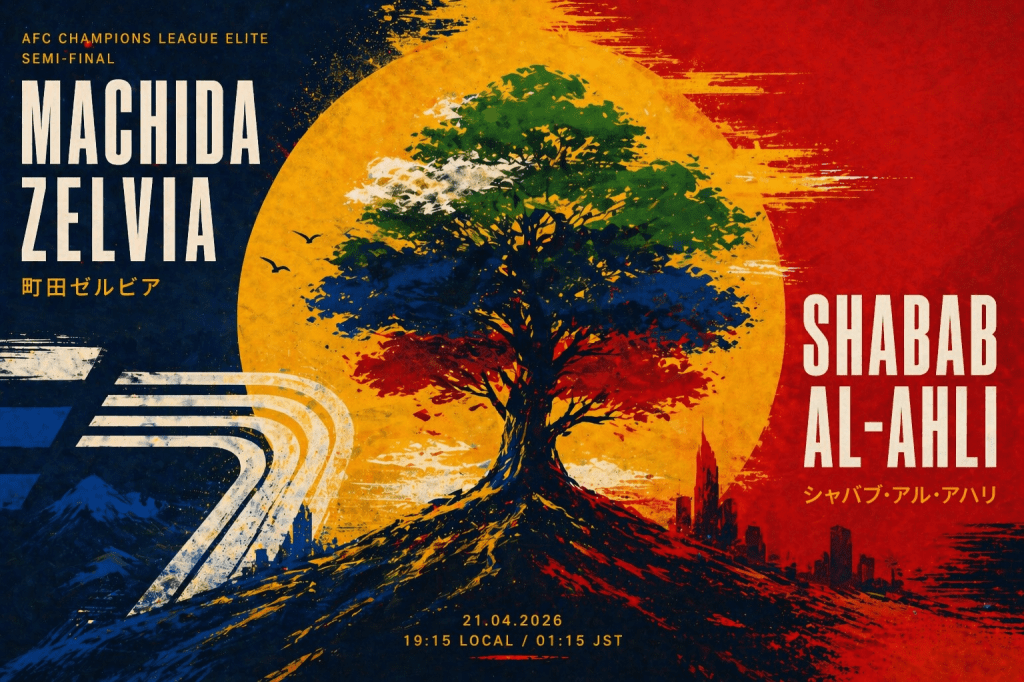
Prince Abdullah Al-Faisal Stadium. Jeddah. One leg. One night.
Another “neutral” stage that feels anything but.
A late venue switch. A reduction in capacity. A shift in rhythm just 48 hours before kickoff. The kind of administrative turbulence that doesn’t break teams—but it nudges them. Off balance. Slightly uncomfortable. Slightly reactive.
And Machida? They don’t thrive in noise. They thrive in control.
So naturally, the game has been stripped of it.
From Spring Air to Heavy Heat
April in Machida, in the Tokyo outskirts, feels like a soft reset.
Mild temperatures hovering around 19–22°C. Evenings that cool just enough to keep the lungs fresh. Cherry blossoms drifting through the air like football forgot it was supposed to be serious. Rain arrives, but gently—more a rhythm than a disruption.
It’s a climate that allows structure to breathe.
Now step into Jeddah.
Thirty degrees at kickoff. Air that doesn’t move so much as sit. Eleven hours of sunlight baked into the pitch long before the first whistle. Even at night, the heat doesn’t leave—it lingers, pressing into the game like an extra opponent.
For Shabab, it’s familiar. Manageable. Expected.
For Machida, it’s something else entirely.
Every sprint costs more. Every press shortens. Every moment of hesitation expands.
And yet—this is the stage they’ve been handed.
The Teacher Who Refused to Stay Small
At the center of it all stands Go Kuroda.
Not a product of elite academies. Not a polished name passed around European dugouts. A high school coach. Twenty-six years shaping teenagers, building habits, teaching discipline in places where nobody was watching.
And now? A continental semi-final.
Across from him: Paulo Sousa. A man shaped by elite dressing rooms, Champions League medals, the full weight of European footballing aristocracy.
It reads like fiction.
But the pitch doesn’t care about resumes.
It cares about clarity.
And Machida have that in abundance.
The Zelvia Machine
They are not here to entertain you.
Machida Zelvia are a contradiction to modern football’s obsession with control through possession. They don’t want the ball. They want the space you leave behind it.
Forty-five percent possession in the J1 League. Bottom tier. And yet, the fewest defensive entries conceded. The tightest lines. The smallest margins.
This is football played with restraint.
At the back, Kosei Tani operates like a final lock on a reinforced door. An 86.1% save rate. Six clean sheets. Numbers that don’t just suggest form—they suggest refusal.
In front of him, Gen Shoji, 33 years old, reading space like it owes him answers. Positioning over pace. Anticipation over reaction.
And when pressure builds?
They go long.
Tete Yengi—193cm of disruption. Not just a striker, but an exit strategy. A way out when the walls start to close in.
Then comes Yuki Soma, the spark. The one moment where Machida allow themselves something close to expression. Four goals. Two assists. Efficiency, not excess.
The Opposition: Volume Without Restraint
Shabab Al-Ahli Dubai FC arrive differently.
They don’t manage games. They flood them.
Twenty goals in the tournament. Two per match. Attacking patterns that lean heavily on individual bursts—moments rather than systems.
Guilherme Bala stretches defences until they fracture.
Sardar Azmoun needs half a yard to finish what others need three for.
Federico Cartabia connects it all, a link between chaos and consequence.
But here’s the trade-off.
They concede. Regularly. 1.6 goals per game.
For all the noise, there are gaps. For all the movement, there are moments where structure dissolves.
And Machida? They live in those moments.
The Fatigue Equation
There’s another layer quietly shaping this.
Shabab are tired.
Four matches in eleven days. One of them stretching to 120 minutes in a sandstorm. Bodies pushed beyond rhythm, into survival mode.
Machida arrive fresher. Calmer. Their route cleaner, their legs lighter.
Kuroda downplays it. Of course he does.
But fatigue doesn’t negotiate. It reveals itself eventually—in a mistimed press, a late recovery run, a decision made half a second too slow.
Against most teams, that might be manageable.
Against Machida, it can be fatal.
Steel After Silk
Kobe were artistry. Flow. A slow suffocation through control.
Machida are something else.
They are steel.
Rigid. Cold. Unforgiving.
They don’t ask if you want to play. They decide how the game is played—and then dare you to survive it.
And now, after Kobe’s fall, they carry something heavier.
Expectation? Not quite.
Responsibility.
Because if there is to be any interruption to what feels like an increasingly one-directional narrative, it has to come from them.
Threads to Watch
- Shoji vs Azmoun: Positioning against instinct. One misread changes everything.
- Midfield Compression: Can Machida shrink the game enough to suffocate transitions?
- Fatigue Timing: When does Shabab’s schedule finally catch them?
- Set Pieces: Machida’s 31.9% shot rate from dead balls isn’t a stat—it’s a weapon.
What Each Team Must Do
Machida Zelvia
- Stay compact. Always. No emotional deviation
- Use Yengi as the release under pressure
- Target defensive lapses ruthlessly—no wasted transitions
Shabab Al-Ahli
- Move the ball quickly before structure settles
- Isolate wide areas and force 1v1s
- Score early—because patience is not their strength
Final Word
This isn’t the match most expected.
But it might be the one that matters more.
Because when the refined approach falls, what remains is something harder. Something less beautiful. Something that doesn’t bend easily.
Machida Zelvia are not here to decorate the competition.
They are here to disrupt it.
And if they succeed—if they drag this game into their world, into their tempo, into their suffocating structure—then this won’t just be a victory.
It will be a fracture in the script.
Where is Machida Zelvia vs Shabab Al-Ahli being played?
At Prince Abdullah Al-Faisal Stadium in Jeddah, Saudi Arabia.
Why is the venue controversial?
A late change and single-leg format create questions around competitive balance and preparation consistency.
Who are the key players for Machida Zelvia?
Kosei Tani, Gen Shoji, Tete Yengi, and Yuki Soma.
What is Machida’s tactical style?
Low possession, compact defensive structure, and efficient counter-attacking with strong set-piece threat.
What advantage does Machida have?
Better rest and physical freshness compared to their opponent’s congested schedule.
What is at stake?
A place in the AFC Champions League Elite final—and the chance to challenge for their first continental title.