There is a version of this derby that exists in highlight reels. Colour, noise, velocity. A clean rivalry.
And then there is the version that arrives this weekend.
Messier. Heavier. Defined less by form and more by what each side is trying not to become.
For Yokohama F. Marinos and Kawasaki Frontale, Matchweek 11 is not simply about points in a compressed format that distorts everything around it. It is about cognitive load. About how teams behave when the context becomes too loud to ignore.
The table tells you where they are. It does not tell you how they are thinking.
Outcome Pressure in a Compressed League
The absence of draws in this format is not a quirk. It is a psychological accelerant.
Every match must resolve. Every performance must land somewhere definitive. There is no middle ground to hide in, no soft landing for uncertainty. You either accumulate or you expose yourself.
Marinos sit ninth with nine points. Frontale fifth with fourteen. On paper, the gap is manageable. In practice, it has created two distinct mental states.
Marinos are in pursuit. Their thinking, by necessity, is more expansive. There is less to protect, fewer illusions to maintain. Risk becomes tolerable, even necessary.
Frontale, meanwhile, exist in a more ambiguous zone. Not secure, not desperate. Close enough to relevance that the cost of failure feels tangible. That is where decision making becomes complicated.
The framework is familiar. Daniel Kahneman and Amos Tversky described it decades ago through Prospect Theory. When individuals perceive themselves to be ahead, even marginally, they become more sensitive to loss than to gain. Choices narrow. Risk appetite contracts.
Football teams rarely cite academic papers. They embody them constantly.
The Residue of March 22
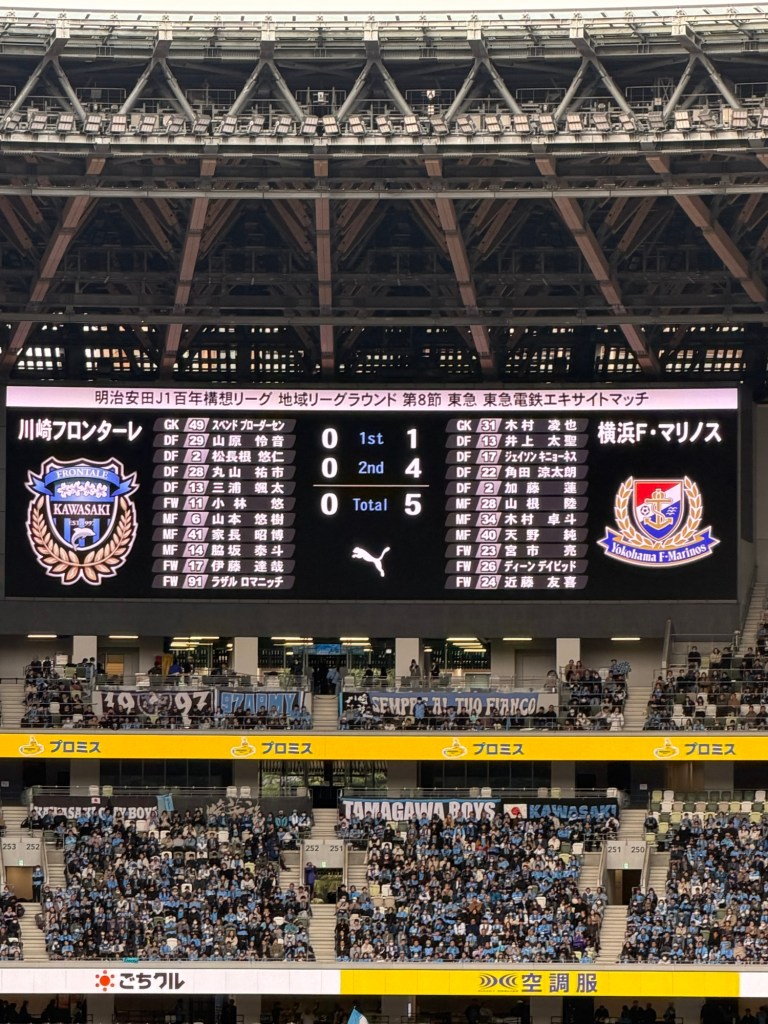
The 5-0 result at the National Stadium has not settled into history. It is still active.
For Marinos, it offered a temporary release. A moment where execution aligned with intent. But even that performance carried an interruption that continues to shape this rematch.
Daiya Tono’s injury did more than remove a player. It altered the internal logic of the team. Systems built around him had to be reconfigured mid-stream. The emotional response, the “for Daiya” narrative, provided short term clarity but long term instability.
Into that space stepped Jun Amano.
His performance that day was not simply productive. It was adaptive. He occupied the spaces Tono once controlled, but interpreted them differently. Less direct, more elastic. Slowing phases of play before accelerating them again.
The question now is whether that was a one off realignment or the beginning of a new structural identity.
Because without Tono, Marinos are not just missing output. They are missing a reference point.
Frontale and the Burden of Response
For Frontale, the same match produced a different kind of residue.
Public criticism. Internal doubt. A sudden need to explain themselves.
Manager Shigetoshi Hasebe is not dealing with tactical failure alone. He is managing perception. How a team responds after a result that challenges its credibility.
Yu Kobayashi’s post match comments framed it clearly. This was not about a bad day. It was about whether the team could confront the implications of that performance.
That framing matters. It shifts focus from execution to identity.
Up front, Erison remains statistically reliable. Six goals, consistent movement, a clear focal point. Behind him, Yasuto Wakizaka provides structure in possession, attempting to maintain rhythm in a system that has shown a tendency to fragment under pressure.
But the key variable may be Shunsuke Hayashi.
His experience in the previous meeting was instructive. Targeted repeatedly, forced into defensive decisions under stress, his performance illustrated how quickly confidence can be eroded in this fixture.
The adjustment now is not technical. It is cognitive. Can he process similar situations without defaulting to the same responses.
Tactical Systems and Their Limits
Structurally, little changes.
Marinos will likely continue with a 4-2-1-3 under Hideo Oshima. Frontale with a 4-2-3-1.
But the interest lies in how these systems behave under strain.
Marinos’ high press is conceptually aggressive but inconsistently executed. When coordinated, it disrupts build up effectively. When mistimed, it creates transitional exposure that opponents can exploit quickly.
Frontale’s build up play is designed to control tempo. Yet under sustained pressure, it often collapses into direct clearances, bypassing midfield entirely. That shift is not strategic. It is reactive.
The statistical patterns reinforce this.
Marinos are most productive early in the second half, a period where energy levels reset and concentration gaps emerge. Frontale score a disproportionate number of late goals, suggesting a capacity to capitalise on fatigue or reduced defensive organisation.
These trends are not incidental. They reflect how each team manages the psychological phases of a match.
Corporate Context and Environmental Noise
Beyond the pitch, the influence of Nissan Motor Corporation cannot be ignored.
Financial instability introduces uncertainty that extends beyond ownership structures. It affects perception. Supporter confidence. The broader narrative surrounding the club.
For players, this manifests as environmental noise. Not always explicit, but present. A background awareness that the institution itself is in flux.
The term Radappertization has been used to describe this phase. A gradual reshaping, where continuity is replaced by ambiguity.
In practical terms, it can influence behaviour in subtle ways. Hesitation in possession. Reduced risk taking. An underlying sense that mistakes carry greater consequence.
Stadium Dynamics and Feedback Loops
Nissan Stadium is large enough to absorb momentum and amplify it simultaneously.
At capacity, it creates a feedback loop. Positive actions generate noise, which reinforces confidence, leading to further positive actions.
The inverse is also true.
Early errors can shift the atmosphere quickly. Sound becomes fragmented. Support turns conditional. Players, consciously or not, adjust their decision making in response.
This is where concepts like clinomania become relevant, not in a literal sense but as a metaphor for behavioural drift. A tendency to retreat into safer options, to minimise exposure rather than engage with risk.
In a derby, that instinct is often punished.
Decision Making Under Stress
The central theme of this match is not quality. It is clarity.
Which team is able to process the context without being overwhelmed by it.
Frontale’s challenge is to avoid overcorrection. To respond to previous failure without becoming overly cautious or excessively reactive.
Marinos’ challenge is different. To maintain the freedom associated with being in pursuit, without allowing structural weaknesses to undermine that approach.
In both cases, the margin for error is reduced by the competition format itself.
There is no draw to settle into. No neutral outcome.
Every decision carries consequence.
Conclusion: Not Just a Derby
This fixture will be framed as a rivalry. Local identity. Historical tension.
Those elements remain.
But underneath, this is a study in applied psychology.
How teams behave when they are aware of what is at stake.
How they manage the tension between risk and control.
How they interpret recent experience and decide whether to adapt or persist.
The result will matter. The performance may matter more.
Because for both clubs, this is less about where they are in the table and more about what they are becoming.
What is Yokohama F. Marinos famous for?
Yokohama F. Marinos are known for their attacking football philosophy, strong corporate heritage, and consistent presence at the top level of Japanese football. They have a reputation for technical, possession based play and a passionate fanbase built around their iconic tricolour identity.
Who owns Yokohama F. Marinos?
The club is primarily owned by Nissan Motor Corporation, with additional backing from City Football Group, which brings international expertise and strategic alignment with other global clubs.
Where is Yokohama F. Marinos?
They are based in Yokohama and play their home matches at Nissan Stadium, one of the largest football venues in Asia.
What’s the average attendance at Yokohama F. Marinos games?
Average attendance typically ranges between 25,000 and 30,000 spectators, with significantly higher figures for major fixtures such as local derbies, where crowds can approach the full capacity of Nissan Stadium.