
There are matches that unfold like stories. And then there are matches that feel like they were always waiting to happen, buried somewhere deep in the soil of the game itself, patient, inevitable, humming with quiet violence.
This is the latter.
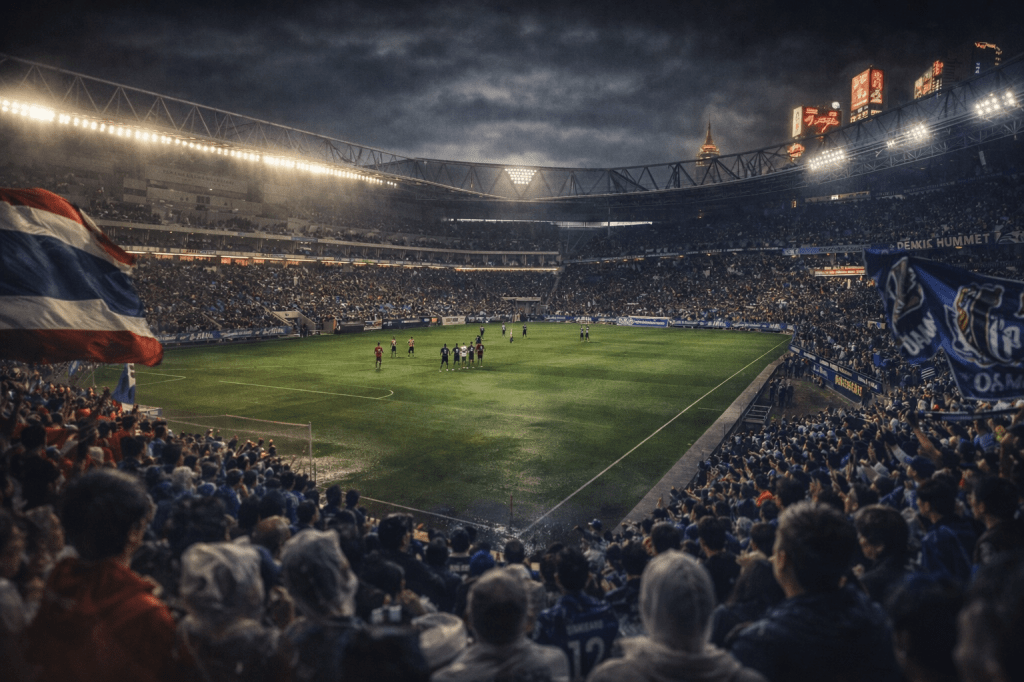
On Wednesday night, inside the vast concrete lungs of Rajamangala National Stadium, football does not merely return. It mutates. It stretches into something heavier, something that clings to the skin like Bangkok’s humid air and refuses to let go.
True Bangkok United arrive carrying a 1-0 lead that feels both delicate and defiant. A single goal, yes. But also a fracture in expectation. A moment in Japan that snapped rhythm, silenced logic, and introduced doubt into a machine that had not known how to stutter.
For Gamba Osaka, this is not just a semi-final second leg in the AFC Champions League Two. This is a reckoning. A question asked in a language they thought they had mastered.
And for True Bangkok United, it is something far more dangerous.
It is possibility.
The First Crack in Certainty
The first leg did not behave.
Seventy-four percent possession. Nineteen shots. Eighteen corners. Numbers that usually form the spine of inevitability. Yet Gamba Osaka left Japan with nothing but frustration stitched into their boots.
Bangkok United did not outplay them in the traditional sense. They endured them.
They bent but did not break. They absorbed wave after wave until Gamba’s pressure became something else entirely, something softer, something almost decorative. The kind of dominance that fills spreadsheets but empties scorelines.
And then came the moment. The penalty. The cool conversion. The silence.
That is the thing about football’s quieter revolutions. They rarely announce themselves. They simply happen, and suddenly the ground beneath the giants feels less stable.
Now the tie breathes differently.
Now Gamba must chase.
A Stadium That Isn’t Just a Stadium
Rajamangala will not feel like a neutral relocation. It will feel like a transformation.
Free admission. A call to the nation. A subtle but unmistakable shift from club football to something closer to collective identity. This is no longer just Bangkok United. This is Thailand stepping forward, asking to be seen, asking to be heard.
The stadium itself becomes an organism. A bowl of noise that does not rise in bursts but settles into a constant, pressing hum. The kind that lives behind your ears. The kind that distorts thought.
Gamba Osaka will walk into that.
Not just heat. Not just humidity. But a layered pressure that has nothing to do with tactics and everything to do with belonging.
And this is where caenogenesis begins to whisper.
Because what Bangkok United are attempting is not evolution. It is not gradual. It is not polite. It is abrupt, disruptive, almost unnatural in its timing. A leap forward that ignores the expected sequence.
A new thing, arriving before anyone is ready to name it.
The Unfinished Machine
Gamba Osaka remain, fundamentally, a force.
Under their German architect, their football is designed to suffocate. To compress space. To hunt the ball like it owes them something. The press is not just tactical. It is ideological.
But in the first leg, that machine misfired.
Not in effort. Not in structure. But in precision. The line-breaking passes never quite pierced. The movement between the lines felt hesitant, almost second-guessed. And when the chances came, they were handled with a kind of nervous urgency that betrayed something deeper.
A lack of calm.
Issam Jebali embodies that tension. A striker caught between belief and memory. The miss from six yards is not just a moment. It lingers. It follows. It replays itself in the quiet seconds before sleep.
He says it will be different this time. Kamahen, perhaps. No problem. A reset.
But football is rarely that forgiving.
Especially not in a stadium that feeds on hesitation.
The White Wall
If Gamba are a machine, Bangkok United are something more elemental.
A wall.
Not static, not passive, but alive. A shifting, breathing structure built on discipline and timing. Everton Goncalves stands at its center, a veteran who understands that defending is not about reacting but about anticipating collapse before it happens.
Alongside him, Philipe Maia becomes less a partner and more a mirror. Together they form a defensive pairing that does not just clear danger. They dissolve it.
In Japan, they survived eighteen corners. Eighteen invitations to chaos. And each time, they refused the narrative.
Now, in Bangkok, that wall will be reinforced by something intangible.
Belief.
Not the loud, performative kind. But the quiet, internal certainty that this might actually be happening.
That history is not something distant. It is something within reach.
The Weight of Time
For Teerasil Dangda, this is not just another match.
This is a closing chapter that refuses to close quietly.
At 37, he carries time differently. Every run, every touch, every decision is layered with the knowledge that these moments do not come infinitely. That there is an edge approaching.
And yet, there is something poetic in his presence here.
A veteran standing at the edge of history, not as a fading figure, but as a central one. A bridge between what Thai football has been and what it might become.
If Bangkok United cross the line, his name will not just be remembered.
It will be etched.
The Tactical Knife Edge
This match will not be played in midfield.
It will be decided in the penalty area.
Gamba Osaka will come forward relentlessly. Fullbacks high. Wingers stretching. Cross after cross delivered into a box that will feel increasingly crowded, increasingly claustrophobic.
Deniz Hümmet becomes the focal point. A physical presence designed to convert chaos into goals. But he will not operate in isolation. Jebali will hover, searching for second balls, loose moments, fractures in the structure.
And Bangkok will wait.
Not passively, but with intent. Every interception becomes a trigger. Every clearance an opportunity. The transition is not an afterthought. It is the weapon.
Muhsen Al-Ghassani understands this rhythm. He does not need many chances. He needs one. Maybe two.
And if they come, they must be taken.
Because against a team like Gamba, waste is not just inefficiency.
It is invitation.
Heat, Fatigue, and the Slow Collapse
There is a physical reality that cannot be ignored.
Bangkok in April does not negotiate.
It presses down. It drains. It turns sharp movements into heavy ones. It stretches minutes into something longer, something more demanding.
For a Gamba side already depleted, already patched together defensively, this becomes a test not just of structure, but of endurance.
The press requires energy. Relentless, sustained energy.
But what happens when that energy begins to fade?
When the distances between players grow just slightly wider. When the reactions become half a second slower. When the recovery runs lose their urgency.
This is where matches unravel.
Not in moments of brilliance, but in moments of fatigue.
Jarta and the Theatre of Defiance
There is a word that fits here. Jarta.
Not a word you will find in tactical manuals or post-match interviews. But it belongs to the feeling of defiance that sits just beneath the surface.
Bangkok United carry it.
A refusal to accept the expected script. A quiet rebellion against hierarchy. Against reputation. Against the idea that some teams are simply meant to progress.
Gamba Osaka, meanwhile, carry their own version.
A different kind of defiance. One rooted in restoration. In the need to reassert order. To correct what feels like an anomaly.
When these two forces meet, the game becomes something more than tactical.
It becomes ideological.
The Danger of Fanfaronad
There is a temptation, especially for teams chasing a deficit, to drift into fanfaronade.
To overcommit. To chase the spectacular rather than the necessary. To mistake urgency for chaos.
Gamba Osaka must resist that.
Because Bangkok United are waiting for it.
Every misplaced pass. Every overhit cross. Every moment where structure gives way to desperation. These are the cracks that counter-attacks are born from.
And in a match where a single goal can tilt everything, those cracks matter.
The Final Shape of the Night
This will not be a clean match.
It will not be elegant. It will not flow in neat patterns or predictable rhythms.
It will be messy. Fractured. Emotional.
There will be blocks that feel like goals. Clearances that feel like victories. Missed chances that echo louder than the crowd itself.
And somewhere within that chaos, the match will decide what it wants to be.
A comeback.
Or a coronation.
For Gamba Osaka, it is about forcing the story back into familiar territory.
For Bangkok United, it is about writing something entirely new.
Something that does not wait its turn.
Something that arrives early.
Something that changes the map.
Who is leading the AFC Champions League Two semi-final tie?
True Bangkok United leads 1-0 on aggregate after winning the first leg in Japan.
Where is the second leg being played?
The match is being played at Rajamangala National Stadium in Bangkok due to scheduling conflicts at True BG Stadium.
What does Bangkok United need to reach the final?
They need to avoid defeat. A draw or win will send them to the final.
What does Gamba Osaka need to qualify?
Gamba Osaka must win by at least one goal to force extra time, or by two goals to win outright.
Why is this match historically significant?
If Bangkok United qualifies, they will become the first Thai club to reach the AFC Champions League Two final.
What are the key tactical themes of the match?
Gamba Osaka will rely on high pressing and attacking width, while Bangkok United will focus on deep defensive structure and counter-attacks.
Which players could decide the game?
Deniz Hümmet and Issam Jebali for Gamba Osaka, and Muhsen Al-Ghassani and Everton Goncalves for Bangkok United.
How could weather impact the match?
The heat and humidity in Bangkok may reduce Gamba Osaka’s pressing intensity and favor Bangkok United’s more conservative approach.




One response to “The White Wall and the Black Tide: Bangkok’s Night of Becoming”
[…] doesn’t just play Japanese football. They curate […]
LikeLike