Some football clubs measure themselves against the teams around them.
Urawa Red Diamonds measure themselves against their own history.
That is both their greatest strength and their greatest burden.
Few clubs anywhere in Asia possess Urawa’s combination of financial muscle, continental pedigree and supporter culture. Three AFC Champions League titles. Eight Emperor’s Cups. Five league championships. Japan’s biggest football-specific stadium. The largest revenues the J.League has ever seen. When Urawa succeed, they elevate the profile of Japanese football itself.
Which made what followed all the more jarring. When they’ve so off the pace for many seasons now.
Cho Kwi-jae has not been appointed simply to improve results.
He has been hired to change the way Urawa play football.
Supporters should also be excited by the return of Ado Onaiwu, back after nine years away from the club, alongside exciting young forward Harumi Minamino, who arrives hoping to become the goalscorer Urawa have been searching for. Behind them, Matheus Sávio remains one of the league’s most gifted creative midfielders and the player most capable of turning Cho’s aggressive ideas into genuine chances.
This is no gentle evolution.
It is a complete reinvention.
Urawa Red Diamonds Transfers
Few clubs approached the summer needing change quite as urgently as Urawa.
The problems had become impossible to ignore.l
Maciej Skorża’s disciplined, defence-first approach had brought organisation, but it also left Urawa predictable. Too often they defended well enough to stay competitive without carrying enough attacking threat to consistently win matches. Away from home especially, they struggled to impose themselves.
Cho Kwi-jae demands the opposite.
His football revolves around relentless pressing, constant movement and attacking within seconds of winning possession. The transfer business reflects that philosophy almost perfectly.
Harumi Minamino arrives from Gamba Osaka carrying significant expectation. Still only 22, he offers the athleticism and direct running required to attack space immediately after turnovers. Ado Onaiwu’s emotional return provides something Urawa have lacked for several seasons: an experienced striker capable of leading the line while understanding exactly what representing this club demands.
Elsewhere, defenders Kotaro Hayashi and Mitsuki Fukui strengthen the back line, while Kota Mizunuma adds further energy in midfield. Young prospects including Shuta Sasa, Yoshiaki Arai and Eito Arai underline the club’s commitment to becoming younger, quicker and more physically capable.
The departures tell an equally important story.
Long-serving figures such as Takahiro Sekine, Yusuke Matsuo, Kai Shibato and Hiroki Abe have all moved on, while experienced internationals Shoya Nakajima and Isaac Kiese Thelin were released. Fifteen players departed during the rebuild.
That is not squad trimming.
That is cultural reset.
There remain unanswered questions. Centre-back depth still appears worryingly thin, particularly for a side intending to defend forty yards from its own goal. Japanese media have linked Urawa with several defenders and forwards, but until further arrivals are confirmed those remain speculation rather than certainty.
Recruitment, however, feels coherent.
Every significant arrival appears selected because they fit Cho Kwi-jae’s football rather than because of reputation alone.
Key Players
Harumi Minamino
Every rebuild needs a face.
Minamino could become this one’s.
Arriving from Gamba Osaka at just 22, he represents exactly the profile Cho Kwi-jae wants: athletic, aggressive and constantly threatening the space behind opposing defences. Rather than patiently waiting for opportunities to develop, Minamino’s game is built around creating them through movement and intensity.
That matters within the new tactical system.
Cho’s famous “10-second rule” demands immediate attacking after regaining possession. Few forwards suit that philosophy better than one willing to run first and ask questions later.
Success should not necessarily mean twenty goals.
If Minamino becomes the reliable attacking focal point Urawa lacked throughout 2025 and the transition season, his signing will already look inspired.
Matheus Sávio
Systems change.
Elite footballers often make those systems work.
Matheus Sávio remains the creative heartbeat of this squad and perhaps the player most likely to benefit from Urawa’s tactical transformation. Previously asked to operate within slower possession structures, he now receives permission to attack earlier, pass forward quicker and influence transitions far more frequently.
Everything should happen closer to the opposition goal.
His vision between the lines, ability to eliminate defenders with one pass and willingness to carry the ball through midfield make him indispensable if Cho’s aggressive philosophy is to succeed.
The challenge is consistency.
If Sávio dominates games often enough, Urawa immediately become contenders for the league’s upper reaches.
Expectations for Urawa Red Diamonds in 2026/27
Predicting Urawa feels unusually difficult this year.
The ceiling is exceptionally high.
So is the possibility of turbulence.
Cho Kwi-jae has inherited one of the deepest and wealthiest squads in Japanese football, but he has also inherited supporters whose patience has been exhausted. Seventh in 2025 was disappointing. Thirteenth during the Centennial transition season felt unacceptable. This is a football club where merely competing is never enough.
The biggest reason for optimism is tactical clarity.
For years Urawa often looked caught between identities, defending solidly without attacking boldly enough to truly frighten opponents. Nobody will accuse Cho’s side of lacking ambition. His relentless pressing, vertical attacks and insistence on creating chances within ten seconds of recovering possession should immediately make Urawa one of the league’s most entertaining teams.
Entertainment, however, does not guarantee balance.
Playing with such an aggressive defensive line places enormous responsibility on Danilo Boza, Kenta Nemoto and a centre-back unit that still appears lighter than ideal. One injury could significantly alter the entire tactical equation.
A realistic target feels somewhere between third and sixth.
Should everything click, Urawa possess enough quality to challenge for silverware once again. Should the defensive risks prove too great, another season of inconsistency cannot be entirely ruled out.
Football occasionally rewards bravery.
It also punishes it.
Few clubs will embody that tension quite like Urawa this season.
How Important Will Saitama Stadium 2002 Be?
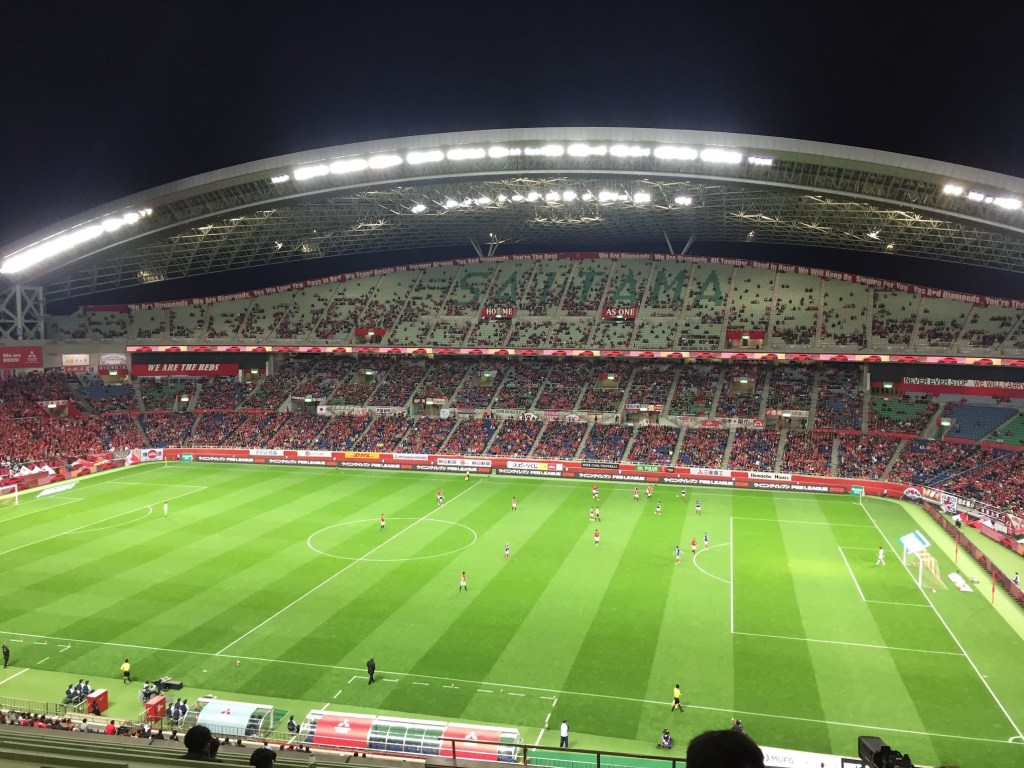
Some stadiums host football.
Saitama Stadium demands it.
Holding more than 63,000 supporters, it remains Japan’s largest football-specific stadium and arguably its most intimidating. Long before kick-off, thousands of supporters dressed almost entirely in red transform the surrounding concourses into something closer to a pilgrimage than a sporting event.
Then the singing begins.
The Curva Est orchestrates one of Asian football’s most celebrated atmospheres. Giant tifos stretch across entire stands. Flags ripple almost continuously throughout matches. Every chant carries the expectation that players will match the effort being poured down from the terraces.
Victory brings its own ritual.
Following every home win, players and supporters unite beneath raised scarves to sing “We are Diamonds,” one of Japanese football’s most recognisable post-match traditions.
The expectations are immense because the supporters invest immensely.
Even throughout disappointing campaigns, Urawa continued attracting crowds exceeding 37,000, comfortably the highest attendance figures in the country. Financial records may demonstrate the club’s commercial strength, but these supporters remain its greatest competitive advantage.
Rebuilding Saitama into a genuine fortress again may become one of Cho Kwi-jae’s biggest achievements.
Because home advantage here is not measured purely through results.
It is measured through belief.
Urawa Red Diamonds J.League 100 Year Vision League Review
Thirteenth.
For many clubs, survival would have represented relief.
For Urawa Red Diamonds, it represented something much closer to humiliation.
The Centennial transition season exposed the limitations of a side struggling to score consistently while gradually losing the confidence of its supporters. A painful penalty shootout defeat to FC Tokyo became the emotional breaking point, leading to extraordinary public meetings between club executives and supporters as frustrations spilled into the open.
There were still positives.
Shusaku Nishikawa continued proving that age remains little obstacle to elite goalkeeping, while Matheus Sávio consistently provided creativity within an otherwise inconsistent side.
Ultimately, though, the season became remembered less for performances than accountability.
At very few clubs in Japanese football would executives publicly answer supporter criticism quite so directly.
That tells you everything about the standards expected at Urawa.
How to Watch Urawa Red Diamonds in 2026/27
Supporters in Japan can continue following Urawa throughout the season on DAZN, which remains the primary broadcaster for J.League football.
International supporters have never had greater access either. Selected fixtures are regularly streamed free through the official J.League YouTube channel, although availability varies depending on territory and weekly selections.
If you are discovering Japanese football for the first time, Urawa offer one of its grandest introductions.
Not simply because they win.
Because they matter.
Watch Saitama Stadium disappear beneath thousands of red flags. Watch Cho Kwi-jae’s players sprint forward the instant possession changes hands. Watch a derby where every tackle feels loaded with decades of history. Watch forty thousand people remain long after full-time simply to sing together.
Some clubs acquire supporters.
Others absorb them.
Urawa Red Diamonds have been doing exactly that for generations.