
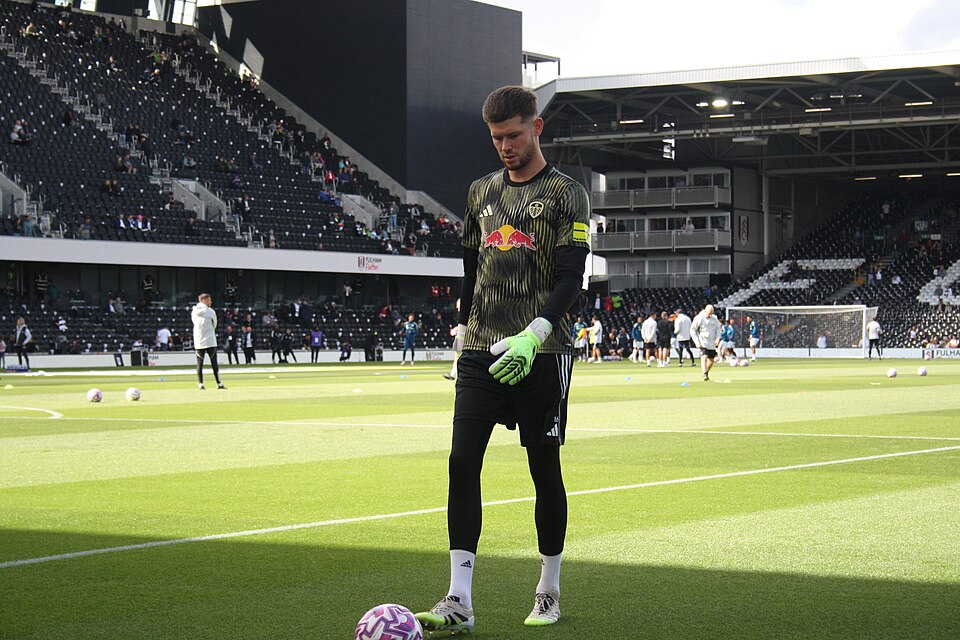
The ball bounced once.
Awkwardly.
Not violently. Not spectacularly. Just enough.
Alan Browne’s stoppage-time effort at Sunderland in October 2024 was neither a thunderbolt nor a piece of genius. It arrived with all the menace of a shopping trolley rolling gently downhill. Yet somehow it slipped through Illan Meslier’s grasp and into the net.
Leeds United had thrown away two points.
Meslier left the pitch in tears.
For many supporters, the verdict was already written.
For others, it was simply the latest entry in a growing collection.
Football is very good at reducing long careers into short clips. One mistake becomes a reputation. One photograph becomes a legacy. One bounce becomes a summary of seven years.
Illan Meslier knows this better than most.
The Goalkeeper Nobody Expected: Meslier
It is worth remembering where this story began.
Because many people no longer do.
When Leeds signed Meslier from Lorient in 2019, he was not arriving as Gianluigi Buffon reborn. He was a teenager with potential, a loan signing from the French second tier who barely spoke English and looked about twelve years old.
The expectation was modest.
The reality was extraordinary.
Within months he had displaced Kiko Casilla and become the goalkeeper of a promotion-winning side. Soon after that, he became the youngest goalkeeper in Premier League history to reach ten clean sheets.
Those moments happened. They are real.
They have simply been buried beneath everything that followed.
Football supporters tend to remember disappointment more vividly than competence. A goalkeeper can make eight saves and concede once. The goal will dominate the conversation.
Meslier spent years learning this lesson repeatedly.
Marcelo Bielsa’s Giant Experiment
Under Marcelo Bielsa, Meslier looked like the future.
Not perfect.
Not finished.
But the future.
Bielsa’s football resembled a Mechagodzilla constructed from caffeine, spreadsheets and stubbornness. It moved forward relentlessly, occasionally ignoring obvious structural concerns because momentum itself was considered a solution.
For a young goalkeeper, it was terrifying and exhilarating.
Meslier faced shots.
Lots of them.
He was asked to sweep behind an aggressive defensive line, distribute under pressure and rescue situations that should never have existed in the first place.
And often he did.
The famous performance at Anfield in October 2022 remains perhaps the finest display of his career. Nine saves. Mohamed Salah frustrated. Darwin Núñez frustrated. Roberto Firmino frustrated. Liverpool beaten.
Those are the moments people pretend to forget.
Not because they didn’t happen.
Because what happened afterwards became louder.
Exposure Becomes Habit
The problem with constantly rescuing a team is that you eventually start to believe it is your responsibility.
Meslier later admitted as much himself.
He spoke openly about being overexposed and trying to do too much. He sought help from a psychologist. He discussed confidence. He discussed pressure.
To be fair, this should probably have earned more respect than it did.
Instead, it often became another talking point.
As Leeds lurched through managerial changes, tactical confusion and defensive instability, Meslier remained.
Bielsa.
Marsch.
Gracia.
Allardyce.
Different instructions. Different systems. Different philosophies.
Same goalkeeper.
The data became increasingly alarming.
His post-shot expected goals numbers collapsed. The goals conceded mounted. The spectacular saves remained, but they were increasingly accompanied by moments that left everybody staring at each other in confused silence.
This tends to happen when confidence starts leaking.
Goalkeeping is a strange profession.
A striker can miss three chances and still score the winner.
A goalkeeper can play brilliantly for 89 minutes and spend the next week answering questions about the one minute that went wrong.
The Ghosts of Elland Road
The relationship between Meslier and the Leeds crowd followed a familiar football trajectory.
First came affection.
Then concern.
Then frustration.
Then something uglier.
Elland Road can be one of the most supportive stadiums in England.
It can also become one of the most unforgiving.
The same supporters who once called him “The Iceman” began greeting routine catches with sarcastic applause.
Every corner felt tense.
Every cross felt dangerous.
Every opposition set piece became an exercise in collective anxiety.
Nobody enjoys this dynamic.
Not the supporters.
Not the player.
Not the defenders standing in front of him.
Yet once it starts, it becomes difficult to stop.
Football crowds behave a little like weather systems. Individual droplets are harmless. Together they become something much larger.
The Nemesis Nobody Could Solve
Meslier’s greatest opponent was never Mohamed Salah.
It was never Erling Haaland.
It was not even Sunderland.
It was the crowded six-yard box.
Opposition managers noticed it.
Supporters noticed it.
Pundits noticed it.
Corners became an invitation.
Crosses became a strategy.
Rather than commanding chaos, Meslier increasingly appeared trapped inside it.
The physical attributes remained impressive.
Six foot six.
Quick reflexes.
Excellent reach.
The architecture of an elite goalkeeper.
Yet football is littered with players who looked perfect on paper.
Meslier became one of them.
The cruel “spaghetti arms” label emerged.
It was harsh.
Perhaps unfair.
But football rarely concerns itself with fairness once narratives take hold.
Daniel Farke’s Final Decision
The irony is that Daniel Farke probably gave Meslier his happiest period since Bielsa.
The Championship suited him.
Leeds dominated possession.
The defence was stronger.
The pressure was different.
Twenty-one clean sheets followed.
A Championship title followed.
A Golden Glove followed.
For a while, it looked like rehabilitation.
Except football has an annoying habit of checking the small print.
The clean sheets masked underlying concerns. The save percentage was respectable rather than exceptional. The defensive structure protected him in ways previous Leeds sides could not.
Eventually the old issues resurfaced.
And when they did, Farke made the decision that perhaps nobody wanted to make but many expected.
He dropped him.
Not temporarily.
Not symbolically.
Permanently.
The relationship never recovered.
What Leeds United News Will Remember
When future discussions emerge around Leeds United news, and supporters scan through old Leeds United fixtures looking for defining moments, Meslier’s story will remain difficult to summarise neatly.
He leaves with 215 appearances.
Two Championship titles.
Promotion.
Relegation.
A Golden Glove.
An Anfield masterclass.
A collection of errors that became impossible to ignore.
Most importantly, he leaves as a reminder that football development is not linear.
Young players are supposed to improve forever.
Except sometimes they don’t.
Sometimes confidence fractures.
Sometimes talent stalls.
Sometimes the environment helps create the very problems it later punishes.
Meslier was failed by circumstances at times.
He also failed himself at times.
Both things can be true simultaneously.
A Sadder Ending Than Anyone Wanted
The easiest thing now would be to join the pile-on.
Many will.
Football loves certainty.
It prefers heroes and villains.
Success stories and disasters.
Meslier fits neither category comfortably.
He arrived as a teenager and gave Leeds far more than most expected.
He left as a free agent after becoming the symbol of everything that went wrong.
Both statements are true.
Which is why his story feels less like failure and more like something sadder.
A promise that almost became reality.
A career that briefly touched greatness before slipping away.
Not dramatically.
Just enough.
Like a bouncing ball that seemed harmless until it wasn’t.
Young keeper arrives
Crowds cheer, then quietly turn
The bounce remains still




 doragon sports
One response to “Illan Meslier, Leeds United and the Slow Erosion of a Promise”
[…] Leeds United supporters became very familiar with this dilemma. […]
LikeLike