
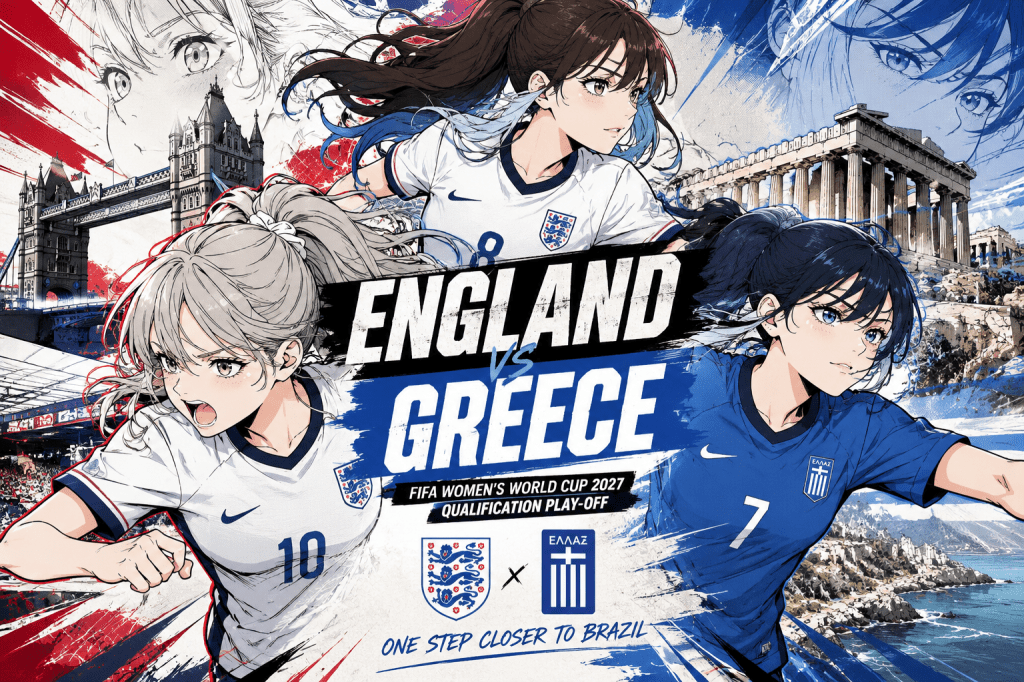
England have been drawn against Greece.
On paper, that sentence lands with a strange thud.
The reigning European champions are heading into a World Cup qualifying playoff. The immediate reaction is to assume something has gone badly wrong. England World Cup 2027 qualification was supposed to be straightforward. Instead, Sarina Wiegman’s side now face a two-legged October showdown against a nation they have never encountered before in senior women’s football.
Yet context matters.
Quite a lot, actually.
England did not stumble into this situation because they were poor. They arrived here because UEFA’s qualification system placed them in direct competition with perhaps the only team in world football currently capable of matching them blow for blow: Spain Women’s National Football Team.
The 4-0 defeat that ultimately handed Spain automatic qualification was bruising. There is no dressing that up. But it also came in a group that effectively contained the two strongest women’s national teams on the planet. One of them had to miss out on direct qualification.
England happened to be the one left standing when the music stopped.
The result is a playoff route that, while uncomfortable in theory, offers significant scope for optimism.
First Greece.
Then either Slovakia or Ukraine.
None of those sides possess anything close to England’s resources, player pool or tournament pedigree.
That does not mean England should stroll through.
It simply means the path remains very much open.
How England Ended Up Here
The narrative surrounding England’s playoff appearance risks becoming a little bit schizophrenic.
One version presents it as a national crisis.
The other views it as an administrative quirk created by an unforgiving qualification structure.
The truth probably sits somewhere in the middle.
England’s recent results have showcased both extremes. There have been emphatic victories, including an 8-0 demolition of China and a 6-1 win over Ukraine. Georgia Stanway has looked particularly devastating, producing goals at a rate usually reserved for forwards rather than midfielders.
Yet there have also been reminders that international football remains brutally unforgiving.
Spain exposed England’s defensive vulnerabilities in a way few teams can.
The consequence is this playoff.
Not ideal.
Not disastrous.
Just another hurdle.
Unlike their male counterparts, currently grinding through another World Cup campaign with all the excitement of a pleather office chair being assembled on a rainy Tuesday afternoon, the Lionesses have at least earned significant goodwill. One poor result against Spain does not suddenly erase everything this generation has achieved.
Greece’s Long Road To This Moment
If England arrive as wounded royalty, Greece arrive as ambitious gatecrashers.
The Greek women’s national team earned promotion and playoff qualification by winning every match in League C4, defeating Georgia and the Faroe Islands across a flawless campaign.
That alone tells part of the story.
The deeper story is more interesting.
Women’s football in Greece has rarely enjoyed the structural support seen in England. Many of the current squad grew up navigating obstacles that would be almost unimaginable for England’s current generation.
Defender Maria Gkouni-Papaioannou has spoken about playing on boys’ teams during her youth development. Others came through systems that lacked funding, visibility and professional infrastructure.
And yet here they are.
One round away from potentially facing England.
One step from perhaps the biggest result in their footballing history.
That journey gives Greece something dangerous.
Belief.
Not the manufactured sort produced by marketing departments and social media campaigns.
The real thing.
The Rangers and Hibs Connection
For British audiences, two names may already feel familiar.
The first is Rangers forward Calliste Brookshire.
Brookshire has become one of Greece’s most important attacking threats, providing goals during their qualification campaign and offering genuine pace in transition. She represents exactly the type of player England cannot afford to underestimate.
Give her space.
Allow Greece to counter.
Suddenly things become uncomfortable.
The second is Hibernian midfielder Georgia Chalatsogianni.
If Brookshire provides the cutting edge, Chalatsogianni provides the heartbeat.
Her recent performance against Georgia, playing through a dislocated shoulder during a dramatic victory, quickly became one of those stories that teammates remember for years.
Not because it was sensible.
Because it revealed something about her.
Greece will not disappear quietly.
Chalatsogianni embodies that mindset.
The Greek Player England Need To Know
England supporters will inevitably focus on household names.
The Walshs.
The Stanways.
The Bronzes.
But Greece possess one player who may emerge as the breakout figure of the tie.
Maria Gkouni-Papaioannou.
At 21, the centre-back has become the cornerstone of Greece’s defence. Strong in the air, composed under pressure and fiercely competitive, she represents the type of defender who relishes underdog situations.
Her recent comments carried a quiet confidence.
“We will be a very competitive team, we will show courage, confidence and certainly it is a game worth watching for everyone.”
Those are not the words of a player arriving merely to admire England.
What Greece Will Actually Do
This is where things become tactically interesting.
England will dominate possession.
That feels almost certain.
Sarina Wiegman’s entire philosophy revolves around control. England’s midfield combinations, particularly involving Keira Walsh and Georgia Stanway, are designed to suffocate opponents through sustained possession and territorial dominance.
Greece have no interest in competing on those terms.
Manager Vasilis Spertos prefers a more reactive approach.
A disciplined defensive structure.
Aggressive pressing triggers.
Rapid transitions.
England will likely have most of the ball.
Greece will try to make the moments without it matter more.
In many ways, it resembles a classic European qualifier.
One team trying to build a palace.
The other waiting patiently outside with a hammer.
The Future Goalkeeper of Greek Football?
Another intriguing subplot surrounds teenage goalkeeper Rafaella Petaloti.
At just 18 years old, she has already established herself as Greece’s first-choice goalkeeper during this qualification cycle.
Goalkeepers are strange creatures at the best of times.
Most spend years waiting.
Petaloti has skipped that stage entirely.
England’s attack will undoubtedly test her.
Yet there is also an opportunity here.
Matches like these can create careers.
Why England Should Still Feel Confident
The temptation is to frame this as David versus Goliath.
To lean heavily into mythology.
To cast Greece as defenders of some footballing Elysium standing against an invading giant.
There’s certainly some truth to that.
But football is not mythology.
It is usually decided by quality.
And England possess vastly more of it.
That sounds dismissive.
It isn’t meant to be.
It’s simply reality.
England’s squad contains players operating at the very highest level of the women’s game. Their bench would improve most international teams in Europe. Their tournament experience dwarfs Greece’s.
The challenge is avoiding complacency.
Because qualification routes have a habit of becoming dangerous when favourites start admiring the map instead of walking the road.
At this moment, one can only assume England will eventually reach Brazil 2027.
The playoff structure has given them every opportunity to do exactly that.
First Greece.
Then one more obstacle.
The Lionesses would be foolish to overlook either.
But equally, they would be foolish not to recognise the position they are in.
For all the noise surrounding England World Cup 2026 discussions, World Cup Qualifiers debates and qualification panic, this remains a route that heavily favours the European champions.
The real question is not whether England can qualify.
It is whether Greece can make them uncomfortable enough to create doubt.
That answer begins in Crete this October.
And for a fixture that has never existed before, that feels like a fascinating place to start.



 doragon sports