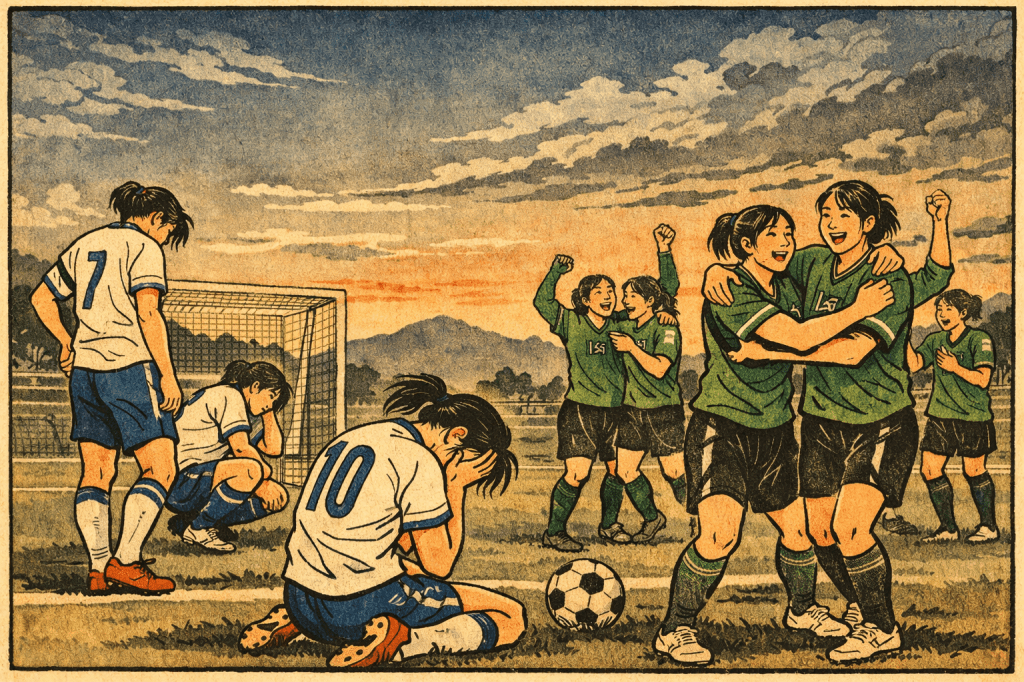
There is a particular cruelty reserved for football matches that refuse to end cleanly. They linger. They stretch themselves into something elastic and suffocating, until time itself feels like a trap rather than a structure. And in Ueno Sports Park, beneath a sky that seemed to hold its breath just a fraction too long, Sfida Setagaya FC were dragged into exactly that kind of ending.
This was not just defeat to Iga FC Kunoichi Mie. This was erosion.
A 94th-minute strike does not simply take three points. It takes something quieter, something more fragile. It reaches into the chest of a team already searching for identity and gently, almost casually, removes another piece.
For Sfida, this is becoming a pattern that feels less like coincidence and more like a curse written in the margins of their season.
The Weight of the Moment
Coming into this match, both teams carried the scent of desperation. Iga FC Kunoichi Mie were winless, drifting in that uncomfortable space between frustration and panic. Sfida were no better, hovering just above them, trapped in their own fog of inconsistency and unanswered questions.
But there was a difference in the air.
Iga felt like a team clinging to survival.
Sfida felt like a team searching for meaning.
The looming 2027 absorption into FC Tokyo casts a long shadow over everything Sfida do. Every misplaced pass, every dropped point, every late collapse feels magnified. This is not just about results anymore. It is about memory. About what remains when the badge changes and the name is repainted.
So when Mizuki Horie broke the deadlock in the 67th minute, there was a flicker. A fragile, flickering light that suggested maybe, just maybe, this could be a moment to hold onto.
But football rarely deals in kindness.
The Anatomy of Collapse
The equaliser arrived quickly. Ai Katsura stepping forward, calm, composed, converting from the spot in the 71st minute. A reset. A reminder that control in football is often an illusion.
From there, the match began to unravel into something far more chaotic.
Iga pushed. Relentless, territorial, wave after wave. Eight corners to zero tells its own story. Thirteen free kicks to two adds another layer. This was pressure not just applied, but sustained. A siege rather than a skirmish.
Sfida, meanwhile, began to shrink.
Not dramatically. Not in a way that screams tactical failure. But subtly. A yard deeper here. A hesitation there. A clearance not fully committed. The kind of small fractures that, when combined, become something structural.
And then came the final moment.
Rima Matsuda. 90+4 minutes. A strike that did not just win the game, but punctured it.
The net rippled. The stadium exhaled. And Sfida were left standing in that strange, hollow silence that follows devastation.
The Longer Journey Back
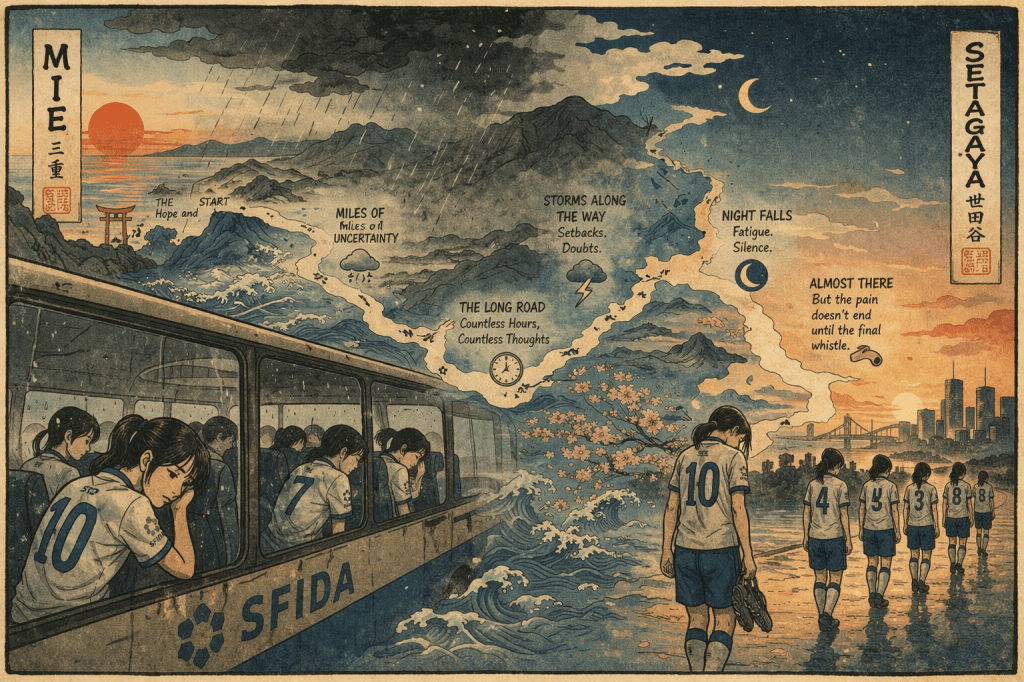
There is something uniquely punishing about losing like this when you are far from home.
A 5 or 6 hour drive from Mie Prefecture stretches differently after a defeat like this. The road feels longer. The air inside the car heavier. Conversations become fragmented, drifting in and out of silence.
Who does not love that kind of journey?
The sarcasm writes itself.
Because this was not isolated. Just one week earlier, Sfida suffered a similar fate against Yokohama FC Seagulls. Another match that slipped. Another result that dissolved in the final moments.
Two games. Two late collapses.
That is not bad luck. That is a pattern demanding attention.
Why This Keeps Happening
Football rarely offers simple explanations. Losses like this are not the product of a single flaw, but rather a convergence of pressures that align at the worst possible moment.
Still, patterns leave clues.
1. Physical Fatigue
There is a visible drop in intensity in Sfida’s closing phases. Tracking runners becomes slower. Second balls are contested with less conviction. The sharpness that defines the early stages of the match begins to dull.
This is not unusual in football. Nearly a quarter of all goals occur after the 75th minute. But when it becomes repetitive, it suggests something deeper.
Is the conditioning sufficient for a full 90-plus minutes at this level?
Or is the team simply being stretched beyond its physical limits?
2. The Battle for Loose Balls
One of the most telling indicators from this match was the consistent loss of second balls.
Football often turns on these small, chaotic moments. The ricochet. The deflection. The half-clearance. Teams that dominate these moments tend to control the closing stages.
Sfida did not.
Whether this is work rate, positioning, or anticipation, it is an area that repeatedly tilts against them when the game becomes scrappy and unstructured.
And in the final minutes, matches almost always descend into that kind of chaos.
3. Tactical Retreat
There is a tendency, subtle but present, for Sfida to drop deeper when protecting a result.
It is understandable. It is human. But it invites pressure.
By retreating, they allow opponents to camp in dangerous areas. Corners pile up. Free kicks increase. The defensive line is forced into constant reaction.
Eventually, something gives.
Against Iga, it gave at the worst possible moment.
4. Psychological Fragility
Perhaps the most difficult element to quantify, but the most important.
When a team concedes late goals repeatedly, it begins to shape expectation. Players do not consciously think, “we will concede.” But somewhere beneath the surface, doubt begins to whisper.
That hesitation in a clearance.
That split-second delay in tracking a runner.
That choice to play safe rather than decisive.
All of it adds up.
And in football, hesitation is often punished immediately.
The Contrast in Identity
This match was not just about tactics or fitness. It was about identity.
Iga FC Kunoichi Mie embody something primal. A team rooted in place, in history, in community. Their performance reflected that. Grit, persistence, refusal to accept defeat even when the clock seemed to dictate otherwise.
Their manager, Yoshiaki Nagai, spoke of tenacity. Of fighting until the end. And his players delivered exactly that.
Sfida, by contrast, feel like a team caught between versions of themselves.
A grassroots club with deep community ties, now facing an uncertain future under a larger corporate umbrella. The question is not just how they play, but who they are becoming.
And right now, that uncertainty is bleeding into their football.
The Bright Spots That Fade Too Quickly
It would be easy to paint this performance as entirely negative. That would not be entirely fair.
Mizuki Horie continues to be a focal point. Her goal was well-taken, her presence constant. She offers a thread of continuity in a team searching for structure.
There are moments where the system works. Where the movement feels coherent. Where the team looks capable.
But those moments are not lasting long enough.
They flicker.
And then they disappear.
What Comes Next
This is the uncomfortable part.
Because the solutions are not simple, but they are necessary.
Fitness levels must be scrutinised. Not just in isolation, but in comparison to opponents. Are Sfida maintaining intensity deep into matches, or are they fading at critical moments?
Game management must improve. Holding possession. Slowing tempo. Recognising when to control rather than chase.
The battle for second balls must become a priority. It is not glamorous, but it is often decisive.
And perhaps most importantly, the psychological cycle must be broken.
Because until Sfida prove to themselves that they can close out matches, every late minute will feel like a ticking clock rather than an opportunity.
The Final Image
When Matsuda’s strike hit the net, Iga erupted.
Players, fans, the entire stadium collapsing into a moment of collective release.
For them, it was salvation.
For Sfida, it was something else entirely.
A reminder that in football, hope can be held for 93 minutes and still be taken away in the 94th.
And as the team boarded the long journey back from Mie, that truth would have sat quietly beside them. Not loud. Not dramatic.
Just present.
Like a shadow that refuses to leave.
Key Questions Answered
Why do Sfida Setagaya keep conceding late goals?
A combination of physical fatigue, tactical retreat, and psychological pressure is contributing to repeated late collapses. Reduced intensity and loss of concentration in the final stages are key factors.
Is fitness an issue for Sfida Setagaya?
There are signs of declining stamina late in matches, including slower reactions and reduced ability to compete for second balls, suggesting conditioning could be a contributing issue.
What tactical problems are affecting Sfida late in games?
Dropping too deep and inviting pressure has led to increased opposition chances, particularly from set pieces and sustained attacking phases.
How important are second balls in these matches?
Very. Sfida’s struggles to win loose balls have allowed opponents to maintain pressure and create decisive moments late in games.
What role does psychology play in repeated late losses?
A pattern of conceding late goals can create anxiety and hesitation, leading to lapses in decision-making and defensive organisation.
What does this loss mean for Sfida’s season?
It deepens concerns about consistency and identity, particularly with the club facing major structural changes in 2027. Performances are becoming as important as results.
How did Iga FC Kunoichi Mie win the match?
Through sustained pressure, dominance in set pieces, and relentless persistence, culminating in a stoppage-time winning goal that reflected their refusal to give up.
 doragon sports