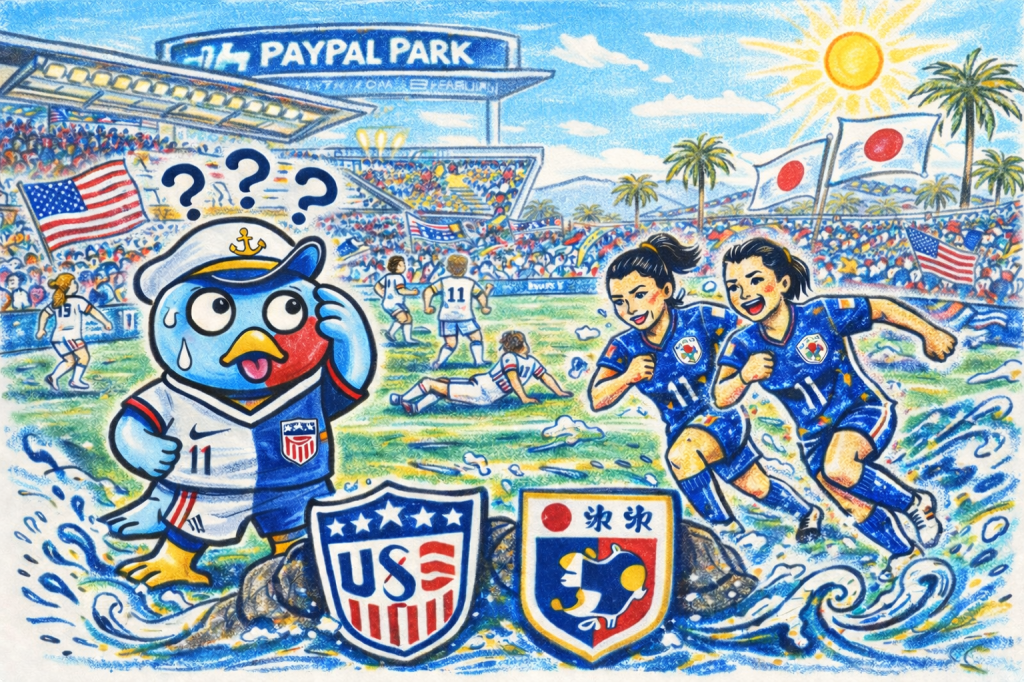
There is something unsettling about empires that try to reinvent themselves mid-collapse.
They don’t fall loudly anymore. No dramatic crumble. No single, defining defeat. Just a slow, grinding erosion. A recalibration disguised as evolution. A shift in language before a shift in results.
And tonight, under the Californian dusk at PayPal Park, that illusion is going to be tested against something far more certain.
Japan are not rebuilding.
They are not searching.
They are not experimenting.
They are arriving.
The Opening Strike: A Trilogy Begins
This is not a friendly. Not really.
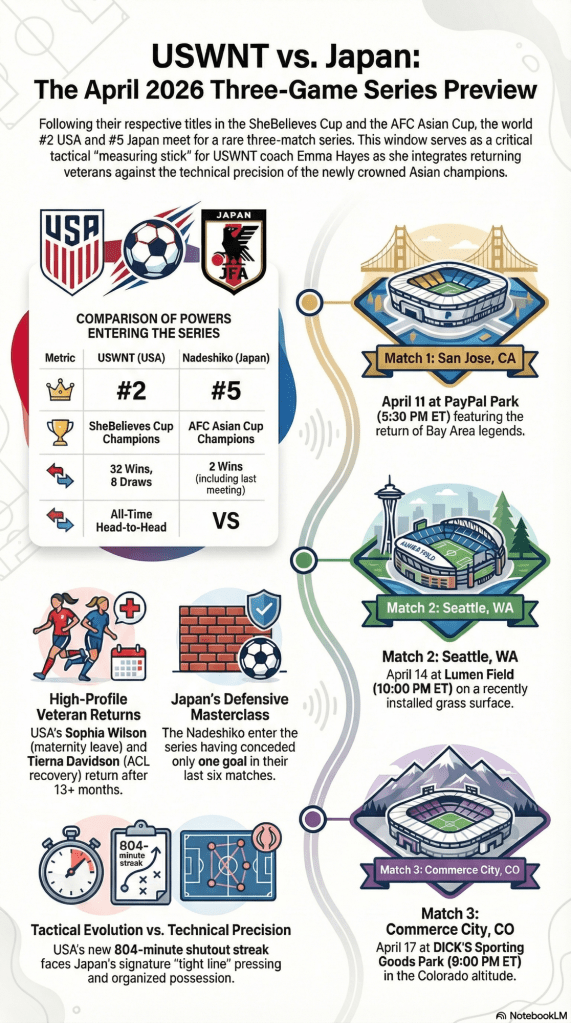
It is the first movement in a three-act symphony that feels like it has been quietly composing itself for years. A collision between two ideologies, two timelines, two versions of what international dominance looks like in 2026.
The United States women’s national soccer team step onto the pitch carrying history like armour. Heavy. Decorated. Slightly outdated.
Across from them, the Japan women’s national football team glide in as something sharper. Not louder. Not physically overwhelming. Just… refined to a dangerous edge.
Japan come crowned. Asian champions. Ruthless. Efficient. Beautiful in the way a blade is beautiful.
29 goals scored.
1 conceded.
That is not form. That is a statement written in surgical ink.
And yet, beneath that perfection, there is chaos.
Japan’s Paradox: Champions in Turmoil
Winning usually buys time. Stability. Trust.
Not here.
The removal of Nils Nielsen just days after lifting the Asian Cup was not just surprising. It was cold. Calculated. Almost theatrical in its brutality. A reminder that, within Japanese football’s internal logic, success is not enough. It must feel right. It must align with something deeper.
The words from the federation cut through the celebrations like glass. Too soft. Not enough passion.
Imagine winning everything… and still being told you are not the right kind of winner.
Now the team walks into this series under interim guidance, caught between continuity and disruption. Between identity and expectation.
And yet, on the pitch, none of that noise seems to matter.
Because this team does not rely on emotional stability.
It runs on structure. On rhythm. On an almost eerie collective intelligence.
They do not panic. They process.
America’s Reinvention: The Empire Learns to Think
On the other side, Emma Hayes is not just coaching a team. She is rewriting a doctrine.
For years, the USWNT played like a storm. Direct. Overwhelming. Relentless in transition. A system built on physical dominance and vertical violence.
That era is fading.
Not because it failed.
Because the world adapted.
Now Hayes is trying to teach patience to a nation that built its footballing identity on urgency. Possession over chaos. Control over instinct.
And to her credit, the early signs are… impressive.
An 804-minute shutout streak does not happen by accident. It is the byproduct of discipline. Of spacing. Of a defensive structure that no longer stretches itself thin chasing moments.
But here is the tension.
In becoming harder to break down, the US risk becoming easier to contain.
Control can suffocate your opponent.
It can also suffocate yourself.
And against Japan, hesitation is oxygen.
The Heartbeat Returns: Sophia Wilson
If there is one emotional current pulling the American narrative forward, it is Sophia Wilson.
Seventeen months away. A child born. A life reshaped.
Her return is not framed as redemption. It is something quieter. More grounded. A player stepping back into the game with a different gravity.
She speaks about presence. About perspective. About a ‘goldfish mentality’ that lets mistakes dissolve instead of linger.
There is something dangerous in that.
Because defenders thrive on hesitation. On doubt. On players who carry the weight of previous moments.
Wilson now carries none of that.
She is freer.
And freedom, in the final third, is chaos disguised as calm.
The Engine Room: Where This Game Will Break
Strip away the narratives, the emotion, the history.
This game will be decided in one place.
Midfield.
Yui Hasegawa is not just a player. She is a tempo. A quiet conductor who bends the shape of the game without ever seeming rushed.
She does not dominate space. She dissolves into it.
Opposite her, Sam Coffey represents the new American spine. Disciplined. Positionally aware. A stabiliser in Hayes’ evolving system.
If Coffey disrupts the rhythm, the US can impose control.
If Hasegawa finds pockets, even briefly, Japan will begin to… unravel them.
Not quickly. Not dramatically.
But piece by piece. Thread by thread.
Until the structure gives way.
The Edge: Where Japan Pull Ahead
Japan are better.
Not historically. Not commercially. Not in legacy.
Right now.
They are more coherent. More aligned. More certain in what they are trying to do.
Players like Maika Hamano bring relentless energy wrapped in technical precision. She does not just attack. She presses. She recovers. She suffocates space before it exists.
And then there is Momoko Tanikawa.
A player who feels like she exists slightly outside the tempo of everyone else. Capable of moments that do not follow logic. The kind that tilt matches without warning.
For the US, emerging figures like Ally Sentnor offer flashes of brilliance. Long-range strikes. Sudden bursts. A reminder that the American pipeline still produces chaos merchants.
But flashes are not systems.
Japan have both.
The Atmosphere: Intimacy and Pressure
There is no hiding in PayPal Park. It’s not Tokyo. Nor Yokohama.
18,000 seats. Steep stands. Sound that drops directly onto the pitch like a weight.
Every touch amplified. Every mistake magnified.
And for players like Chelsea’s Naomi Girma, this is home. Familiar ground layered with expectation.
That matters.
But so does discomfort.
Japan do not need familiarity. They travel well because their game travels well.
Structure does not get jet lag.
What This Match Really Is
It is not just Asia versus America.
It is clarity versus transition.
Japan know exactly who they are.
The US are still deciding.
And in football, that difference is everything.
Because identity is not just philosophy. It is speed of thought. Speed of execution. The ability to act without second-guessing.
Japan play like a team that has already answered the question.
The US are still writing it.
Prediction: The Quiet Takeover
Do not expect domination in the traditional sense.
This will not be a blowout. Not a spectacle of overwhelming force.
It will feel balanced. Competitive. Tight.
Until it isn’t.
Japan will control the invisible layers of the game. The spaces between passes. The timing of movement. The subtle shifts that do not show up in highlight reels but decide outcomes.
And then, at some point, it will click.
A movement. A pass. A finish.
And suddenly the narrative will feel obvious in hindsight.
Japan 2-1 USWNT.
Not an upset.
A confirmation.
Who are the favourites between USWNT and Japan in 2026?
Japan enter as the stronger side based on current form, tactical cohesion, and recent dominance in the AFC Women’s Asian Cup. The USWNT are improving under Emma Hayes but remain in transition.
Why is this match important for the 2027 Women’s World Cup?
This series acts as an early benchmark for two global contenders. It tests whether the USWNT’s tactical evolution can compete with elite, possession-based teams like Japan.
Who are the key players to watch in USWNT vs Japan?
Key players include Yui Hasegawa and Maika Hamano for Japan, and Sophia Wilson and Sam Coffey for the USWNT. Momoko Tanikawa is a major wildcard.
What tactical battle will decide the game?
The midfield duel between Hasegawa and Coffey will dictate tempo and control. If Japan dominate possession, they will likely control the match.
What is Japan’s recent form heading into this match?
Japan won the 2026 AFC Women’s Asian Cup with a dominant run, scoring 29 goals and conceding just once.
How has the USWNT changed under Emma Hayes?
The USWNT have shifted from a transition-heavy style to a more structured, possession-based system, focusing on defensive stability and controlled build-up play.
If this is Act One, it already feels like the ending has been written in a different language. Japan just need to translate it onto the pitch.
 doragon sports