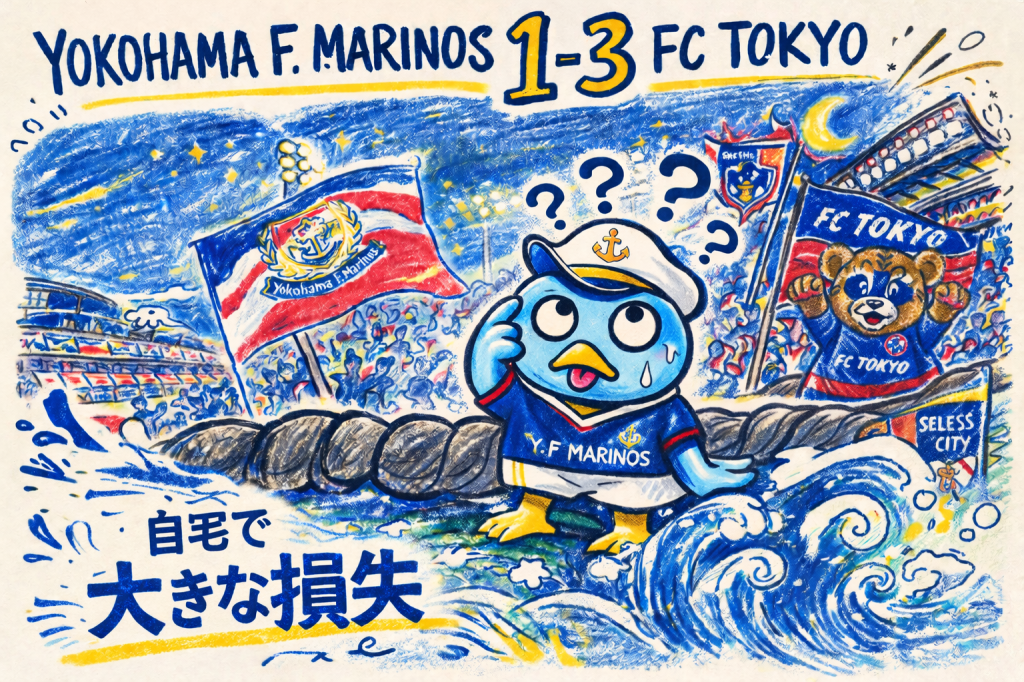
There are defeats that feel deserved. There are defeats that feel inevitable. And then there are defeats like this one, the kind that sit in your chest like a cracked metronome, ticking out of rhythm long after the final whistle has faded.
This was the worst kind.
Because on paper, it does not make sense.
Yokohama F. Marinos had the ball. More of it. Fifty-five percent, to be precise. They passed more. Controlled more. They matched FC Tokyo shot for shot, even edged them in moments. The early exchanges belonged to them, the tempo dictated, the rhythm authored in blue and white.
And yet the scoreboard reads 1–3.
Clinical versus chaotic. Precision versus poetry. One side needed three clean cuts. The other swung wildly, beautifully, and bled out anyway.
It is not just a defeat. It is a diagnosis.
The Illusion of Control
Under that oppressive Nissan Stadium sun, everything about the opening forty-five minutes whispered one story.
Marinos were in control.
The press was aggressive, almost theatrical in its commitment. Man-to-man, high line, suffocating space. FC Tokyo could barely breathe in possession. Long balls became their only escape, hopeful punts into a midfield that Marinos swarmed like a closing tide.
Seven shots to three in the first half. Territory. Momentum. Intent.
And then there was Jun Amano, the returning conductor, threading himself into the match like a forgotten melody rediscovered. In the 22nd minute, he carried the ball through the centre, opened his body, and unleashed a left-footed strike that cracked against the crossbar with a sound that felt like fate knocking.
That was the moment.
Not in hindsight. Even then, you could feel it. That sharp inhale from the crowd. That pause in the narrative where football decides what kind of story it wants to be.
If that goes in, this is a different match.
But it didn’t.
And football rarely forgives “almost.”
The Rope Tightens
FC Tokyo did not panic. That is the first warning sign in any football match, when the side being dominated refuses to look like victims.
They absorbed.
They bent.
They waited.
Manager Rikizo Matsuhashi would later frame it as psychological warfare, but on the pitch it looked simpler. They understood something Marinos either ignored or underestimated.
Heat changes everything.
At 24.5°C, under a sun that turned the pitch into a slow-burning skillet, the cost of intensity multiplies. Every sprint extracts a little more. Every press takes something that does not come back.
Marinos were playing like a team chasing oxygen.
Tokyo were playing like a team conserving it.
So when the moment came, it did not feel sudden to them. Only to everyone else.
The 70-Metre Break That Broke Everything
Football games do not always turn on goals. Sometimes they turn on moments that feel like ruptures.
This was one of them.
A loose touch. A failed trap deep in Tokyo territory. A young defender, a fraction off. And suddenly, the entire structure collapses in reverse.
Space opens. Vast, terrifying space.
The ball is played forward, and then it becomes a race.
Marcelo Ryan drives forward, head up, scanning. To his right, Kein Sato is already moving, sprinting into the vacuum Marinos left behind.
Seventy metres.
Not just distance, but inevitability. Each stride stripping away the illusion that Marinos had built.
Sato meets the pass, takes it in stride, and finishes with the composure of a player who already knows the ending.
1–0.
Right before halftime.
Not just a goal. A psychological incision.
You could feel it. The shift. The subtle draining of belief. The heat suddenly heavier, the legs suddenly slower, the press suddenly just a little less sharp.
Marinos had dominated.
And they were losing.
From Control to Collapse
The second half is where the story turns from frustrating to frightening.
Because this is where the numbers betray you.
Marinos still had the ball. Still passed more. Still, on paper, looked like a team in control.
But the reality had inverted.
FC Tokyo no longer needed to survive the press. They had already broken it.
Now they hunted.
The second goal arrives like a sequel written before the first ended. Transition. Speed. Directness. Marcelo Ryan again, this time finishing with a strike that does not ask questions. It announces.
2–0.
And suddenly the gap between the two teams is not possession. It is purpose.
Tokyo know exactly what they are doing.
Marinos look like they are trying to remember.
The Cruel Flicker of Hope
Football has a habit of offering hope just when it hurts the most.
In the 74th minute, Ren Kato produces something outrageous. A strike hit with defiance, anger, maybe even desperation. It flies, it dips, it crashes into the net like a protest.
2–1.
For a moment, Nissan Stadium wakes up again.
You can almost convince yourself.
The narrative flickers. The possibility of redemption edges back into view. The idea that all that early dominance might still mean something.
But this version of FC Tokyo does not wobble.
They do not panic. They do not retreat into chaos.
They finish.
The Final Blow
Set pieces had been a quiet criticism of Tokyo. Not anymore.
In the 79th minute, Kento Hashimoto steps up over a free-kick. The delivery is vicious, curling with intent, asking questions that defenders do not have time to answer.
The ball finds its way in. Officially an own goal. Functionally a death sentence.
3–1.
And just like that, the match is over in everything but time.
Six minutes of stoppage tick away like a formality. The away end begins to sing. The “Sleepless City” anthem rolls through Nissan Stadium, not as celebration but as occupation.
This is Tokyo’s ground now.
Marinos are just passing through.
This isn’t the first ideology that FC Tokyo is leaving Marinos in the dust with. Tokyo has committed to women’s football with a deal with SFIDA Setagaya, while Marinos still has … no women’s team.
The Stats That Lie and the Truth They Hide
Here is where it becomes uncomfortable.
Because the numbers, stripped of context, suggest something else entirely.
Marinos:
- More possession (55%)
- More passes
- Comparable shots
- Early dominance
And yet, they lost by two goals.
This is where modern football can feel like a paradox.
Control without threat is just decoration.
Possession without precision is just movement.
Shots without ruthlessness are just noise.
FC Tokyo did not need more of the ball. They needed the right moments. And when those moments came, they executed with surgical clarity.
Three goals from fewer, cleaner opportunities.
Marinos, by contrast, created volume but not damage.
That is the difference.
That is everything.
The Tactical Autopsy
Hideo Oshima’s plan was not wrong.
For 44 minutes, it worked.
The high line, the aggressive press, the man-to-man commitment. It suffocated Tokyo’s build-up, forced mistakes, created chances. It imposed identity.
But it demanded perfection.
And perfection does not survive fatigue.
The heat drained the press. The structure stretched. The margins widened.
One mistake became one goal.
One goal became a shift.
And once the psychological balance tipped, the entire system began to unravel.
High lines are brave. They are also unforgiving.
Against a team like Tokyo, built for transition, it becomes a knife edge.
Marinos walked it beautifully.
Until they didn’t.
Not a problem after last week in Chiba, Marinos fans are used to losing.
Youth, Mistakes, and the Cost of Learning
There is a cruelty in how football punishes youth.
One mistimed touch. One misread moment. One lapse in concentration. And suddenly the entire match tilts.
Oshima pointed to it directly. The young players given a chance made errors that led to goals.
That is not blame. It is reality.
But it also speaks to something deeper.
This Marinos side feels caught between identities. Between the fearless intensity they want to play with and the controlled maturity required to sustain it.
They can burn teams.
But right now, they are just as capable of burning themselves.
The Emotional Aftermath
The most telling reactions did not come from the pitch.
They came from the feeling around it.
Fans talking about “cheap goals.” About fear. About the idea that this could spiral into something worse. Even whispers of relegation playoffs creeping into conversations that should not be anywhere near a club like this.
That is what this result does.
It does not just hurt.
It unsettles.
Because it exposes a flaw that feels structural, not situational.
What This Means
This is not a performance you can dismiss.
It is too coherent for that.
Marinos did many things right. They controlled the ball. Created chances. Imposed themselves for long stretches.
But football does not reward effort. It rewards execution.
And right now, FC Tokyo execute at a level Marinos cannot match.
Until that changes, games like this will keep happening.
Different opponents. Same script.
Yokohama F. Marinos vs FC Tokyo – Key Questions Answered
Why did Yokohama F. Marinos lose despite more possession?
Because possession alone does not win matches. Marinos controlled the ball but failed to convert key chances, while FC Tokyo were ruthlessly efficient on the counter-attack and set pieces.
What was the turning point in the match?
The first goal just before halftime. A 70-metre counter-attack finished by Kein Sato shifted the psychological balance and disrupted Marinos’ momentum.
How did FC Tokyo tactically beat Marinos?
Tokyo absorbed pressure, exploited the high defensive line with rapid transitions, and capitalised on mistakes. Their counter-attacking approach directly targeted the spaces Marinos left behind.
What role did the heat play in the game?
The 24.5°C conditions drained Marinos’ high-intensity pressing game, reducing their effectiveness over time and allowing Tokyo to grow into the match.
Who were the standout players?
- Kein Sato for his opening goal and relentless running
- Marcelo Ryan for his assist and goal
- Kento Hashimoto for the decisive set-piece delivery
- Jun Amano for his early creative spark
- Ren Kato for his stunning goal
What does this result mean for Marinos moving forward?
It highlights a critical issue with game management and defensive transitions. Without improved efficiency and control, especially against counter-attacking teams, similar results are likely to continue.
 doragon sports