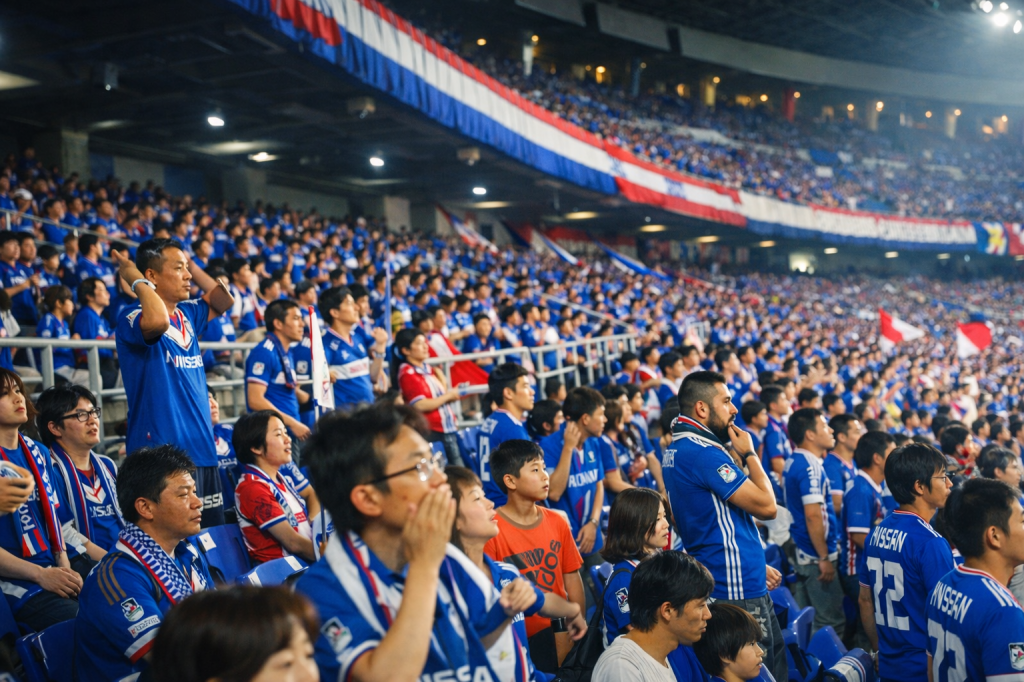
Yokohama F. Marinos vs FC Tokyo – Matchweek 10, East Group
There are matches that feel like fixtures. There are matches that feel like statements. And then there are matches like this, where the pitch becomes a courtroom and the verdict is whispered long before kickoff.
Nissan Stadium is not just hosting football this weekend. It is hosting tension in its purest, most distilled form. A club with history in its bones is staring at its own reflection and wondering what remains if the badge is stripped, repainted, or quietly sold off in a boardroom far removed from the chanting stands.
For Yokohama F. Marinos, this is not about three points. It is about proving they still exist.
A League That Feels… Unusual
This transitional competition was always going to feel strange. A compressed calendar, no draws, penalty shootouts for some points, lurking like sudden-death traps. It has the rhythm of a tournament and the consequences of a season.
Every result carries financial oxygen. Every mistake feels monetised.
Three points is not just a win. It is 6 million yen. A penalty victory is a compromise dressed as relief. Even defeat still drips with subsidy. The structure creates something unusual. It encourages aggression, punishes hesitation, and exposes any tactical fragility with ruthless clarity.
FC Tokyo have adapted to this ecosystem like predators learning a new hunting ground. They are second in the East Group, comfortable in chaos, fluent in suffering and striking.
Marinos, meanwhile, look like a team still trying to understand the rules of the game they are already losing.
Yokohama’s Identity Crisis, Written in Red Ink
There is something heavier than form hanging over this club.
Nissan’s financial collapse is not a distant headline. It is a shadow stretching across the pitch. Job cuts, losses, uncertainty. The club’s ownership feels unstable, and with it, the identity of Yokohama F. Marinos feels negotiable in ways that should make any supporter uneasy.
This is where the word fits. Radappertization.
Not quite rebuilding. Not quite destruction. Something in between. A strange, unsettling reshaping where pieces are moved without clarity of what the final picture should be.
Marinos are not being rebuilt. They are being… adjusted. Softened. Questioned.
And in football, uncertainty is a predator that feeds on structure.
You can see it in their numbers. Attacking volume without purpose. Possession without incision. A high line that feels less like bravery and more like a recurring mistake.
They attack like a team trying to remember what made them dangerous. They defend like a team hoping the problem will solve itself.
Tokyo’s Return of the Exiles
Football loves symmetry. It loves old ghosts walking back through familiar corridors.
FC Tokyo arrive with three names that still echo around Yokohama. Keita Endo. Teruhito Nakagawa. Kei Koizumi.
Nakagawa is the most poetic of them all. A former MVP. A title-winner. A player who once defined Marinos’ attacking identity. Now he returns wearing different colours, operating not as a winger but as something more subtle, more dangerous. A shadow striker drifting through spaces that Marinos struggle to defend.
He does not need to sprint past defenders anymore. He simply needs to exist between them.
Endo brings a different energy. Europe hardened him, but not in the way he wanted. He returns carrying frustration, self-criticism, and a quiet determination to rebuild himself from scratch. He plays like a man trying to rewrite his own narrative in real time.
And then there is the edge. The unspoken tension. Former players returning rarely do so gently.
Tokyo are not just opponents. They are mirrors.
The Tactical Fault Line
If this match were reduced to one sentence, it would be this.
Tokyo wait. Marinos unravel.
Rikizo Matsuhashi has built a system that thrives on discipline and timing. His team can sit deep, absorb pressure, and then break with surgical precision. They do not need dominance. They need moments.
And Marinos offer those moments willingly.
Hideo Oshima’s side still tries to play expansive football. The intention is admirable. The execution is chaotic. Their high line stretches too far. Their defensive transitions collapse too quickly. Their structure dissolves under pressure.
They are balaniferous in nature. Burdened with potential, carrying seeds of something powerful, yet unable to control where those seeds land.
There is talent here. There is attacking instinct. But it grows wild, not structured.
Against a team like Tokyo, that is dangerous.
The Missing Piece, The Rising Pressure
FC Tokyo are not without problems.
Motoki Nagakura’s absence is not a minor inconvenience. It is a structural wound. He was their most reliable attacking output, their statistical heartbeat. Without him, the burden shifts.
Ryunosuke Sato steps forward. Young, talented, full of promise. But this is a different stage now. This is not youth football. This is a match that demands composure under weight.
Marcelo Ryan becomes the focal point. Physical, direct, capable of bullying defenders. And if there is one thing Marinos have struggled with, it is dealing with physical presence combined with intelligent movement around them.
This is where the game could tilt quickly.
Marinos’ Last Line of Resistance
Jason Quinones stands like a lone pillar in a collapsing structure.
His defensive metrics tell one story. His surroundings tell another.
He is tasked with organising a backline that has repeatedly failed to hold shape. He faces runners from deep, crosses from wide, and transitions that arrive faster than his teammates can recover.
Football is rarely kind to defenders in this situation. One player cannot hold back a tide forever.
But if Marinos are to survive this match, his performance will need to border on defiance.
The Psychological Weight of Recent History
There is no hiding from what happened last time.
A 3-0 defeat. Clinical. Controlled. Cold.
Tokyo did not just win. They exposed.
And that memory lingers. It sits in the back of the mind, shaping decisions, influencing risk, whispering doubt at the worst possible moments.
Marinos come into this game wounded again. A heavy loss to Kashiwa Reysol. A red card. A collapse that felt both sudden and inevitable.
Tokyo arrive slightly bruised themselves, falling in a penalty shootout. But their system holds. Their identity remains intact.
That is the difference.
Nissan Stadium, A Stage of Defiance
There is something haunting about a large stadium filled with uncertainty.
Nissan Stadium can feel like a fortress when the energy is right. It can also feel like an echo chamber when doubt creeps in.
This weekend, it will be both.
The fans will arrive early. They will fill Tricolor Land. They will sing, chant, and try to hold onto something that feels like it is slipping.
Because this is what football becomes when identity is threatened. It becomes louder. More emotional. Less rational.
Every pass will carry tension. Every mistake will feel amplified.
And when Tokyo break, as they inevitably will, the silence between the chants might say more than the noise itself.
What Marinos Must Do
They cannot play this game as they have played others.
The high line needs restraint. The midfield needs discipline. The transitions must be controlled rather than chaotic.
Most importantly, they need clarity.
Radappertization has left them in a state of tactical uncertainty. This match demands the opposite. It demands conviction, even if that conviction means abandoning parts of their traditional identity.
If they try to outplay Tokyo in open space, they will lose.
If they control the rhythm, slow the game, and force Tokyo into discomfort, they have a chance.
What Tokyo Must Do
Stay patient.
That is it.
Marinos will offer space. They always do. The key is not forcing it too early. Matsuhashi’s system works because it trusts the moment will come.
Nakagawa between the lines. Endo stretching the width. Ryan occupying the centre.
The structure is there. The plan is proven.
They simply need to execute.
The Verdict
This feels less like a contest and more like a test of stability.
Tokyo are stable. Structured. Comfortable in their identity.
Marinos are searching.
And in football, the team that knows what it is tends to punish the team that does not.
Unless something shifts dramatically, unless Nissan Stadium becomes a force rather than a backdrop, this has the shape of a familiar outcome.
Marinos fighting. Tokyo finishing.
What time does Yokohama F. Marinos vs FC Tokyo kick off?
The match kicks off at 15:00 JST on Saturday, April 11, 2026 at Nissan Stadium in Yokohama.
Why is this match important for Yokohama F. Marinos?
Marinos are struggling in 9th place and face both poor form and off-field uncertainty due to ownership concerns. This match is crucial for stabilising their season and identity.
What is unique about this J1 transitional tournament?
There are no draws. Matches tied after 90 minutes go straight to penalty shootouts. Each result carries financial rewards, making every game high stakes.
Who are the key players to watch?
For FC Tokyo, Teruhito Nakagawa and Keita Endo are central attacking threats. For Marinos, Jason Quinones anchors the defence while Kaina Tanimura leads the attack.
What happened in the last meeting between these teams?
FC Tokyo defeated Yokohama F. Marinos 3-0 in their previous encounter, exposing Marinos’ defensive weaknesses in transition.
What are Yokohama F. Marinos’ biggest tactical issues?
They struggle with defensive structure, particularly their high line, and have one of the worst opponent shot success rates in the league.
Can Marinos turn their season around?
Yes, but it requires tactical discipline, defensive stability, and a clearer identity. Without those, results are unlikely to improve.
 doragon sports