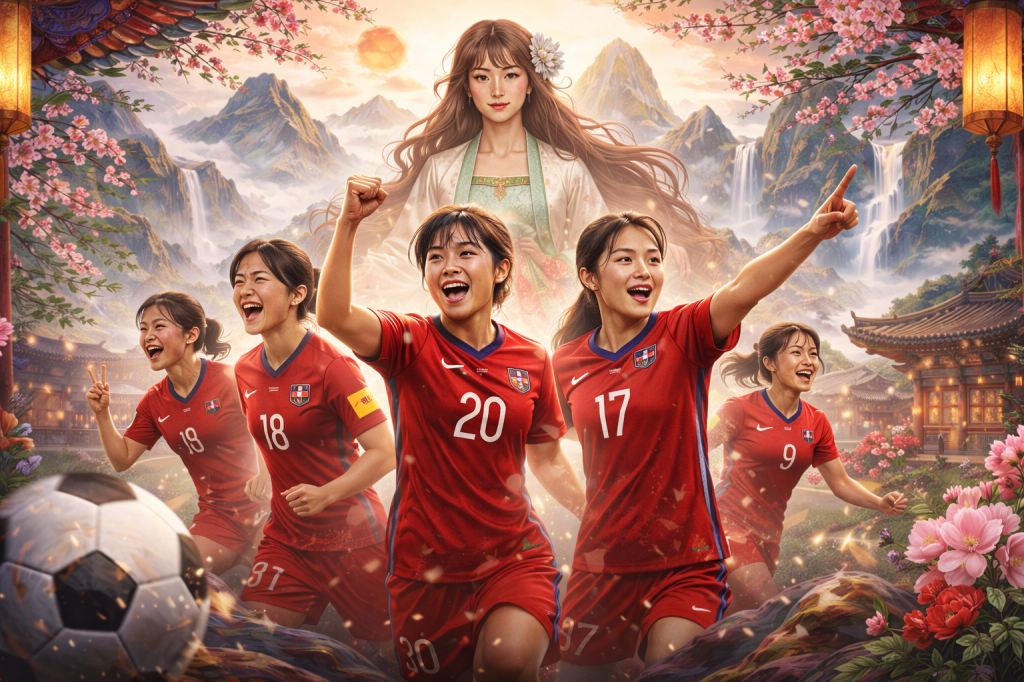
There are dominant group stages, and then there are statements so emphatic they feel almost mythological. What the North Korea U-20 women’s side have produced in Thailand sits firmly in the latter category, a rarissima blend of precision, discipline, and attacking ferocity that leaves opponents not just beaten, but quietly unravelled.
Three games. Three wins. Nineteen goals scored. Zero conceded.
Numbers like that do not simply tell a story. They hum with something deeper, something colder and more deliberate. This is not chaos. This is design.
And in Pathum Thani, under the heavy air and floodlights that cling to the skin, North Korea have moved like a team that already knows the ending.
Opening Salvo: Jordan Swept Aside
The first goal arrived before most had settled into their seats.
Ri Su-jong slipping through in the opening minute felt less like a breakthrough and more like a warning shot. From there, the game tilted sharply, then completely, then irreversibly. By halftime, it was 5-0. By full time, 8-0.
Kang Ryu-mi’s hat-trick carried a ruthless elegance. Not flamboyant, not theatrical, just efficient in a way that drains hope from the opposition. Around her, the goals came in waves, each one another crack in Jordan’s resistance.
It is easy to dismiss such a result as a mismatch. That would be a mistake. The way North Korea controlled space, recycled possession, and suffocated transitions spoke of a system already operating at a higher frequency.
There was no mercy, but there was also no recklessness. Just repetition, precision, inevitability.
Uzbekistan: Control Without Compromise
If the opening match was a storm, the second was something more controlled. A tightening of the grip.
Uzbekistan offered structure, resistance, moments of shape. North Korea dismantled them anyway.
Six goals this time. Another clean sheet. But more telling was the rhythm of the performance. They dictated tempo like a metronome set by someone else entirely. Press when needed. Pause when required. Strike with clinical timing.
Pak Ok-i emerged here as the tournament’s sharpest edge. Her hat-trick was not just about finishing. It was about presence. The kind that pulls defenders out of alignment, that turns hesitation into space.
Even at 3-0, at 4-0, at 5-0, there was no drop. No easing off. Just a quiet insistence on completeness.
Wellaway, you could almost hear it in the stands, not in despair, but in recognition. This was a team operating on a different plane.
Of course they had a lot to live up to with the senior team defeating Uzbekistan in the AFC Cup.
The Defining Moment: South Korea Silenced
Group deciders often carry tension, nerves, fragments of doubt.
This one did not.
South Korea arrived with organisation and intent. They left without registering a single shot.
That statistic alone feels almost unreal. Thirty-two attempts from North Korea, none conceded in return. It is the kind of imbalance that does not just win matches, it redraws them.
Kang Ryu-mi opened the scoring, but it was the quickfire double from Pak Ok-i just before halftime that snapped the contest in two. The second half became an exercise in inevitability.
Five goals. Another clean sheet. Another opponent left chasing shadows.
There is a moment, watching this performance back, where the game seems to slow. Not for the players, but for the viewer. You begin to see the patterns. The rotations. The silent understanding between players who move as if connected by something unseen.
Emberlucock football, if such a phrase can be coined. Glowing, contained, quietly burning through everything in its path.
Ungnyeo’s Daughters: Patience, Power, and the Weight of Favouritism
There comes a point in every competition where the conversation shifts. It moves away from who might win, and settles, almost reluctantly, on who should.
North Korea have dragged this tournament to that point.
Not through noise or spectacle, but through something quieter. Something older. The kind of dominance that feels earned through endurance rather than explosion. There is a thread here that stretches back into story, into symbol, into Ungnyeo, the bear woman who waited in darkness, who endured, who emerged transformed.
This team plays like that myth remembers.
Three matches. Three wins. Nineteen goals scored. None conceded. The numbers are staggering, but they are only the surface. What sits beneath is where the weight of favouritism truly begins to form. Every movement feels rehearsed through repetition. Every press arrives with intent, not urgency. They do not chase games. They reshape them.
Like Ungnyeo in the cave, there is patience in everything they do. A refusal to rush transformation. They wear opponents down not just physically, but mentally, until resistance fades and structure collapses.
And with that comes expectation.
The kind that settles slowly, like dust you only notice once it is everywhere. North Korea are no longer just contenders. They are the standard. The team others must measure themselves against, even if that measurement feels uncomfortable.
Pak Ok-i’s finishing carries the sharp edge of inevitability. Kang Ryu-mi moves with a directness that cuts through hesitation. But it is not just about individuals. It is about the collective rhythm, the sense that each player understands not just their role, but the timing of it.
There is no panic here. No deviation. Just process.
Ungnyeo did not transform overnight. She endured, step by step, until change became irreversible. This team mirrors that same philosophy. They build pressure layer by layer, phase by phase, until the game belongs entirely to them.
Opponents now face something more than a strong side. They face a presence. One that has yet to concede, yet to falter, yet to show even a flicker of doubt. You are not just trying to win. You are trying to interrupt something that feels complete.
So far, nobody has managed it.
But knockout football is not a cave. It does not reward patience alone. It invites disruption. It tempts chaos. It punishes even the smallest lapse.
And yet, watching this North Korea side, it is difficult to imagine them losing themselves in that chaos.
They do not look like a team waiting to be tested.
They look like Ungnyeo after the transformation is complete.
Calm. Certain.
And very, very hard to stop.
The Individuals Within the Machine
Pak Ok-i stands at the summit of the scoring charts with six goals, but numbers alone do not capture her influence. She is not just finishing moves, she is shaping them. A forward who bends the game around her positioning.
Kang Ryu-mi offers a different texture. Direct, incisive, relentless. Her four goals feel like pressure points, each one arriving at moments that tilt the match further out of reach.
And then there is the defensive unit.
Three matches. Zero goals conceded. But more than that, almost no chances allowed. The structure holds. The spacing remains intact. The communication is constant, even if unheard.
It is easy to praise attackers. It is harder to recognise a defence that makes its work look invisible.
This one deserves its own quiet ovation.
North Korea U-20 Women’s Team at 2026 AFC U-20 Asian Cup
Who are the standout players for North Korea U-20 women?
Pak Ok-i leads the scoring charts with six goals and has been the most decisive attacking player. Kang Ryu-mi has added four goals and provides constant forward pressure.
How many goals have North Korea scored in the 2026 AFC U-20 Women’s Asian Cup group stage?
They scored 19 goals across three matches, averaging over six goals per game.
Have North Korea conceded any goals in the tournament so far?
No. They have kept three consecutive clean sheets and have not conceded in 270 minutes of football.
What was the result of North Korea vs South Korea in the group stage?
North Korea defeated South Korea 5-0, limiting them to zero shots while producing 32 of their own.
Where were the matches played?
All group stage matches were played at Pathum Thani Stadium in Thailand.
Why are North Korea considered strong in women’s youth football?
They combine disciplined defensive structure with highly efficient attacking play, supported by a long-standing development system that emphasises teamwork and tactical cohesion.
What makes this team different from others in the tournament?
Their balance. They attack in waves but defend as a single unit, rarely losing shape or control of the game.
Are North Korea favourites to win the tournament?
Based on current form and their perfect group stage record, they are among the strongest contenders.
 doragon sports