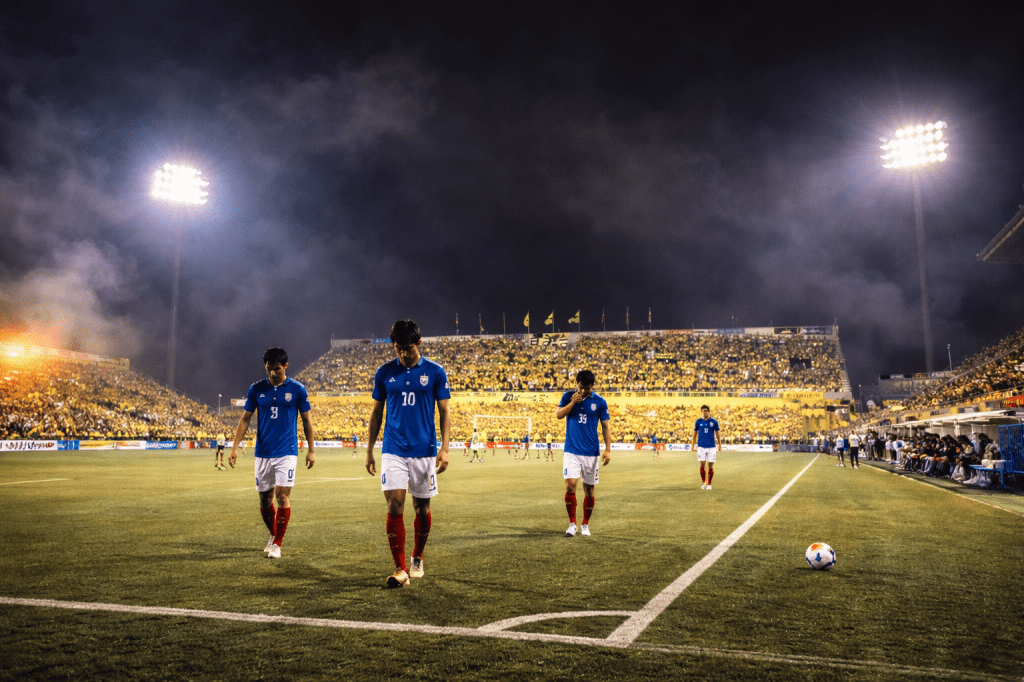
Hitachidai does not overwhelm through scale. It suffocates through proximity.
The stands press inward, the noise arrives early and lingers, and even the sensory details — the scent of charcoal chicken drifting from concourse vendors — create an environment that feels lived-in, territorial, and faintly hostile to outsiders. It is not grand. It is intimate in the most uncomfortable sense.
For visiting teams, that intimacy becomes a distortion. Passing lanes feel narrower. Decision-making accelerates. Small errors echo louder.
For Yokohama F. Marinos, it has become something more than a difficult away ground. It is a recurring problem without a clean solution — a fixture where optimism tends to arrive inflated and leave punctured.
From Cathedral to Cage
The contrast could not have been sharper.
Two weeks prior, Marinos had dismantled Kawasaki Frontale 5-0 under the sweeping architecture of Japan National Stadium. That performance suggested evolution — a team embracing Hideo Oshima’s vision of high-intensity pressing and progressive possession.
It felt expansive.
Controlled.
Forward-looking.
Hitachidai offered none of those comforts.
Instead, it forced compression — of space, of time, of ideas.
And within 11 minutes, the entire tactical framework collapsed.
The Red Card That Rewrote the Game
Football often hinges on marginal moments. Occasionally, it hinges on a single irreversible one.
When Hinata Yamauchi stripped possession near midfield, the transition was immediate and ruthless. His run carried not just the ball, but the entire trajectory of the match.
Behind him, Jason Quinonez made the only decision available in that fraction of time — a foul born from necessity rather than malice.
The outcome was decisive: red card for denying a clear goal-scoring opportunity.
In that instant, Oshima’s philosophical project — the pressing triggers, the positional rotations, the calculated aggression — became irrelevant. Structure gave way to survival.
Resistance as Identity
Reduced to ten men before the game had settled, Marinos were forced into a tactical retreat that redefined the match.
The system compressed into a reactive block — nominally a 4-4-1, but in practice a fluid defensive shell shaped by constant pressure. Kota Watanabe dropped deeper to anchor transitions, while Taisei Inoue adapted into a central defensive role.
The objective was no longer progression.
It was containment.
For extended periods, that containment held.
Even after Yota Komi converted from the penalty spot in the 18th minute — following an unusually prolonged, almost theatrical run-up — the scoreline remained within reach. At 1-0, the narrative could still be framed as resilience.
And for nearly an hour, Marinos embodied that resistance.
Lines held.
Spaces closed.
Effort multiplied.
This was not passive defending. It was active endurance — a team negotiating the physical and psychological demands of playing a man down in one of the league’s most oppressive environments.
Kashiwa’s Controlled Aggression
If Marinos’ performance became defined by resistance, Kashiwa Reysol’s approach was defined by calculated expansion.
Under Ricardo Rodriguez, the nominal 3-4-2-1 system evolved into something far more aggressive in execution. Taiyo Koga remained as the central defensive anchor, but his fellow centre-backs operated with unusual freedom, stepping into advanced positions to create overloads in midfield and half-spaces.
The effect was structural imbalance — intentional and effective.
Kashiwa stretched the pitch horizontally and vertically, forcing Marinos’ compact block to constantly shift and recalibrate. Possession was not sterile; it was probing, iterative, and patient.
The red card did not simply tilt the match.
Kashiwa’s structure ensured it stayed tilted.
Rodriguez’s post-match reflection framed it succinctly: the dismissal was not an isolated incident, but a product of sustained pressure and effective play.
The Illusion of Stability
For all of Kashiwa’s territorial dominance, the match remained precariously balanced deep into the second half.
At 1-0, the game existed in a fragile equilibrium. One clearance, one counterattack, one moment of individual quality could have disrupted the script.
But endurance has limits.
Physical fatigue manifests first in the legs, then in the mind. Concentration wavers. Reactions slow by fractions that prove decisive.
By the 80th minute, that erosion became visible.
Collapse in the Margins
The second goal did not arrive as a moment of brilliance. It arrived as a moment of inevitability.
A strike from Koya Yuruki took a deflection, looping beyond control and into the net. An own goal, but more accurately a consequence of accumulated pressure.
At 2-0, the resistance narrative ended.
Two minutes later, the third goal followed — a transition finished by Hayato Nakama with composure that reflected the state of the game. Marinos, having expended themselves for nearly 80 minutes, had nothing left to reorganise.
The final scoreline — 3-0 — suggested comfort.
The process that produced it was anything but.
Statistical Reflection vs Emotional Reality
The raw numbers underline the imbalance:
- Shots: 17 (Kashiwa) to 4 (Marinos)
- Territorial control heavily favouring the home side
Yet statistics alone fail to capture the nature of the contest.
For long stretches, this was not a dominant performance in the traditional sense. It was a sustained application of pressure against a team operating at the edge of its physical capacity.
Marinos’ defensive effort was not reflected in possession or shot metrics, but in duration — nearly 70 minutes of organised resistance with ten players.
A Glimpse Beyond the Result
Amid the structural and physical breakdown, a quieter narrative emerged.
Hiroto Asada’s late introduction carried limited immediate impact on the match, but broader symbolic weight. An 18-year-old entering a high-pressure scenario after a prolonged absence reflects both necessity and intent within the squad’s development pathway.
His post-match comments — focused on competitiveness and readiness to challenge senior players — aligned closely with the “toughness” Oshima has publicly identified as a missing component.
In a match defined by structural failure and physical depletion, that individual mentality offered a different lens on progression.
The Broader Pattern
This defeat does not exist in isolation.
For Marinos, the season has become a series of extremes — emphatic victories followed by heavy defeats. The 5-0 dismantling of Kawasaki Frontale now sits in stark contrast to a 3-0 loss that exposed fragility under pressure.
The league table reflects that inconsistency:
- 3 wins
- 6 losses
- 9th place in a 10-team regional group
This is not merely a matter of results. It is a question of identity consolidation.
Oshima’s approach demands technical precision and collective resilience. The red card at Hitachidai exposed how quickly that framework can collapse when either element is compromised.
Kashiwa’s Momentum
For Kashiwa, the result represents more than three points.
Back-to-back full-time victories signal emerging stability within Rodriguez’s system. The tactical flexibility, aggressive positioning, and emotional cohesion — amplified by the context of his birthday weekend — contributed to a performance that felt both controlled and expressive.
Celebration and structure coexisted.
That combination is often a marker of a team moving in a clear direction.
The Enduring Question
Hitachidai continues to function as a revealing environment.
Not because it is uniquely hostile, but because it magnifies existing qualities — both strengths and weaknesses.
For Marinos, it has become a recurring site of exposure. Tactical ambition alone is insufficient without the structural resilience to withstand disruption. Playing with ten men for 80 minutes is an extreme scenario, but the underlying issues it reveals — fragility, inconsistency, reliance on ideal conditions — extend beyond a single match.
For Kashiwa, it is a platform that reinforces identity. Compact, intense, and aligned with their approach.
The Final Image
At full time, the scoreboard recorded a comprehensive defeat.
Yet the more telling image lay beyond the numbers.
Marinos’ players, physically exhausted, acknowledged a travelling support that had witnessed both resistance and collapse. The response from the stands remained supportive — an affirmation of effort, if not outcome.
In a season defined by fluctuation, that relationship between team and supporters may prove as significant as any tactical adjustment.
Because while systems can be redesigned and results recalibrated, belief — once fractured — is far harder to reconstruct.
Kashiwa Reysol vs Yokohama F. Marinos (April 2026)
What was the final score?
Kashiwa Reysol defeated Yokohama F. Marinos 3-0 at Hitachidai.
What was the key turning point?
The 11th-minute red card for Jason Quinonez (denial of a goal-scoring opportunity) forced Marinos to play with ten men for most of the match.
How did Kashiwa Reysol win tactically?
- Aggressive 3-4-2-1 system with advanced centre-backs
- Sustained pressure against a reduced defensive block
- Effective use of width and overloads
Why did Yokohama F. Marinos struggle?
- Early red card disrupted tactical structure
- Heavy defensive workload led to late fatigue
- Inability to transition from defence to attack
Who scored the goals?
- Yota Komi (penalty)
- Own goal (deflection from Koya Yuruki shot)
- Hayato Nakama
What does this result mean for the standings?
- Marinos drop to 9th in the EAST group (3 wins, 6 losses)
- Kashiwa move up to 7th, building momentum
What are the key takeaways?
- Marinos’ inconsistency remains a defining issue
- Kashiwa’s tactical identity is strengthening
- Hitachidai continues to expose structural weaknesses in visiting sides
 doragon sports