
There are defeats that expose weakness.
And then there are defeats that hurt precisely because they reveal strength.
Sfida Setagaya’s 3-2 loss away to Yokohama FC Seagulls at Nippatsu Mitsuzawa Stadium belongs firmly in the second category. This was not the collapse of a poor side. It was the anguish of a team that played with conviction, imposed itself for long stretches, clawed its way back into the contest, and still somehow left empty-handed under the grey Yokohama sky.
That is what made it sting.
Because for much of this Matchday 4 meeting in the 2026 Plenus Nadeshiko League Division 1, Sfida looked like the more purposeful side. The more assertive side. The side with the clearer idea of what it wanted to be.
They played like a team in motion. A team with identity. A team with urgency. A team that understood the weight of this season and refused to treat it like background noise.
But football, cold little creature that it is, does not always reward the side that carries the stronger narrative or even the stronger spell of control. Sometimes it waits until the 94th minute, lets you believe you’ve rescued something, and then tears it away anyway.
That was the cruelty of Mitsuzawa.
That was the cruelty of this result.
A Match Loaded With More Than Points
This fixture already carried an edge before a ball was kicked.
Recent meetings between these two sides had become stubborn, tense, almost ritualistically level. The last four league clashes across 2024 and 2025 had all ended in draws. Not wild, chaotic, trading-blows draws either. Tactical stalemates. Arm-wrestles. Games in which neither team could fully impose itself on the other.
This one felt different from the start.
For Yokohama, there was emotional fuel in the air after the season-ending injury to defender Kotono Kamiduru. For the home side, this was a chance to channel pain into momentum, to carry that energy into a season that had started unevenly but now hinted at lift-off.
For Sfida, the emotions ran deeper still.
Every match this season is framed by the looming reality of change. The coming merger and transition into FC Tokyo Sfida in 2027 hangs over every kickoff, every away trip, every moment of joy and every setback. That does not mean the current club is vanishing quietly. Quite the opposite. It means every performance now feels a little more charged, a little more defiant, a little more conscious of legacy.
And after the thunderous 5-0 dismantling of Okayama Yunogo Belle in their previous outing, Sfida arrived in Yokohama with genuine momentum. They were not coming here to manage a point or survive the occasion. They were coming to build something.
For long periods, they did.
SFIDA’s Identity Was Clear From the First Whistle
From the opening phases, Takashi Hamada’s team played with the same bite and conviction that had overwhelmed Okayama a week earlier.
The shape was aggressive. The intent even more so.
Sfida pressed high, squeezed space, and tried to pin Yokohama into uncomfortable areas. They did not come to admire Mitsuzawa or absorb its atmosphere. They came to take the game by the throat.
That assertiveness mattered.
Too often, away performances in emotionally loaded fixtures can become passive. Teams talk themselves into caution, convince themselves the sensible thing is to settle in, keep shape, feel the match out. Sfida did the opposite. They went straight at it. There was no apology in their football.
And crucially, they were rewarded.
Their opener came as a vindication of the whole approach. A high press, a forced turnover, a quick finish. It was classic Hamada-ball in miniature. Suffocate the buildup, turn pressure into panic, turn panic into a goal.
That goal was not just an early lead. It was a statement. A reminder that the 5-0 against Okayama had not been a one-off burst of sunshine and finishing form. The mechanisms were real. The confidence was real. The pressure system was real.
At that stage, Sfida looked like a side growing into its season.
Yokohama’s Response Changed the Texture, Not the Truth
To their credit, Yokohama responded quickly.
Yuho Matsuo’s equaliser in the 11th minute shifted the emotional rhythm of the afternoon and gave the home crowd something to grab onto. It was the kind of opportunistic goal that can steady a team and sharpen its belief.
And yet, even with the score level, the match did not suddenly become a story of Yokohama dominance.
That is the important distinction.
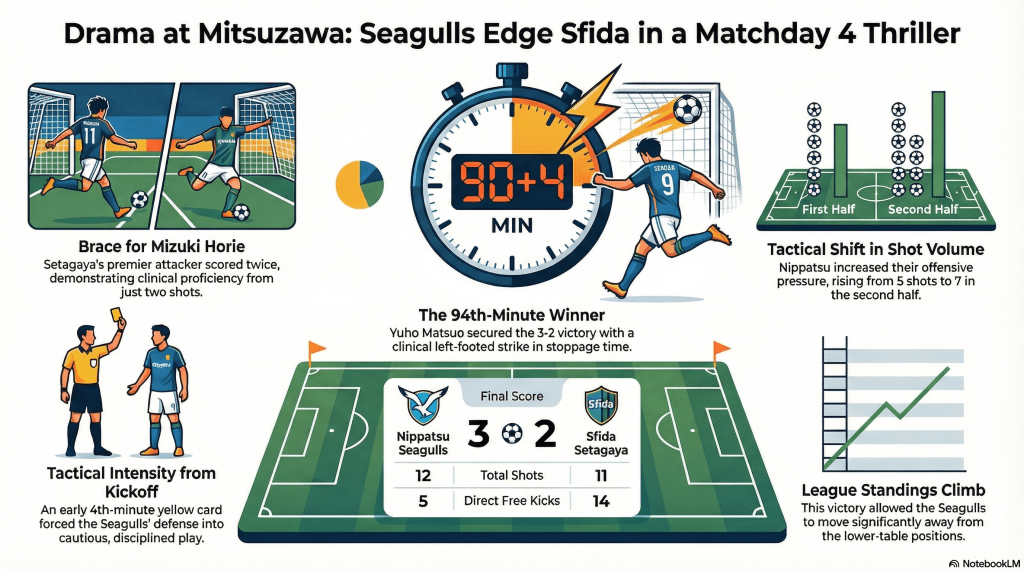
Sfida continued to carry the greater territorial aggression. They continued to push, to force restarts, to earn free kicks, to keep the match in areas Yokohama would rather have escaped from. The away side finished with a remarkable 14 direct free kicks to Yokohama’s five, and while statistics rarely tell the whole emotional truth of a football match, that number captures something important here: Sfida were not passengers. They were instigators.
This was not a smash-and-grab defeat. It was a game in which Sfida invested heavily, physically and tactically.
Their pressing shape kept asking questions. Their set-piece threat remained live. Their forward line kept making itself a nuisance.
The outstanding symbol of that threat was, once again, Mizuki Horie.
Mizuki Horie Continues to Look Like the Reference Point
Every strong side needs a figure through whom its chaos can become something concrete.
For Sfida, Horie increasingly looks like that figure.
At 174cm, she offers a physical reference that few teams in the division can comfortably ignore, but reducing her game to height alone would miss the point. What makes Horie so important to this Sfida side is not just aerial dominance. It is the way she turns pressure into consequence.
Her first goal in this match, a one-touch ground finish created from the press, showed sharpness and instinct. Her second, a soaring header from a corner, showed authority and timing. Together, the two finishes captured why she matters so much to the way Sfida play.
When Hamada’s side forces games into frantic, compressed, high-pressure territory, they need someone who can finish those sequences. Someone who can punish half-errors, attack deliveries, occupy defenders, and give the whole structure a focal point.
Horie did all of that.
And in doing so, she gave Sfida a route back into the game when it looked like the afternoon might tilt away from them.
The Comeback Said Everything About SFIDA’s Character
If the first goal was a statement of intent, the equaliser at 2-2 was a statement of character.
Because by then, the match had already swung emotionally.
Koko Muroi’s superb 51st-minute solo goal for Yokohama was the kind of strike that can break an opponent’s spirit. A driving run down the left, a cut inside, a thunderous finish into the far corner. It was a beautiful goal, and it gave the home side the kind of emotional surge that can turn a stadium into a weapon.
This is where weaker teams fold.
This is where teams with shaky identity begin to drift, begin to chase the game emotionally rather than structurally.
Sfida did neither.
They stayed in the fight. They stayed in themselves. They continued to press, continued to ask questions, continued to lean on their strengths instead of panicking and reaching for something alien.
That response deserves enormous credit.
Because coming back in a game like this, away from home, in a stadium tightening with noise, is about more than tactics. It is about nerve. It is about self-belief. It is about a squad refusing to accept the emotional script being written around it.
And when Horie powered in the equaliser from a corner, it felt deserved.
Not lucky. Not accidental. Deserved.
At 2-2, Sfida had dragged themselves back to a place their play had merited.
That mattered.
This Is Why the Ending Hurts So Much
If Sfida had been poor and lost late, the reaction would be frustration.
Because they were brave and good and resilient and still lost late, the reaction is closer to heartbreak.
Yuho Matsuo’s winner in the 94th minute was a brutal way for the afternoon to end. A late arrival in the box, a left-footed finish, the stadium erupting, the points gone.
And that is the part that will linger.
Not because Yokohama did nothing to earn their victory. They did. Their moments were sharp, their finishing decisive, and players like Muroi and Matsuo punished the openings available to them.
But from a Sfida perspective, this was a match that should leave an ache rather than embarrassment.
They led the game.
They came back into it.
They carried long stretches territorially.
They showed again that their pressing identity can travel.
They showed again that their key players are in form.
That is why dropping points at the death feels so cruel. Because it wasted a performance that contained so much of what is compelling about this team right now.
The Bigger Picture Still Favors SFIDA’s Direction
Results matter. Of course they do.
But so do signs.
And there were plenty of encouraging ones for Sfida here, even through the pain.
Misuzu Uchida continues to feel like a player vibrating with purpose, especially in emotionally charged matches like this. Horie is turning into one of the league’s clearest attacking reference points. The press remains disruptive. The set-piece danger is real. The team’s willingness to keep playing its own football, even in difficult moments, is unmistakable.
Most importantly, this performance followed the spirit of the Okayama demolition rather than contradicting it.
This was not a limp regression after a big win. It was a continuation of a side rediscovering itself.
The disappointment is real, and it should be. Losing like this should hurt. It should leave a bitter taste. It should irritate everyone connected to the club.
But it should not blur the more important truth.
Sfida are alive.
They are dangerous.
And if they keep producing performances with this much personality, pressure, and stubborn refusal to fold, there will be more days ahead when the ending belongs to them.
At Mitsuzawa, they deserved more.
That is precisely why it hurts so much to get none.
What was the final score between Yokohama FC Seagulls and Sfida Setagaya?
Yokohama FC Seagulls defeated Sfida Setagaya 3-2 in Matchday 4 of the 2026 Plenus Nadeshiko League Division 1.
Why is this defeat so disappointing for Sfida Setagaya?
Because Sfida played well enough to take the lead, respond strongly after falling behind, and remain the more territorially aggressive side for long stretches before conceding a 94th-minute winner.
Who were Sfida Setagaya’s standout players in the match?
Mizuki Horie was the biggest standout, scoring twice and again proving herself as the focal point of Sfida’s attack. Misuzu Uchida also remained an important emotional and tactical presence.
What positives can Sfida take from the match?
Their pressing system worked in spells, they created sustained pressure, they showed resilience to come back into the game, and key attacking players remain in strong form.
How did Yokohama FC Seagulls win the game?
Yokohama were ruthless in key moments. Koko Muroi scored a brilliant solo goal in the second half, while Yuho Matsuo struck twice, including the 94th-minute winner.
What does this result mean for Sfida’s season?
Although the defeat is painful, the performance suggested Sfida’s identity is growing stronger. After beating Okayama 5-0 and then competing strongly away at Yokohama, there are clear signs this team is building momentum despite the loss.
 doragon sports