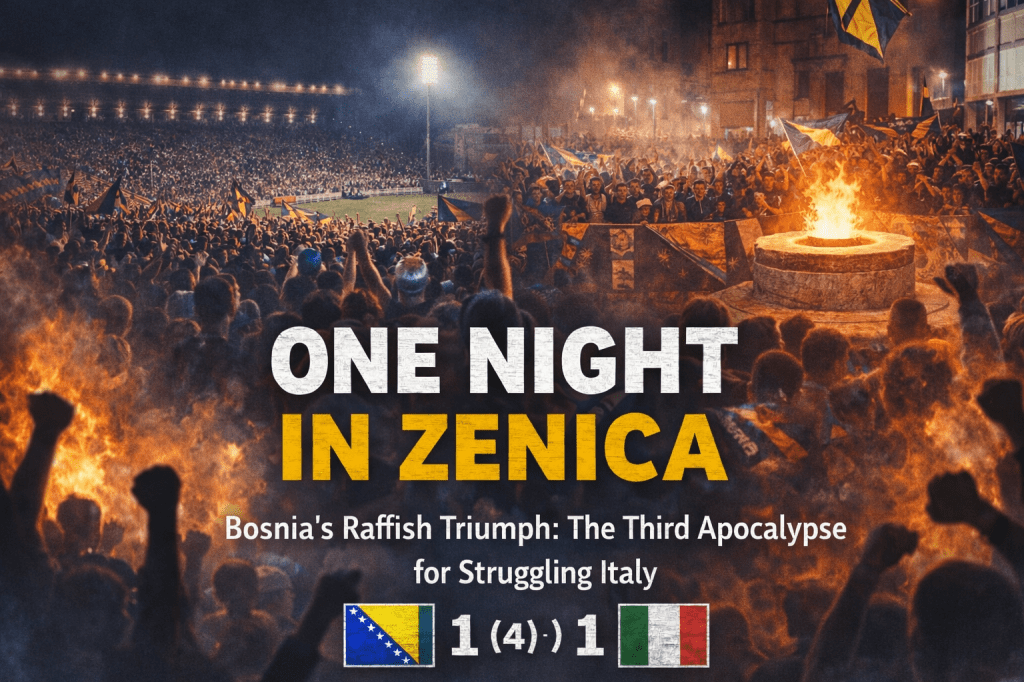
There are nights in football that feel borrowed from folklore. And then there are nights like this one in Zenica, where reality itself seems to bend under pressure. Bosnia and Herzegovina didn’t just beat Italy. They dragged them into something elemental, something volcanic, something that spat sparks and swallowed reputations whole.
This was not just a playoff final. This was a reckoning dressed up as a football match.
Game Context & Stakes: The Third Apocalypse Knocks
Italy arrived in Zenica carrying history like a fragile heirloom. Four World Cups, a cabinet of legends, and yet here they were again, staring down the possibility of a third consecutive absence from football’s grandest stage. A nation that once defined international football now stood on the brink of becoming a cautionary tale whispered across generations, from Milan to Naples.
For Bosnia and Herzegovina, the stakes felt entirely different. This was not about preserving legacy. This was about writing it. Only one World Cup appearance as an independent nation, back in 2014, and now a chance to carve a second chapter into existence.
At the heart of it all stood Edin Džeko, 40 years old, moving through the game like a man who understood time was no longer a friend but a negotiator. Every touch, every duel, every glance toward goal carried the weight of a final act.
On the other side, Italy’s identity crisis deepened. Children across the country are now growing up with stories of the Azzurri rather than memories. That shift matters. It reshapes what a football nation believes about itself. Supporting Juventus isn’t even that fun anymore.
Narratives & Human Subplots: From Control to Collapse
Italy struck first. A sharp, clinical finish from Moise Kean in the 15th minute. It felt like order had been restored, like the script would follow familiar lines.
But football rarely respects scripts in places like Zenica.
The turning point arrived in the 41st minute. Alessandro Bastoni, caught in a moment of desperation, brought down Amar Memić as the last man. Red card. No debate. No escape.
From that moment, the game mutated.
Italy retreated into themselves, their 3-5-2 collapsing into something shapeless, something reactive. Bosnia sensed it instantly. The energy shifted. The air thickened. Every pass, every challenge carried an extra ounce of intent.
And then came the siege.
Wave after wave, Bosnia pressed forward. Not elegantly, not delicately, but with a radular insistence. The kind of pressure that grinds rather than dazzles. The kind that asks questions until something breaks.
It did.
Haris Tabaković’s equaliser in the 79th minute felt inevitable, like a geyser finally bursting through layers of resistance. Italy had been bending for nearly 40 minutes. Now they snapped.
Extra time blurred into exhaustion. And then penalties.
The Theatre of Nerves: Youth Without Fear
Penalty shootouts are strange creatures. They strip football down to its barest essentials. Technique, nerve, and something harder to define.
Bosnia stepped forward like a team unburdened by history.
Esmir Bajraktarević, the “Milwaukee Messi,” carried a dual identity and turned it into a singular moment. His penalty was decisive, fearless, the final brushstroke on a masterpiece of defiance.
Even more striking was the composure of Kerim Alajbegović. Just 18 years old, stepping into a moment that could define careers, and placing his penalty with the calm of someone playing in a quiet park rather than under the glare of a nation’s expectations.
Italy, meanwhile, unraveled.
Gianluigi Donnarumma, the Man City keeper, a hero across so many nights, found himself caught in the psychological quicksand of the shootout. His attempt to disrupt Bosnia’s preparation by tearing up Nikola Vasilj’s notes felt less like cunning and more like desperation dressed in dark arts.
It didn’t work.
Bosnia won the shootout 4-1.
Tactics & Stats: A Game Turned Inside Out
On paper, Italy’s setup made sense. A structured 3-5-2, wing-backs providing width, midfield control dictating tempo. It’s a system designed for authority.
But systems rely on stability. And Bastoni’s red card shattered that foundation.
From then on, Italy became reactive. Deep lines, rushed clearances, fragmented transitions.
Bosnia, under Sergej Barbarez, embraced chaos in the most organised way possible. A direct 4-4-2, relentless in its intent. Crosses, second balls, aerial duels. Not pretty, but devastatingly effective.
The numbers paint it starkly:
- 65% possession for Bosnia
- 30+ shots to Italy’s 9
- 11 shots on target to Italy’s 3
- Over 700 passes completed
This wasn’t just pressure. This was territorial dominance, sustained and suffocating.
Italy didn’t just lose control. They lost the ability to regain it.
Atmosphere & Culture: The Inferno of Zenica
Stadion Bilino Polje is not a place that welcomes you gently. It engulfs you.
The stands press close, the noise folds in on itself, and the entire space feels alive in a way that modern stadiums often don’t. On this night, it burned. Not metaphorically. Emotionally, viscerally, relentlessly.
The roar wasn’t constant. It pulsed. It surged. It reacted to every duel, every clearance, every half-chance. A living organism feeding off the game unfolding beneath it.
When the final penalty hit the net, the release was immediate and overwhelming.
Zenica erupted.
And then Sarajevo followed.
The celebrations spilled into the streets, into the night, into something that felt bigger than sport. Football, in Bosnia and Herzegovina, is not just entertainment. It is identity. It is unity. It is memory and hope tangled together.
Italy’s Paradox: Champions Without a Future?
Here lies the strangest contradiction.
Italy are not a fallen nation in the traditional sense. They are recent European champions. UEFA Euro 2020 still glimmers in the rearview mirror.
And yet, here they are. Absent again. Lost again.
How does a team capable of conquering Europe find itself unable to navigate qualification?
The answer is not simple. It lives somewhere between tactical rigidity, generational transition, and psychological fragility. A deontic weight of expectation that turns every setback into a spiral.
Players like Leonardo Spinazzola now face the reality of careers without World Cup memories. Fans face something even stranger. A gradual detachment from a tournament that once defined their summers.
Italy are not just losing matches. They are losing continuity.
Bosnia’s Moment: A Story That Refuses to Sit Still
For Bosnia and Herzegovina, this victory is not just a qualification. It is a declaration.
A team led by a manager with no prior senior experience. A squad blending veterans and fearless youth. A style that prioritises intensity over elegance.
And at the centre, Džeko. Shoulder strapped, body battered, spirit unbroken. Watching, guiding, embodying everything this night represented.
Football loves narratives. This one writes itself.
A nation divided in so many ways, unified by 90 minutes and a shootout. A generation stepping forward without hesitation. A legend refusing to fade quietly.
Final Whistle: One Night That Echoes
Some matches fade. Others linger.
This one will echo.
Because it wasn’t just about who won or lost. It was about how it happened. About the shift from control to chaos. From expectation to disbelief. From history to possibility.
One night in Zenica, the inferno burned bright.
And from it, Bosnia and Herzegovina emerged, not just as qualifiers, but as something far more dangerous.
Believers.
Bosnia vs Italy Playoff Final Explained
Who won Bosnia vs Italy in the 2026 World Cup playoff?
Bosnia and Herzegovina defeated Italy via penalties (4-1) after a 1-1 draw.
Why is this result significant for Italy?
Italy failed to qualify for a third consecutive World Cup (2018, 2022, 2026), marking a historic slump despite winning Euro 2020.
Who were the key players in the match?
Edin Džeko led Bosnia with experience and influence, while young players like Esmir Bajraktarević and Kerim Alajbegović starred in the shootout. Moise Kean scored Italy’s only goal.
What changed the game tactically?
Alessandro Bastoni’s red card forced Italy into a defensive shape, allowing Bosnia to dominate possession and create sustained pressure.
Where was the match played?
At Stadion Bilino Polje in Zenica, Bosnia and Herzegovina.
What does this mean for Bosnia?
They qualify for the 2026 FIFA World Cup, marking only their second appearance as an independent nation.
 doragon sports