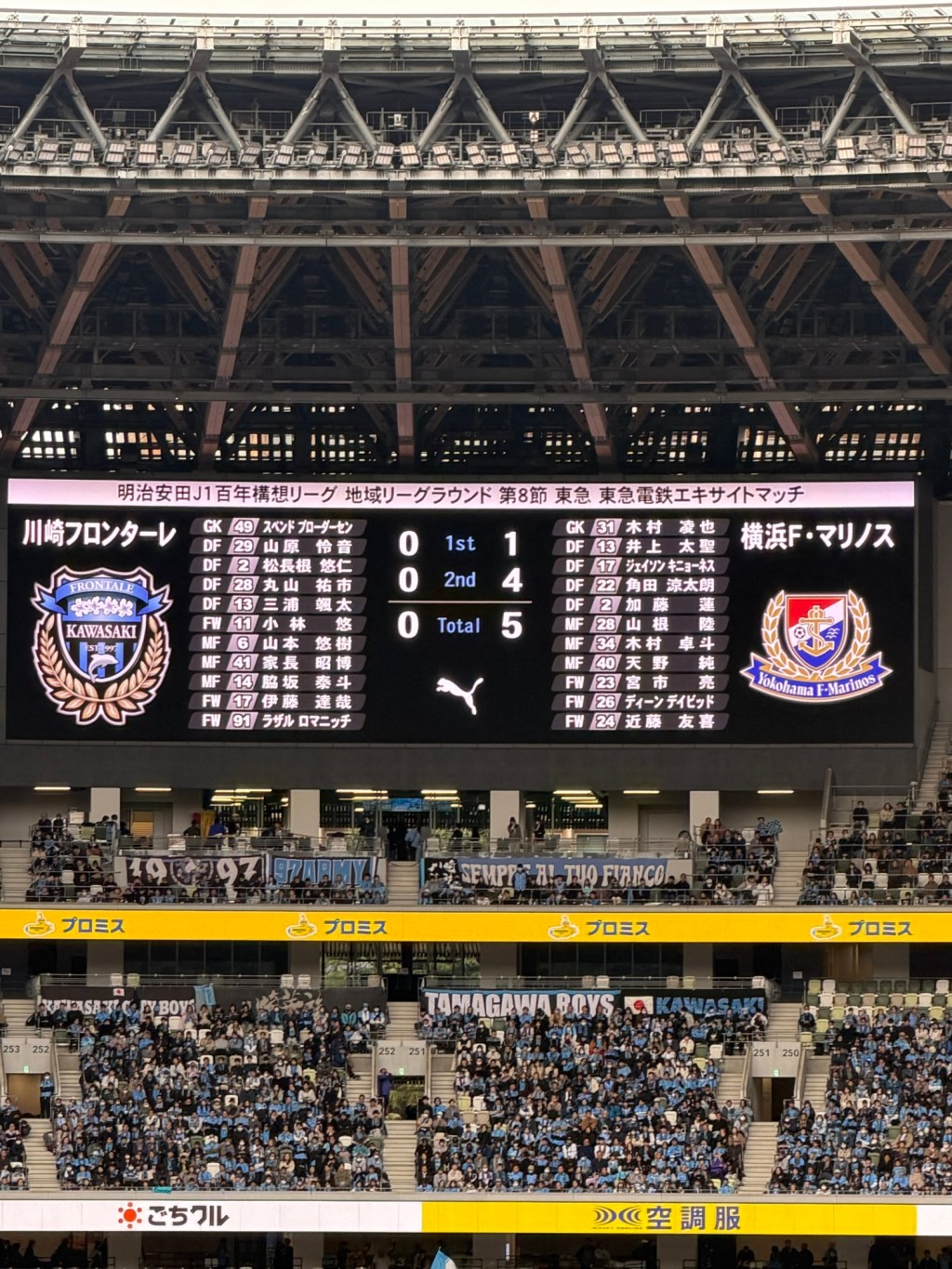
There are football matches that drift by like commuter trains. Then there are those that crash through the national psyche like a thunderclap. On a restless Tokyo afternoon, beneath the sweeping steel halo of the National Stadium, Kawasaki Frontale and Yokohama F. Marinos staged a derby that felt less like sport and more like ritual. This was billed as celebration, history, spectacle. It became something far darker and far more unforgettable.
For Frontale, hosting their first ever “home” fixture at the capital’s grandest stage was meant to be an enchanting declaration of ambition. A statement that their championship DNA still pulsed beneath the skin. For Marinos, bruised by recent disappointment and drifting mid-table, the journey across Kanagawa lines was supposed to be about survival. By the final whistle, the narrative had been shredded, rewritten in harsh neon ink across a stunned crowd of over fifty thousand.
A Colosseum Baptism
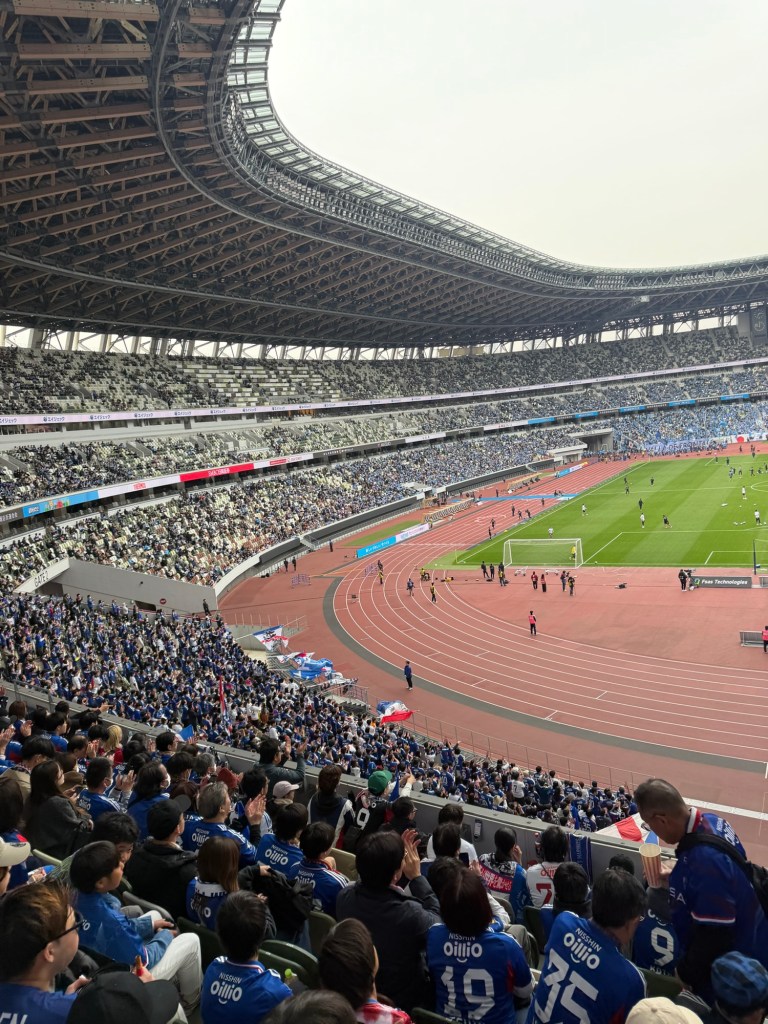
From the outset, the symbolism was impossible to ignore. Pre-match festivities had transformed the stadium into a cultural pageant. Yabusame archers galloped across ceremonial turf, arrows slicing the air in a choreography that felt equal parts ancient and theatrical. Supporters in sky blue scarves sang of continuity and pride. The setting glowed with an enchanting sense of occasion.
Yet football has a habit of torching its own stage props. Within ninety brutal minutes, the pageant gave way to public reckoning.
Frontale entered the contest sitting sixth in the table, still clinging to the belief that their title-winning aura could be rekindled. Marinos, two places lower, arrived carrying the sour aftertaste of defeat and the quiet urgency of a team desperate to rediscover its identity. The derby, as always, promised fire. Few anticipated the inferno becoming of a scramble match.
The Moment the Stadium Fell Silent
The first half unfolded with a brittle intensity. Kawasaki probed, occasionally finding rhythm through captain Yasuto Wakizaka’s clever positioning. A disallowed goal hinted at their attacking potential. Yet the mood shifted irrevocably just before the interval.
Daiya Tono, Marinos’ creative heartbeat, collapsed unchallenged near the centre circle. The stadium’s roar evaporated into an eerie hush as medics rushed on. He clutched his right Achilles, a haunting echo of last season’s injury nightmare. Teammates knelt nearby, their faces etched with disbelief. Supporters who moments earlier had traded chants now shared a collective intake of breath.
Inside the Marinos dressing room at halftime, tactics became secondary. Players spoke later of a single rallying cry, raw and stripped of analysis: For Daiya. Football’s emotional circuitry had been rewired in real time.
Amano the Avenger
Enter Jun Amano. Introduced under a cloud of anxiety, he emerged as the game’s architect of devastation. Within minutes of the restart, his presence reshaped the derby’s tempo. He glided between Kawasaki’s lines with predatory intelligence, as if reading defensive hesitations like sheet music.
His first contribution, a sharply taken goal, punctured Frontale’s composure. The second was a work of sly artistry. Receiving possession outside the box, he caressed the ball into a looping trajectory that hung in the air like a cruel thought before dipping into the net. The third act of his personal symphony came via an assist, a dagger threaded through a disintegrating backline.
Amano later spoke of responsibility. Of wanting to honour Tono’s suffering by turning pain into purpose. His performance was not merely effective. It was theatrical, decisive, merciless.
The Boy in the Furnace
On the opposite side of the emotional spectrum stood Shunsuke Hayashi. Nineteen years old, academy-raised, debuting at centre-back in the nation’s most intimidating arena. Football careers often hinge on moments of revelation. For Hayashi, the derby became a trial by fire.
Marinos targeted him relentlessly. Long balls rained toward his zone like guided missiles. Veteran striker Kaina Tanimura prowled nearby, ready to exploit hesitation. One mistimed decision opened the pathway for Marinos’ second goal, a sequence that seemed to drain the young defender’s confidence in visible increments.
To his credit, Hayashi faced the aftermath with disarming honesty. He admitted his naivety, his split-second miscalculations. In a sport that rarely forgives innocence, his candour felt almost heroic.
Tactical Chess or Controlled Explosion
From a strategic perspective, the derby offered a study in contrasts. Marinos adopted a disciplined 4-4-2, compact in midfield yet explosively direct in transition. Recognising the fragility of Kawasaki’s youthful defensive pairing, they bypassed pressing traps with ruthless efficiency. Quick channel balls stretched Frontale’s shape, exposing spaces that became highways to goal.
Kawasaki, meanwhile, attempted to construct attacks through a possession-based three-back structure. In theory, the system promised fluidity. In practice, it collapsed into predictability. Goalkeeper Svend Brodersen’s panicked long clearances symbolised a broader loss of composure. Build-up sequences dissolved before they could mature.
The statistical ledger underlined the narrative. Marinos produced a significantly higher expected goals figure, converting chances with surgical precision. Frontale created opportunities yet lacked the emotional equilibrium to capitalise. Football, in this instance, rewarded clarity of intent over aesthetic aspiration.
Pride, Pressure and Public Fury
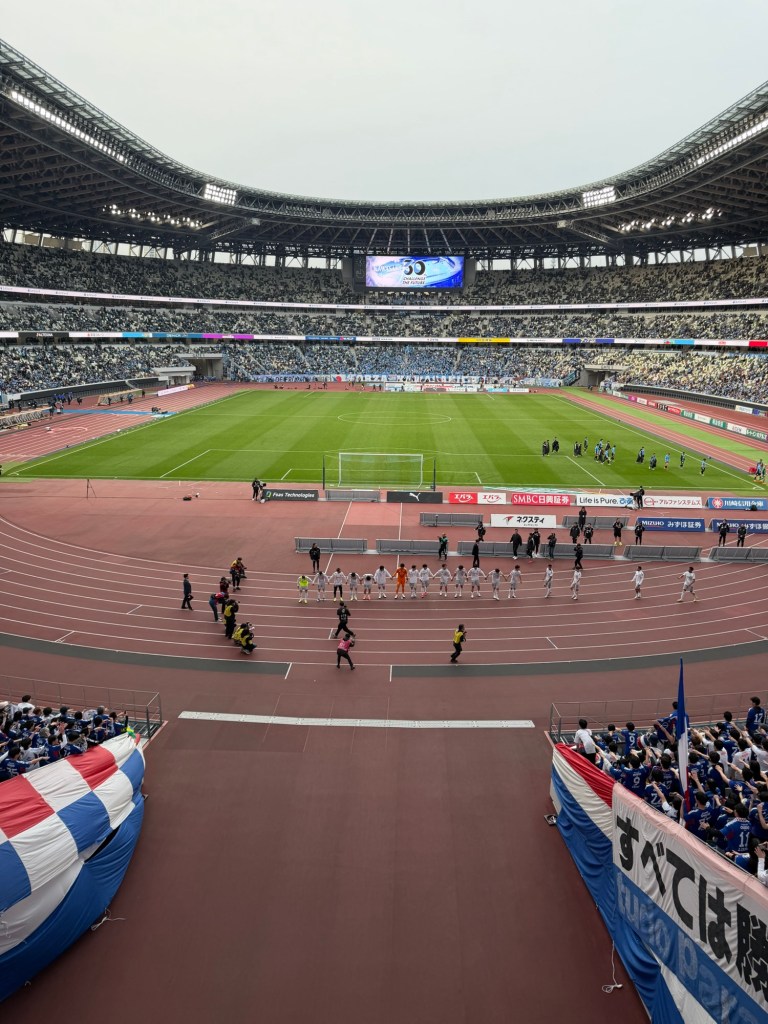
Perhaps the most enduring image of the afternoon arrived after the final whistle. Kawasaki’s players approached their supporters, expecting empathy, maybe reluctant applause. Instead they encountered a wall of boos. Not scattered frustration, but a unified roar that reverberated through concrete tiers.
Frontale’s fanbase has long been celebrated for its warmth and community spirit. This eruption felt seismic. The 5-0 defeat did more than dent league ambitions. It fractured a sacred covenant between club and city. Veteran forward Yu Kobayashi articulated the collective anxiety with stark bluntness. If the team failed to confront this collapse, he warned, the era of Frontale’s glory might truly be over.
Manager Shigetoshi Hasebe now finds himself navigating turbulent waters. Injuries have limited his tactical options, yet supporters demand resilience and psychological steel. The derby exposed a side lacking both.
A Derby That Redefined Momentum
For Marinos, the victory represents more than three points. It is a psychological reset, a demonstration that adversity can catalyse unity. The squad’s response to Tono’s injury forged a narrative of brotherhood that may define their season. Amano’s explosive cameo has elevated him from supporting cast member to central protagonist.
For Kawasaki, the aftermath feels heavier. Questions about squad depth, defensive structure and leadership loom large. The enchanting dream of transforming the National Stadium into a fortress dissolved into a cautionary tale about expectation and fragility.
Football often romanticises redemption arcs. This derby, however, lingered in harsher territory. It reminded observers that the sport’s emotional gravity can tilt suddenly, pulling heroes and hopefuls into orbit before casting them back toward earth.
What was the result of Kawasaki Frontale vs Yokohama F. Marinos on March 22, 2026?
Yokohama F. Marinos won convincingly, defeating Kawasaki Frontale 5-0 at the National Stadium in Tokyo.
Why was this match historically significant?
It marked Kawasaki Frontale’s first ever home fixture staged at the National Stadium, turning the derby into a landmark event in club history.
Who was the standout player in the Kanagawa Derby?
Jun Amano delivered a decisive performance for Marinos, scoring twice and providing an assist after coming on as a substitute.
What does the result mean for Kawasaki Frontale’s season?
The heavy defeat has intensified scrutiny on the manager and highlighted defensive vulnerabilities, raising concerns about the club’s ability to sustain a title challenge.
In the theatre of Japanese football, derbies often write their own mythology. This chapter will be remembered not just for goals or tactics, but for the fragile humanity that flickered between celebration and collapse under Tokyo’s vast, watchful sky.
 doragon sports