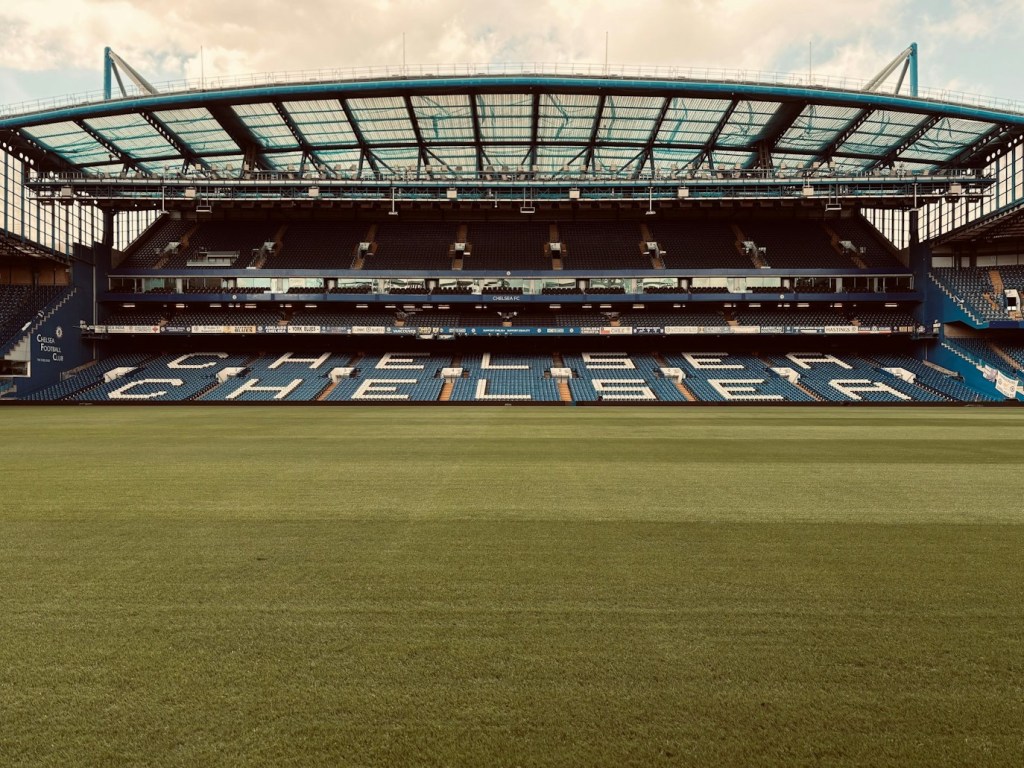
There is something beautifully stubborn about Stamford Bridge.
It does not sprawl like a futuristic bowl nor shimmer like a corporate spaceship. Instead, it sits tightly stitched into Fulham’s urban fabric, a football cathedral pressed between railway lines and terraced streets. You feel the club before you even see the pitch. The scent of pre-match lager, the hum of anticipation drifting down Fulham Road, scarves swaying like tidal currents in royal blue.
Opened in 1877 as an athletics venue and transformed into Chelsea’s home in 1905, the ground has evolved in chapters rather than revolutions. Today it holds roughly 40,000 supporters, making it intimate by elite Premier League standards. That intimacy is the magic. Noise does not disperse here. It ricochets. It breathes.
Stand-by-stand character
- Matthew Harding Stand (North)
The emotional engine room. Songs rise early here and rarely stop. Expect flags, defiance, and sharp tactical commentary shouted over plastic pint cups. - East Stand
A relic of bold 1970s architecture. Its steep upper tier feels almost theatrical, like watching football from a balcony in a roaring opera house. - Shed End (South)
Once a raw standing terrace, now modernised but still rich in mythology. Away fans gather in the lower tier, creating a charged conversational duel across the pitch. - West Stand
The polished heartbeat of corporate Chelsea. Executive boxes, hospitality lounges, and the steady murmur of networking layered over matchday tension.
Hidden quirks and historic whispers
Outside the Megastore stands a fragment of the old Shed Wall, a surviving relic from football’s sepia-toned past. Expansion plans have long danced with reality, yet geography and fan ownership structures keep Stamford Bridge proudly rooted where it has always been. Progress here is negotiated rather than imposed.
Matchdays unfold like ritual theatre. The reggae pulse of “The Liquidator” rolls through the stands. The anthem “Blue is the Colour” turns thousands of voices into a single shimmering chorus. Then comes the carefree chant that feels less like arrogance and more like collective release.
Chelsea’s identity has always been urban, sharp-edged, occasionally misunderstood. But it is fiercely loyal. Supporters literally hold influence over the club’s future through fan ownership structures protecting the stadium’s existence in Fulham.
Getting to Stamford Bridge Without Losing Your Sanity
Driving into Fulham on matchday is a strategic error worthy of a last-minute own goal. Residential parking zones tighten like a net and road closures arrive early.
Best routes:
- District Line → Fulham Broadway
Three minutes from station to stadium. Effortless. - London Overground → West Brompton or Imperial Wharf
Adds a gentle 15-minute stroll through matchday buzz. - River boat → Chelsea Harbour
A scenic prelude for romantics who like football with a cinematic entrance.
Pre-Match Food & Drink Rituals
The pub circuit around Stamford Bridge is practically a folklore trail.
- The Butcher’s Hook
Birthplace of the club. Drinking here feels like sipping history. - The Chelsea Pensioner
A warm-up venue humming with nostalgia and analysis. - The Tommy Tucker & Cock Tavern
Classic football pubs where tactical debates become performance art. - Al Santo (Vanston Place)
Local favourite for Italian and Greek comfort fuel before kick-off.
Away supporters often orbit Earl’s Court where pubs are more neutral ground, socially and geographically.
Inside Stamford Bridge
Entry points such as the Britannia Gate funnel supporters into a well-organised but energetic flow. Inside, modern conveniences meet traditional football pleasures.
- Expect pints around £5.70
- Mobile ordering via the CFC Express app in selected areas
- Sightlines that rarely disappoint due to the stadium’s tight geometry
The sound here is layered. Studs scraping turf. Tactical instructions bouncing off steel beams. Collective gasps turning into thunder.
Chelsea Megastore & Museum Experience
Arrive early and wander the two-storey Megastore, a shrine of scarves, shirts, and spontaneous retail decisions.
The Chelsea Museum offers emotional context. Trophy displays shimmer under soft lighting, each silver surface reflecting eras of reinvention and ambition.
The Fulham & West London Snapshot
This corner of West London blends affluence with understated charm. King’s Road offers boutique shopping and stylish cafés. A short Tube ride unlocks cultural landmarks like South Kensington’s museums or riverside walks near Battersea Power Station.
Matchday can easily become a full-day London story. Coffee. Football. Nightlife. Repeat.
Players, Icons & Living Legacy
Chelsea’s timeline glows with larger-than-life figures.
- Peter Osgood symbolises romantic swagger.
- Didier Drogba represents decisive greatness under floodlights.
- John Terry embodies tribal leadership.
Modern narratives centre around Reece James, whose academy roots connect past and present, and creative attackers like Cole Palmer, injecting flair into evolving tactical blueprints.
The Women’s Era of Dominance
Yet the club’s contemporary identity cannot be told without the rise of Chelsea Women, a side that has quietly become one of the most formidable forces in European football.
Under long-time manager Emma Hayes, the team built a culture of relentless excellence, blending technical clarity with emotional intelligence. Domestic titles became almost rhythmic, each season adding another layer to a dynasty rooted in professionalism and collective belief.
Icons such as Sam Kerr brought explosive charisma and decisive finishing, while leaders like Millie Bright anchored the side with steel and composure. Midfield technicians, academy graduates, and international stars have all contributed to a squad identity that feels both global and distinctly Chelsea.
In recent seasons, the women’s team has increasingly stepped onto the Stamford Bridge stage itself, drawing larger crowds and reshaping perceptions of matchday culture. These fixtures carry a different emotional hue. The atmosphere feels lighter yet intensely proud, as supporters recognise they are witnessing not just success but structural change in the club’s legacy.
Chelsea’s story is therefore no longer a single timeline but a twin constellation. One forged in historic European nights and Premier League battles, the other blazing forward with modern ambition and a progressive vision of what football at Stamford Bridge can become.
Tickets & Practical Essentials
Demand often exceeds supply. Stamford Bridge’s relatively modest capacity means:
- Purchase directly via the official club box office
- Consider membership schemes to access early sale windows
- Expect quick sell-outs for major fixtures
On matchday, ticket queries are handled near the Shed End ticket office.
Chelsea FC Quick Answer Hub
Where is Stamford Bridge located?
Fulham Road, West London, England.
What is Stamford Bridge’s capacity?
Approximately 40,000 spectators.
Best transport option for Chelsea matches?
London Underground District Line to Fulham Broadway.
Which stand has the best atmosphere?
The Matthew Harding Stand is widely considered the loudest and most passionate.
Can you visit Stamford Bridge on non-matchdays?
Yes. Stadium tours and the Chelsea Museum are open most days.
Is it difficult to get Chelsea tickets?
Yes. High demand and limited capacity make membership highly recommended.
 doragon sports