Aston Villa FC | Birmingham, England
Club Identity & Origins
Founded in 1874, Aston Villa stands as one of the grand architects of English football’s DNA. Nestled in the historic Aston district of Birmingham, the club grew from Victorian sporting enthusiasm into continental royalty, crowned European champions in 1982.
Nicknamed The Villans, their identity is stitched together with working-class pride, generational loyalty, and a stubborn refusal to fade quietly into the background noise of modern football. Even after relegation heartbreak in 2016, Villa’s revival has felt less like a comeback and more like a prophecy finally fulfilled.
On matchdays, the digital terraces echo with one phrase that feels half prayer, half war cry.
#UpTheVilla.
The Stadium
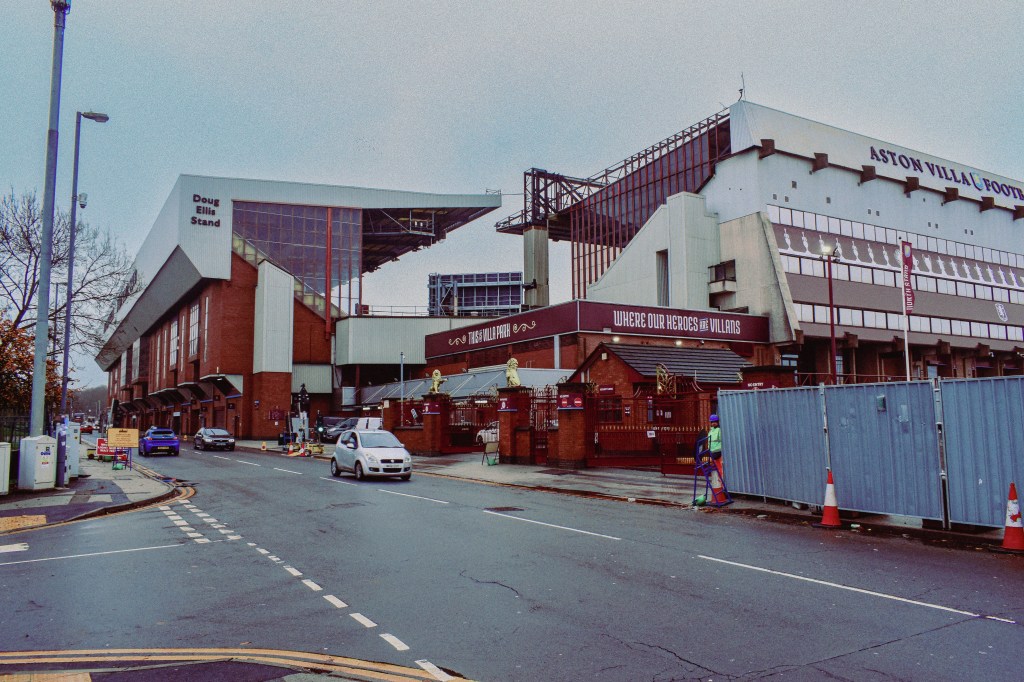
Opened in 1897, Villa Park is less a stadium and more a footballing time capsule that still breathes. Built on the grounds of an old amusement park near the stately Aston Hall, the venue blends aristocratic elegance with terrace-born ferocity.
Capacity sits around 42,000 to 43,000, but the geometry matters more than the number. Four distinct stands give the ground a personality modern bowl stadiums rarely achieve.
- Holte End
A sweeping mass of over 13,000 supporters. Brickwork, mosaics, and thunderous vocals combine to produce one of England’s most visceral soundscapes. - Trinity Road Stand
Rebuilt in 2001, towering, corporate-polished, yet still atmospheric when the stakes spike. - Doug Ellis Stand
Long, linear, pragmatic. Houses away fans along the touchline, a quirky layout that creates unusual sightlines and sharp acoustics. - North Stand
Next in line for expansion as Villa plot a push towards the 50,000 capacity horizon.
Villa Park has staged a global theatre too. Matches at the 1966 FIFA World Cup, fixtures during UEFA Euro 1996, and a record 55 FA Cup semi-finals have given it an aura that feels internationally validated.
Right before kickoff, the stadium transforms into something closer to a rock concert cathedral as Ozzy Osbourne’s Crazy Train detonates across the speakers.
Never Stop Believing – That’s the Villa Way: Matchday Experience
Getting There
Navigating Your Journey: Rail, Bus, and Road
With over 40,000 fans descending on the Aston area, choosing the right transport method is the difference between a smooth arrival and missing the first 15 minutes.
Transport Comparison Table
| Method | Station/Route | Distance to Stadium | Frequency (Pre/Post Match) | Key Benefit |
| Rail | Witton Station | 5-minute walk | Frequent/Very Busy | Closest to the stadium and away section. |
| Rail | Aston Station | 15-minute walk | Every 10 minutes | Dual rail lines; more frequent city-center links. |
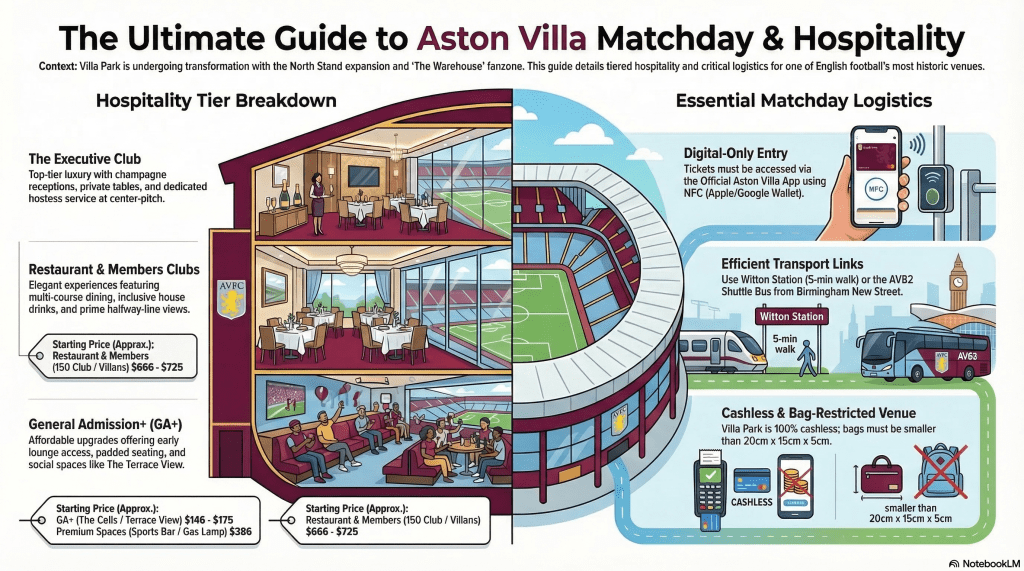
| Shuttle | AV82 Bus | Direct (Dudley St) | Every 15 mins / Up to 2h post-match | Direct link from Birmingham New Street Station. |
| Shuttle | AV1 Bus | Direct (Tamworth) | Specific matchday times | Best for supporters traveling from Tamworth. |
The Parking Reality
Driving is the most difficult way to reach Villa Park. If you must drive, keep these three facts in mind:
- Traffic Exclusion Zones: Streets like Trinity Road and Witton Lane are closed up to two hours before kick-off.
- Residents-Only Schemes: Street parking is strictly enforced with heavy fines to protect local residents.
- Pre-Booking is Essential: You must book a space in advance. Use the official travel site at travel.avfc.co.uk or reputable partners like YourParkingSpace.
Landmarks
Outside Trinity Road Reception stands the bronze statue of William McGregor, the visionary who founded the Football League itself. Villa supporters often treat it like a shrine of gratitude.
Pubs & Pre-Match Rituals
- The Witton Arms
Legendary pre-game fortress with separate entrances for rival fans. - The Bartons Arms
Victorian grandeur meets football folklore. - The Yew Tree
No-frills atmosphere, pure terrace energy.
Inside the ground, pies and burgers share menu space with local cult classics like chicken tikka wraps and chips, a culinary nod to Birmingham’s multicultural soul.
Fanzones
The modern Villa experience now includes The Warehouse, a beer-hall-scale social hub with live bands, DJs, and street food aromas drifting into the concourses.
The Trinity Fanzone provides a slightly calmer prelude for supporters who prefer their excitement with rhythm rather than chaos.
Players & Legacy
The current Villa narrative revolves around leadership, resilience, and attacking intent.
- John McGinn
Barrel-chested dynamo, captain, cult icon. - Tyrone Mings
Commanding defensive presence and vocal organiser. - Ollie Watkins
Relentless runner and Premier League goal machine.
From the dugout, Unai Emery has orchestrated a tactical renaissance, transforming Villa from survival scrappers into continental contenders.
Tickets & Essentials
- Buying tickets:
Official portal via the club website or the Villa Village Ticket Office. - Entry system:
Digital-first NFC scanning through the Aston Villa app. - Typical pricing:
Around £55 to £67 for major fixtures depending on category. - Away fans:
Positioned along the sideline in the Doug Ellis Stand, with alcohol service only in the lower-tier Block Q.
Visiting Villa Park – Key Questions Answered
Where is Villa Park located
Villa Park is located on Trinity Road in the Aston area of Birmingham, England (postcode B6 6HE).
The stadium sits just north of Birmingham city centre and is surrounded by residential streets and traditional matchday pubs.
What is the capacity of Villa Park
Villa Park currently holds around 42,600 to 43,000 spectators.
A planned redevelopment of the North Stand is expected to increase capacity to over 50,000 in the coming years.
What is the best way to get to Villa Park
The easiest way to reach Villa Park is by train.
Witton Station is only a five-minute walk from the stadium, while Aston Station is around fifteen minutes away.
Driving is not recommended due to matchday traffic restrictions and limited parking.
Which stand is the best at Villa Park
The Holte End is widely considered the best stand for atmosphere.
This is where Aston Villa’s most passionate supporters gather, creating one of the loudest matchday environments in English football.
Where do away fans sit at Villa Park
Away supporters are seated in the Doug Ellis Stand along the side of the pitch.
The typical allocation is just under 3,000 tickets across upper and lower tiers.
Are there good pubs near Villa Park
Yes, several popular pubs sit within walking distance of the stadium.
The Witton Arms is the most famous matchday venue, while the Bartons Arms and The Yew Tree are also popular with supporters.
What food is available inside Villa Park
Fans can buy traditional football food such as pies, burgers and chips inside the stadium.
Local favourites like chicken tikka wraps are also commonly available, reflecting Birmingham’s multicultural food scene.
Do Aston Villa use digital tickets
Yes, Villa Park operates a digital-first entry system.
Supporters are encouraged to download the official club app and scan their NFC ticket via Apple Wallet or Google Wallet at the turnstiles.
Is Villa Park a historic football stadium
Villa Park is one of the most historic stadiums in England.
It has hosted World Cup matches, European Championship fixtures and a record number of FA Cup semi-finals.
What is the matchday atmosphere like at Villa Park
The atmosphere is intense, traditional and very vocal.
Pre-match music, large tifos and coordinated chants from the Holte End help create a powerful sense of occasion.
 doragon sports