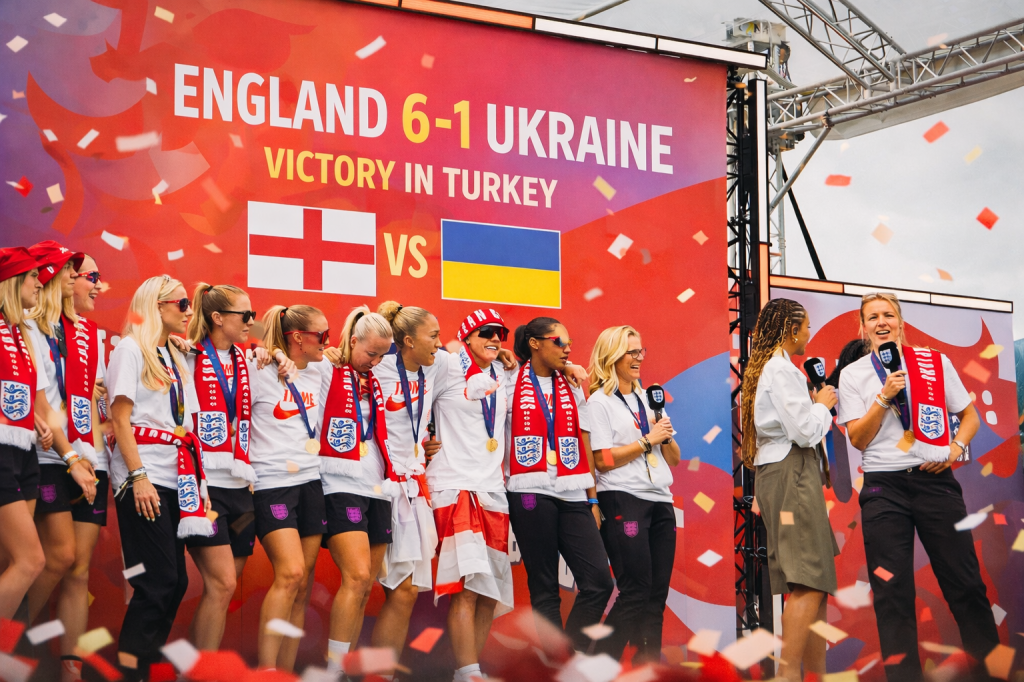
Football sometimes pretends to be a level field. Ninety minutes. Eleven against eleven. A ball, two goals, and a promise that anything can happen.
But on a quiet evening in Antalya, beneath the soft Mediterranean air at the Mardan Sports Complex, reality was far more complicated.
Ukraine arrived carrying the weight of geography, conflict, and exhaustion. England arrived as European champions, one of the most meticulously constructed machines in the modern women’s game. The scoreboard would eventually show a commanding 6–1 victory for England, but the story of the night was more layered than a simple scoreline.
For forty-five minutes, Ukraine resisted.
Then England solved the puzzle.
And once the door opened, the Lionesses walked through it with ruthless certainty.
Exiles and Champions
The road to the 2027 FIFA Women’s World Cup in Brazil has barely begun, yet the stakes already feel unforgiving.
In UEFA League A Group 3, only one nation will earn automatic qualification. England know their main rival is the world champions, Spain. Every match matters. Every goal could matter.
Ukraine’s battle is different. Their aim is survival in League A, a fight to remain among Europe’s elite while their country continues to endure the devastation of war.
The setting itself told part of the story.
Antalya is a Turkish resort city where tourists normally drift between beaches and hotels. Yet for Ukraine, it has become something else entirely: a temporary home for “home” matches.
Their players travel through a logistical gauntlet that would break most squads.
A 15-hour train journey. Border queues stretching five hours. Flights scheduled at midnight. The journey to simply play football can take a full day.
Forward Nicole Kozlova described it bluntly before kickoff.
“First the girls need to get to Kyiv. Then it’s a 15-hour train ride with a five-hour standstill… usually a midnight flight. Every trip is like that.”
England’s preparation, by contrast, runs like clockwork. Charter flights. Elite facilities. Tactical precision shaped by Sarina Wiegman, the most decorated coach in the modern women’s game.
Two footballing planets, orbiting the same pitch.
Ukraine’s manager Iya Andrushchak, making her debut in the role, captured the contrast perfectly.
“I understand that we are on different planets. How everything is built there is space. But the field is level, the ball is round. They are living people just like our team.”
For one half, Ukraine proved her right.
A Silent Stadium and a Loud Fight
The Mardan Sports Complex was unusually quiet.
Official attendance: 275 spectators.
A few curious hotel guests. Some local Turkish residents allowed in free of charge. And roughly 200 England supporters who had travelled across Europe to watch the Lionesses.
In that almost surreal quiet, the players’ voices carried across the pitch.
Instructions. Encouragement. Frustration.
England dominated possession from the start. The statistics later confirmed the imbalance.
- Possession: 82.8% England
- Shots: 31 England, 4 Ukraine
- Touches in the box: 78 England, 6 Ukraine
But for forty-five minutes, Ukraine’s defensive structure held firm.
They deployed a deep 4-5-1 low block, compressing space horizontally and vertically. At times the entire defensive unit dropped to the edge of their own six-yard box.
England probed.
They crossed. They recycled possession. They fired speculative shots.
Nothing broke the line.
The Cruel Blow
Eight minutes into the match, the night took a darker turn.
Ukraine forward Nicole Kozlova collapsed without contact.
ACL injuries are among football’s most feared moments. The body simply stops cooperating, the knee buckles, and everyone on the pitch instantly knows something is wrong.
Kozlova had already endured the exhausting journey that defines Ukraine’s international windows.
Her night lasted eight minutes.
She left the pitch in tears.
Football can feel brutally indifferent in moments like that.
The Tactical Epiphany
England reached halftime with 14 shots and zero goals.
For most teams, that would trigger anxiety.
For Sarina Wiegman, it triggered a small adjustment.
She swapped her wingers.
Lauren Hemp moved right. Jess Park moved left.
It sounds almost trivial. Yet tactically, it changed everything.
Instead of staying wide and crossing, both players could now cut inside onto their stronger feet, attacking the half-spaces between Ukraine’s defensive lines.
The Ukrainian block suddenly had to make choices.
Step forward and risk space behind.
Stay deep and allow England to shoot from central channels.
Within minutes, the dam broke.
The Russo Explosion
At the heart of England’s breakthrough stood Alessia Russo.
Russo’s first half had been frustrating. Headers drifting wide. Half chances just missing connection.
But the moment space appeared, her instincts took over.
47th minute.
Russo received a cutback in the box. One touch to control. One touch to finish.
1–0.
Four minutes later, the movement was even sharper.
51st minute.
Russo ghosted between defenders, collected another delivery, and finished calmly again.
2–0.
The match had shifted completely.
Stanway’s Midfield Symphony
If Russo was the executioner, Georgia Stanway was the conductor.
Stanway has long been England’s midfield heartbeat, and in Antalya she produced another complete performance.
In the 64th minute, Lauren Hemp burst into the penalty area and drew a foul after a mazy run at Ukrainian defender Kateryna Korsun.
Stanway stepped up.
Penalty.
Calm strike.
3–0.
Then came the moment that made the small crowd gasp.
70th minute.
Stanway collected the ball outside the box and unleashed a thunderous strike into the top left corner.
Not a delicate finish.
A rocket.
4–0.
The match was now unmistakably England’s.
Ukraine’s Moment of Joy
Yet Ukraine refused to leave the night empty-handed.
In the 58th minute, veteran forward Yana Kalinina pounced on a rare defensive lapse from England following a set piece.
The finish was simple. No clean sheet for Hampton.
But the reaction from the Ukrainian bench said everything.
Arms raised. Players sprinting to celebrate.
For a moment, the scoreline did not matter.
The goal was a reminder that resilience still had its reward.
Jess Park’s Statement
The final act belonged to Jess Park.
Park has been building momentum at club level and her second-half role on the left flank unlocked her creativity.
Late in the match she struck twice.
The second goal was particularly memorable.
From roughly 20 yards, Park lifted a dipping, looping strike that floated over the Ukrainian goalkeeper and dropped perfectly beneath the bar.
Elegant.
Unexpected.
And the perfect punctuation mark on England’s evening.
The final score settled at 6–1.
A Bridge Across Generations
England wore black armbands throughout the match.
The gesture honoured Lynda Hale, the former England number seven who scored in the Lionesses’ very first official international match in 1972.
Hale played at a time when women’s football was still fighting for legitimacy. Facilities were basic. Recognition was scarce.
More than fifty years later, England are European champions and one of the most powerful forces in the global game.
The armbands connected those eras.
Past struggle.
Present dominance.
Looking Ahead: England vs Iceland
For England, the victory over Ukraine is only the beginning of the qualification journey.
The next step brings a different kind of test: England vs Iceland.
Iceland rarely collapse defensively the way Ukraine eventually did. Their pressing is more aggressive, their midfield more combative.
England will expect to dominate again, but Iceland’s structure could make the match far more physically demanding.
The Lionesses now carry momentum, but the group remains tight.
With Spain also competing for the automatic World Cup berth, every performance matters.
The Final Contrast
Ukraine fought with heart, discipline, and dignity.
England responded with quality, depth, and tactical clarity.
For one half, the match felt like a miracle waiting to happen.
For the second half, it became a reminder of football’s harsh logic: talent and preparation eventually tilt the balance.
Still, Ukraine’s players left the pitch having shown something powerful.
Not just resistance.
But presence.
In a quiet stadium in Turkey, with only a few hundred witnesses, they carried their country’s colours onto the international stage.
And for forty-five minutes, they made the European champions work for every inch of grass.
What was the result of Ukraine vs England in the 2026 Women’s World Cup qualifier?
England defeated Ukraine 6–1 in their UEFA Women’s World Cup qualifying match on March 3, 2026, at the Mardan Sports Complex in Antalya, Turkey.
Who scored for England against Ukraine?
Key scorers included:
- Alessia Russo (2 goals)
- Georgia Stanway (penalty and long-range goal)
- Jess Park (2 goals)
Why did Ukraine play their home match in Turkey?
Due to the ongoing war following Russia’s invasion, Ukraine’s women’s national team cannot safely host matches at home. As a result, their “home” fixtures are played at neutral venues such as Antalya in Turkey.
What tactical change helped England beat Ukraine?
England manager Sarina Wiegman swapped wingers Lauren Hemp and Jess Park at halftime, allowing them to cut inside into central spaces. The adjustment created overloads in Ukraine’s defensive block and led directly to multiple second-half goals.
When is England’s next qualifier?
England’s next key fixture in the qualification campaign is England vs Iceland, another important match in the race for a place at the 2027 FIFA Women’s World Cup in Brazil.
Why is England vs Iceland important?
The England vs Iceland qualifier could shape the group standings in UEFA League A. With Spain also competing for the automatic qualification spot, England must maintain strong results to secure direct passage to the World Cup.
 doragon sports