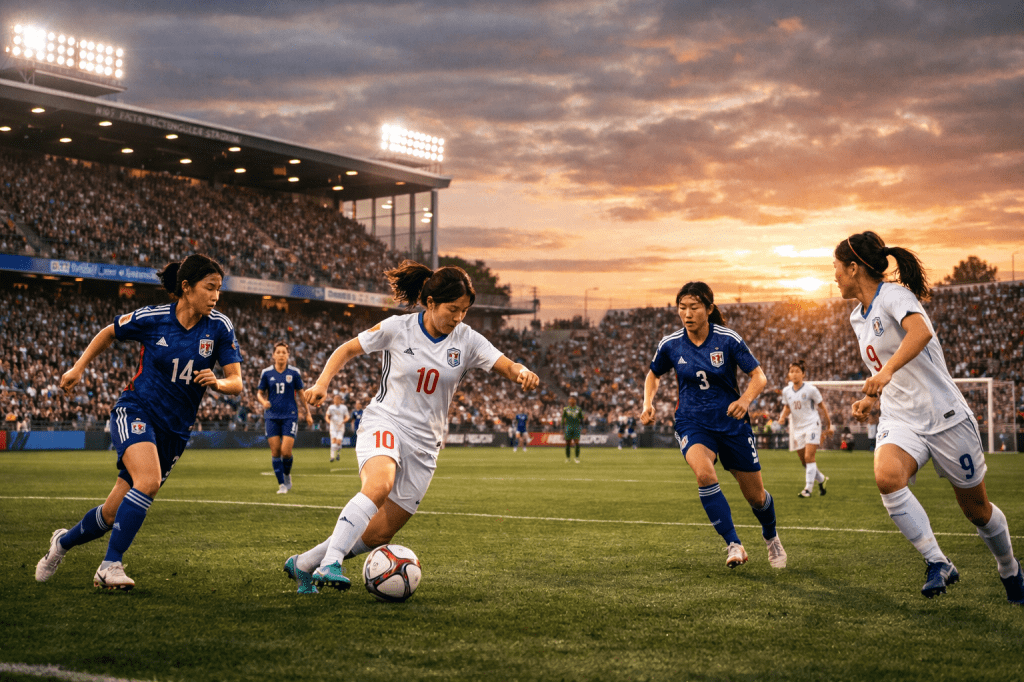
2026 AFC Women’s Asian Cup – Group C, Matchday 1
There are opening games, and then there are declarations.
When Japan women’s national football team step into the Perth sun on March 4, this is not about easing into a tournament. It is about reclaiming a throne. It is about the Road to Brazil 2027 beginning not with a whisper, but with a controlled detonation.
Across from them, the Chinese Taipei women’s national football team arrive with something heavier than expectation. History. Three straight Asian titles between 1977 and 1981. Then silence. Decades of near misses, structural limitations, and fading echoes of former greatness.
This is Japan vs Chinese Taipei at the 2026 AFC Women’s Asian Cup.
This is ambition versus hunger.
This is philosophy versus pragmatism.
And beneath it all, it is personal.
The Gateway to Brazil
The 2026 AFC Women’s Asian Cup preview writes itself in numbers. Top six qualify directly for the 2027 Women’s World Cup in Brazil. Quarter-final losers get thrown into a playoff furnace. There is no comfort here. There is no soft landing.
Japan enter ranked among the world’s elite. They are expected to glide through Group C. Anything less than dominance is framed as regression.
Chinese Taipei enter ranked far lower, but that number hides something. They are not here to admire the view. They are here to disrupt it.
The Road to Brazil 2027 women’s football campaign begins here, in Western Australia, at 13:00 local time. The sun will be unforgiving. So will Japan’s press.
The Defector’s Dream
There is a scriptwriter somewhere who must be laughing.
Saki Matsunaga was born in Funabashi, Chiba. Raised in the Japanese system. Represented Japan at youth and university level. Immersed in Nadeshiko methodology.
Then she chose to leave.
Leveraging her grandfather’s heritage, she naturalised in 2025. She learned Mandarin. She committed to Chinese Taipei’s project. She took the number 10 shirt.
Her reward? Her first Asian Cup match is against Japan.
This is not betrayal. It is pursuit. A player chasing a World Cup dream that Japan’s depth chart may never have allowed her to realise.
Every touch she takes will carry double meaning. Every interception will feel like a question. Every progressive pass will test not just Japan’s midfield, but its emotional equilibrium.
Saki Matsunaga Chinese Taipei versus her homeland is the human subplot that makes this more than a tactical preview.
Nielsen’s Brave New Nadeshiko
Nils Nielsen did not arrive to maintain. He arrived to rewire.
Japan women’s national team 2026 is not the conservative, counter-punching iteration of recent cycles. Nielsen has demanded initiative. Verticality. Risk tolerance.
The old singular captaincy model has been replaced by a leadership collective. Yui Hasegawa at its heart. Supported by Moeka Minami and the established pillars around them.
This is not symbolism. It is structural change.
Japan now build in a 4-3-3. In possession, the fullbacks step high. The interior midfielders rotate aggressively. Out of possession, one midfielder joins the front line to create a 4-4-2 press.
The message is clear.
Take the initiative.
Suffocate the opposition.
Win the ball back within seconds.
Japan’s recent form underlines it. SheBelieves Cup triumph. Ten goals scored. Two conceded. A statement win over major opponents.
Asian Cup predictions 2026 will lean heavily in their favour. And tactically, it is difficult to argue otherwise.
The Pragmatist in Red
On the other bench sits Prasobchoke Chokemor.
Where Nielsen speaks in the language of bravery, Chokemor speaks in containment.
Chinese Taipei women’s football team will not try to outplay Japan in prolonged possession phases. That would be self-sabotage.
Instead, expect a compact 4-2-3-1 collapsing into a 4-4-2 without the ball. Narrow horizontal lines. Minimal space between midfield and defence. The objective is not aesthetic pleasure. It is survival.
The ball, when won, goes forward immediately. Not recycled. Not decorated. Launched into channels.
This is where Su Yu-hsuan becomes central. A transitional specialist. She scored in every qualifying match. She thrives when structure collapses for three frantic seconds.
Japan’s high line is aggressive. It is also vulnerable if the first press is bypassed.
Women’s football tactical preview rarely feels this stark. This is chess played at sprinting speed.
The Maestro and the Anchor
Yui Hasegawa Japan is the metronome. At 1.57m, she dictates games in the WSL through scanning, anticipation, and spatial intelligence. Leading possession recoveries. Interceptions without fouling. She reads football like a grandmaster reading a board three moves ahead. Just like she does for Man City.
Opposite her, Hsu Yi-yun serves as Chinese Taipei’s ballast. Physical. Direct. Willing to absorb contact and reset phases under pressure.
If Hasegawa controls tempo unchallenged, this becomes an exhibition.
If Hsu disrupts rhythm, breaks lines with first-time vertical passes, and shields the back four effectively, Japan’s dominance could feel less comfortable.
Moeka Minami Japan adds aerial authority at the back. Her positioning will be critical against Su Yu-hsuan’s channel runs.
And from the bench, Maya Hijikata Japan offers unpredictability. A striker who relishes contact, unafraid to attack near-post zones, willing to shoot early.
These individual duels will determine whether this is routine or revelation.
Atmosphere and Identity
Perth is not neutral. Western Australia carries a significant Asian diaspora. Expect blue Nadeshiko banners. Expect red and white Taiwanese flags. Expect noise that feels personal.
The stadium itself is tight. Intimate. Every tackle audible. Every tactical instruction amplified.
This is Asian football rivalries reframed. Not political. Not historical grievance. Instead, generational contrast.
Taiwan’s Mulan legacy from the late 1970s stepping into the professionalised, data-driven modern era.
Japan shedding caution and embracing controlled aggression.
The cultural collision is subtle but profound. One side fighting to prove it still belongs. The other determined to prove it leads.
Tactical Fault Lines
Japan’s 4-3-3 morphs defensively into a 4-4-2 press. The trigger is simple. As soon as the ball enters central midfield for Chinese Taipei, the nearest interior steps forward, compressing space.
The risk lies in overcommitment. If Hasegawa or Minami are drawn too high and bypassed, space opens between centre-backs and midfield.
Chinese Taipei’s weakness is ball retention. If Su Yu-hsuan cannot secure the first outlet pass, Japan will recycle pressure instantly. Wave after wave.
Expect possession numbers around 60 percent for Japan. Expect Chinese Taipei to concede territory intentionally.
The question is efficiency. Can Japan convert territorial dominance into early goals? If not, doubt creeps. Frustration grows. Compact blocks thrive on impatience.
This women’s football tactical preview hinges on tempo management.
Prediction and Edge
Asian Cup predictions 2026 suggest Japan should control this game from minute one. Their depth, tactical clarity, and recent results support that.
But tournaments are not spreadsheets. They are lived in moments.
If Saki Matsunaga produces one decisive through ball.
If Su Yu-hsuan times one run perfectly.
If Chinese Taipei survive the first 25 minutes unscathed.
Then the pressure flips.
Japan women’s national team 2026 must balance bravery with discipline. Initiative without recklessness.
On paper, Japan’s quality should prevail. A two or three goal margin feels logical.
But emotionally, this game is fragile.
The Battle of Perth is not just about qualification pathways. It is about identity reconstruction on one side and resurrection on the other.
The whistle will blow. The heat will rise. And somewhere in midfield, a Japanese-born number 10 will test the resolve of her former nation.
The Road to Brazil 2027 begins here.
Japan vs Chinese Taipei Women’s Asian Cup – Key Questions Answered
What is at stake in Japan vs Chinese Taipei at the 2026 AFC Women’s Asian Cup?
This Group C opener is part of the 2027 Women’s World Cup qualifiers Asia pathway. The top six teams from the tournament qualify directly for Brazil 2027, making every group-stage point critical.
Where is the match being played?
The match takes place at Perth Rectangular Stadium in Perth, Australia.
Who is the Japan head coach in 2026?
Japan are managed by Danish coach Nils Nielsen, who has introduced a more aggressive, initiative-driven tactical approach.
Who is Saki Matsunaga and why is she important?
Saki Matsunaga is a Japanese-born midfielder who naturalised to represent Chinese Taipei in 2025. Her first Asian Cup match comes against Japan, adding emotional intensity to the fixture.
What formation does Japan use in 2026?
Japan typically operate in a 4-3-3 system that transitions into a 4-4-2 pressing shape without the ball.
Who are the key players to watch?
- Yui Hasegawa (Japan)
- Moeka Minami (Japan)
- Maya Hijikata (Japan)
- Saki Matsunaga (Chinese Taipei)
- Su Yu-hsuan (Chinese Taipei)
What are the Asian Cup predictions for this match?
Most predictions favour Japan due to superior ranking, depth, and recent form. However, Chinese Taipei’s compact defensive structure and transitional threat could create moments of danger.
 doragon sports