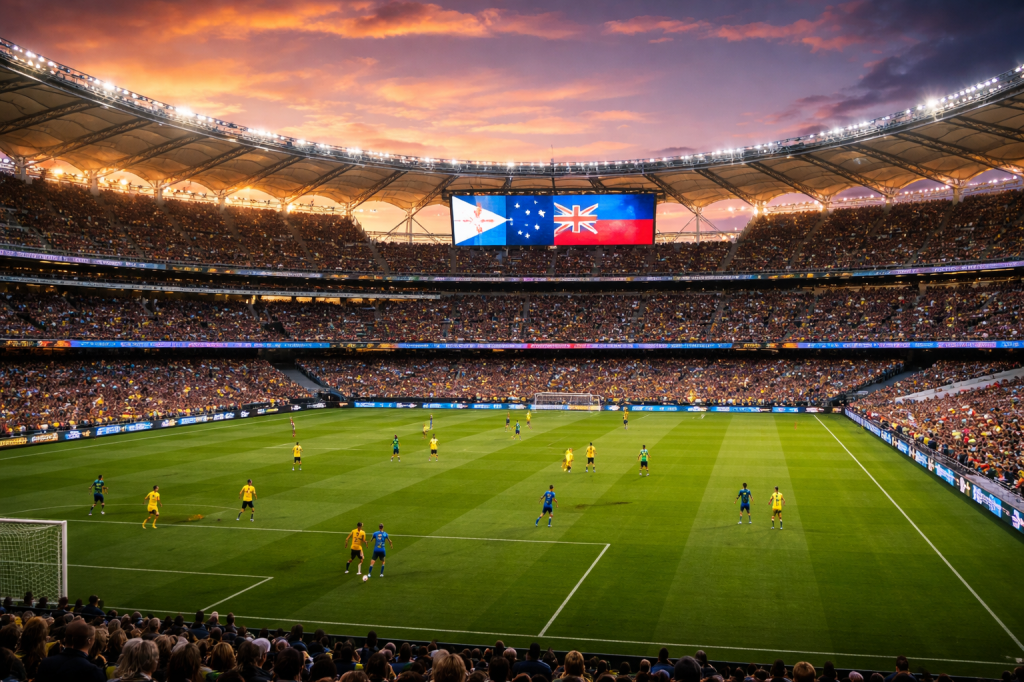
Perth, at 17:00 on a fading March Sunday, does something peculiar to light. It turns gold into something almost ecclesiastical. The roofline of Optus Stadium curves like a disciplined Pterodactyl, poised but patient, and 44,379 people gather beneath it as though attending both a sporting contest and a civic ritual.
This was the tournament opener of the 2026 AFC Women’s Asian Cup. But to reduce it to that would be like describing qigong as stretching. Technically correct. Spiritually negligent.
For the CommBank Matildas, this was the opening stanza of a World Cup qualification crusade. Reach the semi-finals and Brazil 2027 awaits. For the Filipinas, navigating what many are calling a group of death, survival is strategy, oxygen, ideology. Two consecutive World Cup appearances would cement their rise as structural rather than sentimental.
And threaded through it all was a homecoming. Sam Kerr, Perth’s favorite daughter, mother now, survivor of 851 days of ACL rupture and recovery, stepped out not as an abstract talisman but as a body that had been broken and rebuilt. If sport has an ecbatic quality, a narrative arc that rises from fracture to form, then this was its living thesis.
The Return of Royalty
Kerr described herself at “85% and above.” It felt honest. Not mythic. Not inflated. Just calibrated.
In the 14th minute, she found a fraction of space that most forwards might measure with a xanthometer, such was its subtlety. A lofted cross. A glance of the head. Seventy international goals. One exhale from a stadium that had been holding its breath for nearly two years.
It was not simply a goal. It was a punctuation mark against absence.
Mary Fowler’s presence added another layer to this ACL subplot. She too carried the quiet scars of reconstruction. When she entered in the 68th minute, the technical temperature rose immediately. Close control. Peripheral vision. A long-range effort that skimmed the air like an unfinished thought.
If Kerr was the resurrection narrative, Fowler was the reminder that youth, too, must negotiate fragility.
A Goalkeeping Crisis in Real Time
Behind the polished exterior of tournament hosting, Australia’s week had been closer to oligomania than serenity. One obsession after another.
Teagan Micah withdrawn with concussion. Jada Whyman ruled out with a knee issue. Mackenzie Arnold on the bench with calf fatigue. Into this churn stepped 21-year-old Chloe Lincoln for only her fourth international cap.
Goalkeeping is often described as lonely. But this felt closer to accelerated adulthood. Lincoln was composed, yes, but largely untested. The Philippines managed just a single speculative effort. Still, the psychological weight of knowing you are plan C can compress the lungs.
It is tempting to see this as footnote material. It is not. Tournament football punishes instability. The Matildas navigated it with minimal visible tremor, but the tremor existed.
The Blue Barricade
Three years ago, Australia dismantled the Philippines 8–0. That result hovered in Perth like a ghost that refused to dissipate.
Mark Torcaso, Australian-born coach of the Filipinas, understood something essential. Pride must sometimes be placed in temporary storage. Expansive football, however admirable, would be ornamental suicide.
He erected a low block that functioned less like a formation and more like olericulture. Layered cultivation. Rows upon rows of disciplined positioning. A 4–4–2 that folded into a 6–2–2 when necessary. Spatial denial as philosophy.
Possession statistics can be intoxicating. Australia recorded 85% of the ball. 674 passes to the Philippines’ 118. 119 final third entries. Fifteen shots. Six on target.
Yet for long stretches, it resembled a controlled laboratory experiment in frustration. Montemurro calls his system a “controlled mess.” Center-backs stepping into midfield. Wingers inverting. Heatley operating as a roaming 10. It is intricate, fluid, intelligent.
Against a low block built on palaban, that inner fight, intricacy can become circular.
The Kerr vs Long Duel
Hali Long captained the Filipinas with an understated ferocity. Kerr was rarely alone. Rarely unmarked. Rarely afforded the luxury of rhythm.
And yet she scored.
This is perhaps the most unsettling element for defenders. The knowledge that total control is unattainable. That even an 85% Kerr needs only a single lapse.
Long’s organization ensured the contest remained dignified at 1–0 rather than disintegrating. For a team once humiliated by eight unanswered goals, dignity is not cosmetic. It is developmental.
The Wall Named McDaniel
If the match had a secondary protagonist, it was Olivia McDaniel. Five high-quality saves. A diving parry to deny Arsenal’s Steph Catley free-kick that elicited a collective groan from the stands.
Goalkeepers often operate in a paradox. They can be outstanding in defeat yet still carry the scoreboard as indictment. McDaniel’s performance ensured the Philippines left with something intangible but significant: goal difference intact, narrative altered.
Had Australia scored a second before halftime, the psychological texture shifts entirely. Instead, the game lingered in that uneasy territory where one moment can undo 80 minutes of effort.
The Engine Room and the Geometry of Frustration
Clare Wheeler deserves attention beyond box score minimalism. She functioned as metronome and disruptor, injecting directness into sequences that risked drifting laterally.
But here lies the instructive tension. Australia’s 119 final third entries yielded only one goal. The geometry of low-block football compresses space into something almost metaphysical. Passing lanes narrow. Angles evaporate. Patience must not decay into passivity.
Montemurro’s “controlled mess” is thrilling when opponents chase. When they retreat into disciplined stillness, the system must evolve. Tournament football will offer no shortage of similar puzzles.
VAR and the Thin Line
Hayley Raso’s disallowed goal in the 29th minute felt like narrative insurance at the time. Chest down. Finish. Celebration. Silence. Offside by what seemed the width of a philosophical doubt.
VAR interventions are clinical. The crowd’s emotional arc is not. For several minutes, the energy inside Optus Stadium flickered between vindication and irritation.
At 2–0, Australia cruises. At 1–0, tension persists. That distinction matters when calibrating expectations against performance.
Atmosphere as Cultural Mosaic
Perth delivered a record Women’s Asian Cup attendance on day one. Green and gold met blue in a stadium that felt celebratory rather than hostile.
The AFC’s cultural crossover elements added layers. Audrey Nuna performing “Golden.” ZIPPORAH debuting “That’s How We Win.” Asian percussive rhythms echoing through a Western Australian twilight.
For Kerr, this was hometown validation. For the Filipino diaspora, visible and vocal, it was assertion. The word palaban reverberated not as slogan but as stance.
Sport, at its most resonant, becomes civic theatre. This felt close to that.
What Does 1–0 Mean?
For Australia, the mandate remains unchanged. Semi-final or bust. First Asian Cup since 2010 on home soil is not a polite aspiration; it is institutional expectation.
Yet there is analytical caution required. Dominance without incision can become habit. Against stronger opposition, 85% possession will not materialize. Efficiency, not volume, defines champions.
For the Philippines, the result recalibrates perception. No longer the continent’s punching bag. A team capable of absorbing pressure and emerging structurally intact.
Torcaso’s admission that they would “be annoying” was not self-deprecation. It was blueprint.
The Human Aftermath
Kerr walking the lap of appreciation felt less triumphant and more grateful. Motherhood, injury, expectation. Her journey resists simplification.
Perhaps that is the central note of this opener. Complexity. Controlled mess. Cultivated resistance. Statistical dominance tempered by tactical stubbornness.
The tournament has only just begun. But already we have seen resurrection, reinvention, and the subtle art of survival.
And as the Perth sun finally surrendered to evening, one sensed that Group A may not yield to inevitability as easily as some predicted.
What was the result of Australia vs Philippines in the 2026 AFC Women’s Asian Cup opener?
Australia defeated the Philippines 1–0 at Perth Stadium, with Sam Kerr scoring the decisive goal in the 14th minute.
Why was Sam Kerr’s goal significant?
It marked her first competitive international appearance after an 851-day absence due to an ACL injury. The goal was her 70th for Australia and symbolized a major personal comeback.
How dominant was Australia statistically?
Australia recorded 85% possession, completed 674 passes to the Philippines’ 118, registered 119 final third entries, and attempted 15 shots (6 on target). Despite dominance, they scored only once.
How did the Philippines approach the match tactically?
Coach Mark Torcaso deployed a disciplined low block, shifting from a 4–4–2 into a 6–2–2 defensive shape. The strategy focused on spatial denial and limiting clear scoring chances.
Why is this result important for World Cup qualification?
The top four teams at the 2026 AFC Women’s Asian Cup qualify directly for the 2027 FIFA Women’s World Cup in Brazil. Both Australia and the Philippines are seeking qualification, with Australia aiming to win their first Asian Cup since 2010.
 doragon sports