
AFC Women’s Asian Cup 2026 – Group B Preview
There are opening matches… and then there are reopenings.
Some games feel like the lifting of a curtain after intermission. Others resemble the unlocking of a vault sealed decades ago, dust rising as history steps cautiously back into sunlight. Uzbekistan versus North Korea sits firmly in the second category. This is not simply the beginning of Group B at the 2026 AFC Women’s Asian Cup. It is the reappearance of two footballing timelines interrupted by absence, politics, patience, and persistence.
Western Sydney Stadium will host something rare on March 3rd. Not just a football match, but a collision between momentum and mystery.
For Uzbekistan, this tournament represents rebirth after twenty three years wandering outside Asia’s elite conversation. For North Korea, it marks the return of a powerhouse that once terrified global giants before disappearing almost entirely from view.
Qualification routes matter here. Olympic dreams matter. World Cup pathways matter.
But beneath all of that sits something heavier.
Recognition.
The Tournament Pressure Cooker
Group B is cruelly constructed.
Defending champions China lurk ahead like an exam nobody wants to sit early, while Bangladesh arrive with fearless debutant energy and nothing to lose. That makes this opener brutally important. Three points here reshape probability tables immediately. Lose, and suddenly qualification scenarios become mathematical gymnastics involving goal difference and hope.
The AFC Women’s Asian Cup now functions as more than continental bragging rights. It is the direct gateway toward both the 2027 FIFA Women’s World Cup in Brazil and the 2028 Los Angeles Olympic Games.
One strong week in Australia can redefine an entire generation.
One bad afternoon can bury momentum before it properly begins.
Uzbekistan arrive knowing survival requires emotional control. North Korea arrive believing survival is irrelevant because domination is the expectation.
That difference alone may define ninety minutes.
Two Nations Emerging From Silence
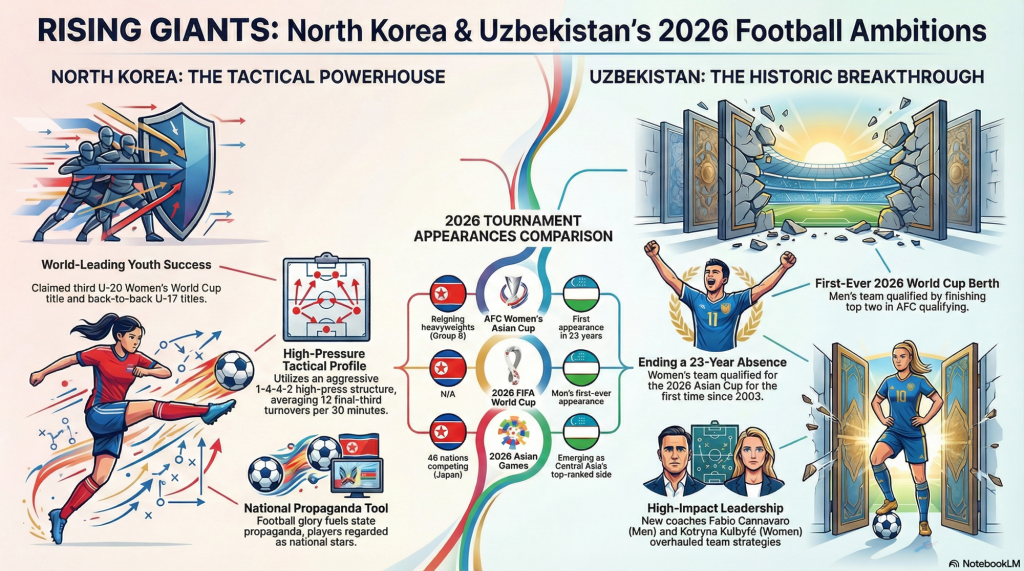
Football loves comeback stories, but rarely do they arrive shaped so differently.
Uzbekistan’s journey feels human. Messy. Emotional. Almost cinematic in its unpredictability.
Their qualification campaign ended in chaos against Nepal. A 3–3 draw swung wildly between confidence and panic before penalties decided everything. When Maftuna Jonimqulova made the decisive saves, players collapsed into tears that looked less like celebration and more like release. Twenty three years of waiting dissolved in seconds.
Manager Kotryna Kulbytė understood immediately what it meant.
She did not speak about tactics first. She spoke about transformation.
Her appointment itself symbolises change. A Lithuanian coach barely into her thirties arriving to modernise an entire football culture through analytics, positional structure, and European methodology. Uzbekistan are attempting something ambitious: accelerating development instead of waiting patiently for it.
Across the tunnel stands the opposite narrative.
North Korea never truly rebuilt. While very much laced with potential, they’ve suffered by seeing their southern neighbours become more established.
They simply disappeared.
Once among the most feared teams in women’s football, the DPRK vanished following the fallout from the 2011 doping scandal involving deer musk gland medicine, followed by years of isolation and pandemic border closures. Matches became rare sightings. Data became scarce. Opponents relied on outdated scouting memories.
And yet beneath that silence, development continued.
Youth teams quietly conquered the world.
The 2024 U17 and U20 World Cup triumphs were not accidents. They were signals sent from behind closed doors.
The Eastern Azaleas are back.
And they may have evolved.
Ideology on the Touchline
This match might actually be decided thirty metres away from the ball.
Kulbytė represents football’s modern academic wave. Training sessions built around data modelling, positional rotations, and controlled transitions. Uzbekistan under her are learning patience in possession, encouraging defenders to initiate attacks rather than simply survive pressure.
She speaks openly about community growth and long-term identity.
Across from her stands Ri Song-ho.
His reputation travels ahead of him like thunder.
Forged through North Korea’s military club system, Ri coaches with ruthless precision. Stories circulate of substitutions before halftime simply to correct tactical rhythm. Intensity is not optional within his system. Every movement exists within structure.
Heather O’Reilly once described facing North Korea as trying to catch hummingbirds with bare hands.
Fast. Relentless. Everywhere.
Ri’s philosophy embraces exactly that chaos through discipline.
If Uzbekistan want space, they must earn every centimetre.
The Tactical Battlefield
At its simplest level, this match becomes pressure versus resistance.
North Korea operate a suffocating 4-4-2 high block that behaves less like formation and more like swarm behaviour. Their pressing numbers are extraordinary. They rank among the world leaders for sustained high-pressure sequences, forcing turnovers deep inside attacking territory with frightening regularity.
Minimal touches.
Vertical passing.
Immediate recovery after loss.
Opponents rarely breathe long enough to construct attacks.
Qualification statistics underline the danger. Twenty six goals scored. None conceded. Entire matches spent camped inside opposition halves.
Uzbekistan cannot match that athletic tempo across ninety minutes.
Instead, they must manipulate it.
Kulbytė’s evolving system encourages flexible buildup phases designed to lure pressure before exploiting space behind aggressive defensive lines. Players like Maftuna Shoimova offer hybrid roles capable of stabilising midfield while launching counters quickly.
The risk appears obvious.
Lose possession centrally and North Korea attack instantly.
Uzbekistan’s qualifier against Nepal exposed fragility when momentum swings against them. Leading comfortably before conceding ground psychologically remains a recurring issue.
Against DPRK intensity, emotional composure becomes tactical necessity.
Stars Waiting for the Spotlight
Every tournament opener introduces new names to wider audiences.
This one might introduce several at once.
Diyorakhon Khabibullaeva represents Uzbekistan’s sharpest weapon. Forty three goals in thirty seven appearances for Trabzonspor tells its own story. She thrives on physical duels and transitional chaos, capable of turning half chances into momentum shifting moments.
If Uzbekistan score, her involvement feels inevitable.
North Korea counter with terrifying efficiency through Kim Kyong-yong. Twenty six goals from eighteen caps suggests striker instincts bordering on inevitability. She finished qualification as joint top scorer despite limited minutes.
But the true fascination lies elsewhere.
Seventeen year old Choe Il-son arrives carrying generational expectation after claiming both Golden Ball and Golden Boot at the U20 World Cup. Watching her movement reveals something unsettlingly mature. She drifts between defensive lines almost invisibly before accelerating into decisive spaces.
Uzbekistan’s young answer may be Asalkhon Aminjanova.
Ten goals in ten senior appearances at eighteen years old signals fearless instinct. She represents the future Kulbytė hopes to build around: technically confident midfielders comfortable dictating tempo rather than reacting to it.
Then there is Jonimqulova.
Goalkeepers rarely headline narratives, yet Uzbekistan’s qualification hero may face the busiest afternoon of anyone in Sydney.
Atmosphere: Celebration Meets Silence
Western Sydney Stadium could feel divided emotionally rather than numerically.
Uzbekistan’s arrival in Australia triggered vibrant scenes at the airport. Diaspora supporters waving flags, singing songs, embracing players who suddenly represent national possibility again. The team itself carries joyful energy, famously interrupting press conferences to sing around their coach.
They look like a group enjoying discovery.
North Korea project something entirely different.
Focus bordering on severity.
Training sessions reportedly unfold with near mechanical precision. Public emotion remains minimal. Interviews rarely drift from collective messaging centred on national pride and responsibility.
Filmmaker Brigitte Weich once observed that within DPRK football culture, individual glory dissolves into national achievement.
Victory belongs to everyone.
Failure belongs to everyone too.
That psychological framework creates fascinating tournament dynamics. Pressure that crushes other teams often sharpens theirs.
Threads That Could Decide Everything
Several micro battles hover beneath the surface.
First, Uzbekistan’s defensive organisation against Myong Yu-jong’s midfield orchestration. If she dictates pressing triggers successfully, turnovers will arrive constantly.
Second, transition speed. Uzbekistan must escape pressure cleanly at least five or six times to create genuine chances.
Third, stamina curves.
North Korea traditionally grow stronger late in matches. Early resistance may not be enough.
And finally, belief.
Uzbekistan arrive thrilled simply to be here. North Korea arrive expecting trophies.
Somewhere between those emotional poles lies unpredictability.
Prediction: The Edge of Mystery
Predicting North Korea remains notoriously difficult because data gaps distort analysis.
But stylistically, their pressing structure presents immediate problems for a side still adapting to elite tempo after long absence.
Uzbekistan’s resilience and attacking threat should create moments. The diaspora support may even tilt early momentum emotionally.
Yet tournament football often rewards systems refined under pressure.
North Korea possess exactly that.
Expect resistance. Expect flashes of Uzbek bravery.
But also expect the Azaleas to remind Asia why their return matters.
Projected Result: North Korea 2–0 Uzbekistan.
The real story, though, may not be the scoreline.
It may be the beginning of two journeys finally continuing again.
When is Uzbekistan vs North Korea in the AFC Women’s Asian Cup 2026?
The match takes place on Tuesday, March 3, 2026, kicking off at 13:00 AEDT at Western Sydney Stadium in Sydney, Australia.
Why is this match important?
This Group B opener plays a crucial role in qualification pathways for both the 2027 FIFA Women’s World Cup and the 2028 Olympic Games. With defending champions China also in the group, early points are essential.
Why is North Korea’s return significant?
North Korea are three-time Asian Cup champions returning after more than a decade away due to suspension, isolation, and pandemic restrictions. They remain one of the highest ranked teams in Asia.
How did Uzbekistan qualify?
Uzbekistan qualified dramatically through a penalty shootout victory against Nepal following a 3–3 draw, ending a 23-year absence from the tournament.
Who are the key players to watch?
Key players include Uzbekistan striker Diyorakhon Khabibullaeva, goalkeeper Maftuna Jonimqulova, North Korean forward Kim Kyong-yong, and teenage prodigy Choe Il-son.
What tactical styles will we see?
North Korea play an aggressive high-pressing 4-4-2 system focused on rapid transitions and turnovers, while Uzbekistan are transitioning toward a possession-based European model under manager Kotryna Kulbytė.
Where is Western Sydney Stadium?
Western Sydney Stadium is located in Parramatta, Sydney, and is one of Australia’s premier football venues, known for intense crowd proximity and atmosphere ideal for international tournaments.
 doragon sports