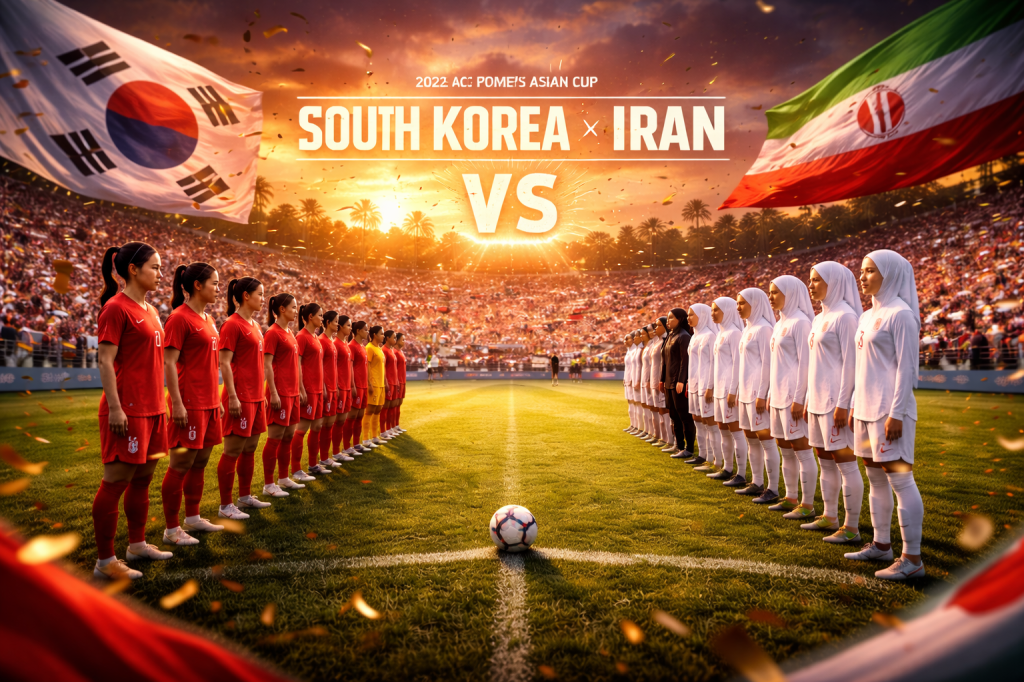
AFC Women’s Asian Cup 2026 – Group A Preview
The First Meeting, Heavy With History
On Monday evening at Gold Coast Stadium, beneath Queensland humidity and a sky that never quite feels neutral, two teams will step into something entirely new.
2026 AFC Women’s Asian Cup.
South Korea women’s national football team versus Iran women’s national football team.
It is their first-ever official meeting.
For decades, the men’s rivalry between these nations was branded the “Asian Classico,” a contest laced with tension and geopolitics. But this encounter belongs only to the women. There is no inherited script. No historical baggage between them on this stage. Only urgency.
Group A is unforgiving. Australia wait. The Philippines wait. A loss here feels less like a setback and more like a locked door. For South Korea, runners-up in 2022, this is about redemption and the final chapters of a golden generation. For Iran, this is about survival and firsts: first Asian Cup points, first breakthrough, first proof that they belong among the continent’s elite.
The stakes stretch further. This tournament is the gateway to the 2027 World Cup in Brazil. Every point is oxygen.
And yet, the emotional architecture of this match is heavier than qualification maths. One side recently fought its own federation for dignity. The other plays under the shadow of domestic unrest and scrutiny. The football will matter. But the context hums beneath it, impossible to ignore.
Beneath the headlines and the emotion, this fixture is a study in structural contrast. South Korea under Shin Sang-woo are attempting to modernise not just personnel but geometry. Their build-up phase often resembles a controlled distortion: full-backs narrowing into midfield channels, centre-backs stepping beyond the first pressing line, the single pivot rotating to create staggered passing lanes that stretch a compact block horizontally before piercing it vertically.
It is choreography built on repetition. Iran, by contrast, prefer compression. Marziyeh Jafari’s defensive framework is less about chasing the ball and more about managing oxygen. The distances between their back five and midfield four rarely exceed 12 to 15 metres, creating a corridor so tight that central progression becomes claustrophobic.
In pure data terms, this is a clash between a side averaging 1.85 expected goals per match and one conceding territory by design, content to reduce game state into moments rather than minutes. The opening exchanges will not simply reveal intent; they will reveal patience thresholds. How long can South Korea circulate before forcing? How long can Iran absorb before fatigue fractures the lines? In that tension lies the match’s intellectual centre.
The Battle for Respect vs The Battle to Endure
South Korea arrive not just as contenders but as reformists.
Earlier this year, the squad, led by their senior players, threatened to boycott the tournament. Operating on less than 10 percent of the men’s budget, flying economy while representing their country, and covering their own airport transfers, they finally drew a line. It was not loud. It was firm.
At the centre stood Ji So-yun.
Thirty-five years old. 171 caps. 74 goals. A legend who returned home after eight decorated years at Chelsea to elevate the domestic game.
Her words were careful but cutting. They felt necessary. Within weeks, the federation relented. Business-class travel. Improved support. Recognition.
So when South Korea walk out in Robina, they do so as athletes who forced institutional change. That shifts posture. It changes how a badge sits on the chest.
Iran’s context is more fragile.
This is only their second Asian Cup appearance. The squad has endured political tension, internet blackouts, emotional strain. Some players have stepped away, unable to carry both national representation and private grief. Former defender Kousar Kamali’s retirement statement echoed through regional media, describing a heart too wounded for refuge in football.
Head coach Marziyeh Jafari has held the group together with clarity and steel. She is revered domestically, architect of an 11-title dynasty with Bam Khatoon. Her public tone is measured: “We must critically assess ourselves to overcome weaknesses.” But privately, her task has been psychological as much as tactical.
For South Korea, this is a fight for respect.
For Iran, it is a fight to keep standing.
Casey Phair: The Wild Edge
At 18, Casey Phair carries history lightly but visibly.
Born in the United States to an American father and South Korean mother, she became the youngest player ever to appear at a World Cup in 2023. Sixteen years and 26 days old. The moment felt seismic at the time.
Now, the novelty has faded. What remains is the footballer.
Playing for Angel City FC in the NWSL, Phair is adapting to a league that does not protect young forwards. She is 5ft 8in, explosive over short distances, fearless in contact. South Korea have historically struggled against tall, physical defences. Phair was recruited into the senior setup to solve that equation.
Former coach Colin Bell once said they needed “strong, fast players with physicality.” Phair embodies that sentence.
There is a softness in her off-pitch rituals. She listens to BTS’s “Airplane pt.2” before matches. She loves her grandmother’s kimchi-jjim. But on the field, she offers collision and verticality.
Against Iran’s compact block, she may not receive endless touches. But she will test the centre-backs’ nerve. She will force clearances. She will turn hopeful crosses into second balls.
She is not a metaphor for the future. She is already part of the present.
Ji So-yun: The Architect
To describe Ji simply as a playmaker feels reductive.
She is tempo. She is memory. She is the axis around which South Korea’s attacking logic rotates.
Operating as a deep-lying orchestrator in Shin Sang-woo’s fluid 4-3-3 that morphs into a 3-4-3, Ji drifts between lines and angles. She scans before receiving. She releases passes that alter defensive shape.
Opponents do not just mark her. They design entire blueprints to contain her.
Iran’s central midfield pairing, likely Melika Motevalli and Sana Sadeghi, will have to shadow relentlessly. Ninety minutes of concentration. One lapse, one mistimed step, and Ji threads something irreversible.
This may be her final continental tournament. There is a quiet urgency to that fact. It does not make her sentimental. It sharpens her.
Jeon Yu-gyeong: Forged in the Cold
Jeon Yu-gyeong chose discomfort.
Rather than stay within the Korean domestic system, she moved to Norway, signing with Molde FK. Eleven goals in 21 matches in 2025. Promotion secured. Contract extended.
Scandinavian football hardened her game. At 170cm, she plays as a modern number nine. Back to goal. Quick feet. Bold shooting. She absorbs contact without retreating.
An untimely thigh injury delayed her senior breakthrough. But she arrives in Australia fit and quietly determined.
Against Iran’s defensive wall, Jeon’s hold-up play may be crucial. When Korea overload wide areas and drive crosses in, she must occupy centre-backs, disrupt clearances, create half-yards for Phair or late-arriving midfielders.
Her game is not loud. It is purposeful.
Maryam Yektaei: The Wall and the Debate
No selection in Iran’s squad has generated more discussion than Maryam Yektaei.
At 32, she is a pioneer. She left Iran in 2018, playing in Serbia before moving to Turkey’s Super League, where she featured for Beşiktaş and others. She retired from the national team in 2021.
Now she is back.
Critics question the recall. Domestic goalkeeper Mina Nafei had the strongest clean-sheet record in Iran’s league. Media narratives swirl around favouritism toward “legionnaires.”
But tactically, Yektaei makes sense. At 1.77m, she brings commanding vertical reach. She is proactive, aggressive on her line, shaped by European training environments. Against South Korea’s aerial bombardment, that authority matters.
Her ambition to one day coach in Iran feels sincere. Her presence feels symbolic.
On Monday, symbolism must convert to saves.
Tactical Fault Lines
South Korea will dominate possession. The numbers support it: recent averages place them around 57%t possession, 13 shots per match, 1.85 xG. Iran hovers closer to 43% possession, seven shots, under one expected goal.
But possession without incision can curdle into frustration.
Shin Sang-woo’s “fluidity model” encourages defenders to step into midfield, creating overloads. It is progressive. It is brave. But it leaves space behind.
Iran will likely set up in a 5-4-1 or 4-5-1, compressing horizontally and vertically. Their plan is simple in theory, brutal in execution: absorb, survive, counter.
Captain Zahra Ghanbari will hold up play. Negin Zandi will run into channels. If South Korea’s high line misjudges a transition, Iran can strike quickly.
The psychological battle may eclipse the tactical one. South Korea recently suffered a 5-0 defeat to the Netherlands, a reminder of vulnerability under sudden pressure. Iran, meanwhile, qualified despite low external expectations. That underdog freedom can be powerful.
Atmosphere in Robina
Gold Coast Stadium seats 27,000. Built for the 2018 Commonwealth Games, it carries coastal warmth and a kind of contained intensity.
Do not expect neutrality.
Australia hosts vibrant Korean and Iranian diaspora communities. Korean supporter groups from Brisbane and the Gold Coast are organising coordinated cheering sections. Iranian fans, many politically engaged, view the team as a symbol of female agency and resilience.
The crowd will not simply chant. It will narrate.
Humidity will test legs. Pressing requires oxygen. The team that manages energy better in the final 20 minutes may dictate the outcome.
Threads to Watch
- Ji’s Freedom: If Iran double-mark her effectively, can South Korea generate creativity elsewhere?
- Phair vs Yektaei: Physicality meeting command. Who wins the aerial duels?
- The First Goal: If Iran score first, the match transforms into siege warfare. If Korea score early, the block must stretch.
- Emotional Composure: Which side channels context into clarity rather than tension?
Prediction
South Korea possess superior depth, experience, and attacking variation. Over 90 minutes, their quality should surface.
But do not expect ease.
Iran will compress space until it feels unplayable. They will counter with intent. They will defend with urgency shaped by more than football.
This may begin as a tactical contest and end as a test of patience.
South Korea 2–0 Iran feels plausible. But the scoreline will not capture the weight carried into the stadium.
Because this is not simply about three points.
It is about proving worth.
It is about remaining visible.
It is about stepping into Australian sunlight and insisting you belong there.
When is South Korea vs Iran at the 2026 AFC Women’s Asian Cup?
Monday, March 2, 2026, at 19:00 AEST (12:30 Tehran time).
Where is the match being played?
Gold Coast Stadium in Robina, Queensland, Australia.
Why is this match important?
It is the opening Group A fixture and critical for qualification to the 2027 FIFA Women’s World Cup in Brazil. A loss significantly reduces knockout-stage chances in a group that includes Australia and the Philippines.
Who are the key South Korea players?
Ji So-yun, Casey Phair, and Jeon Yu-gyeong are the primary attacking focal points.
Who is Iran’s key player?
Goalkeeper Maryam Yektaei is central to Iran’s defensive strategy, alongside captain Zahra Ghanbari.
What are the expected tactics?
South Korea are expected to control possession in a fluid 4-3-3, while Iran will likely deploy a compact 5-4-1, focusing on counter-attacks.
 doragon sports