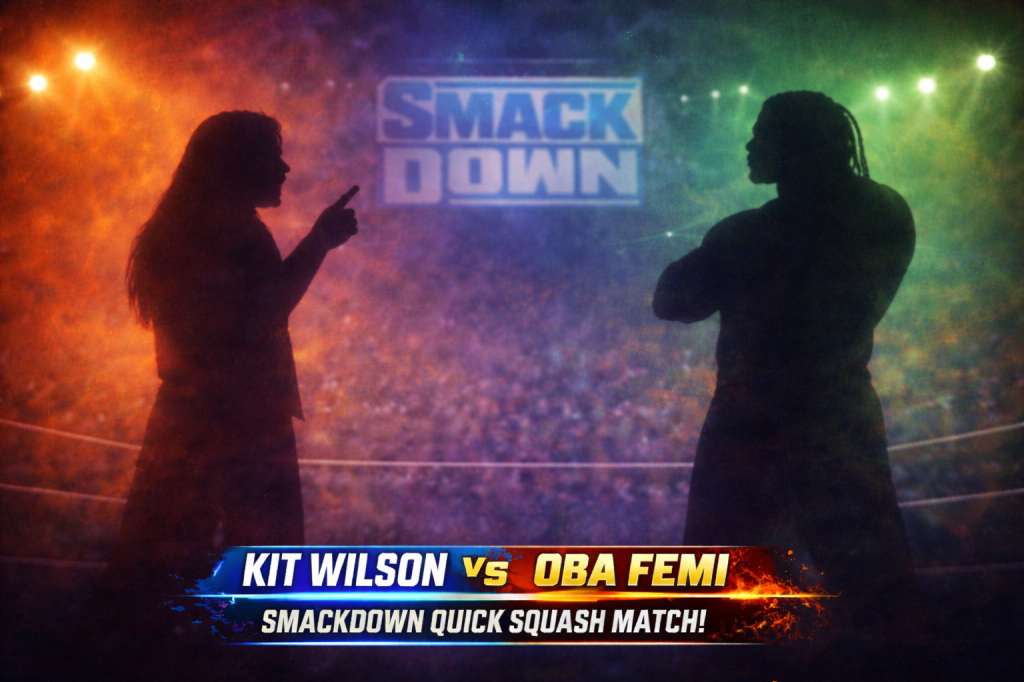
Oba Femi beat Kit Wilson in under a minute.
That is the fact. That is the statistic. That is the clean, corporate version WWE will file away under “dominant debut” and “main roster monster established.”
But wrestling has never been about the clean version. Wrestling is a viticetum, a tangled vineyard of performance and contradiction, where the obvious result is rarely the real story. The pinfall is not the point. The point is the feeling left in the air after the bell, the strange aftertaste of what the crowd actually responded to, the thing people will still be quoting on social media three days later.
And in that sense, Oba Femi did not win anything important.
Kit Wilson did.
Because Kit Wilson, in early 2026, is doing something far rarer than being strong. He is doing something far rarer than being protected. He is doing something far rarer than being pushed with green lighting and drumbeats.
He is being interesting.
He is being specific.
He is being the breakout star WWE didn’t even fully realise it was creating.
Oba Femi is a monster.
Kit Wilson is a character.
And characters last.
Wrestling Is Camp, And Kit Wilson Understands That Better Than Anyone
Kit Wilson’s current run is basically WWE accidentally stumbling into honesty. Not the scripted kind, but the cultural kind. The kind where wrestling briefly admits what it actually is: a spectacle of masculinity performed so loudly it becomes theatre, so exaggerated it becomes parody, so earnest it becomes art.
Kit’s entire “anti-toxic masculinity” crusade is not subtle. It is racemiferous in its intensity, loud and sprawling, like a sermon delivered with perfect hair and pelvic thrusts. He comes out moisturised and morally superior, telling the crowd they are the problem, scolding opponents for sweating too aggressively, gyrating like he’s trying to exorcise the arena.
And here’s the truth that makes it work:
The audience knows it’s ridiculous.
Kit knows it’s ridiculous.
But Kit never breaks.
He commits so fully that the ridiculous becomes real.
This is what people miss when they dismiss him as “comedy.” Comedy in wrestling is not a lesser lane. Comedy is often the purest lane, because it requires timing, conviction, self-awareness without smugness. Kit Wilson is not mocking wrestling from outside the ring. He is exposing wrestling from inside it.
He is metaphorically whipping the audience with a chabouk, lashing away our so-called “toxic attributes,” and the sick brilliance is that we enjoy it. We chant along. We sing his song. We become willing participants in the absurd cleansing ritual.
That’s not jobbing.
That’s power.
The Kit Wilson Theme Is Doing More Work Than Oba’s Aura
WWE has quietly given Kit Wilson something they do not give to disposable midcard acts: production investment.
The Kit Wilson theme is sticky. The Kit Wilson song has that rare quality wrestling themes used to have, the quality of becoming part of the crowd’s voice. Fans aren’t just reacting to Kit, they are participating in Kit. They are singing, chanting, leaning into the bit with him.
And that matters more than any squash match.
Because being over is not about wins. It’s about inevitability. It’s about walking into an arena and hearing the crowd already halfway inside your act before you’ve even raised the microphone.
Kit Wilson’s “Man Up” era, this strange performative sermon of redefined masculinity, is landing because it is both satire and sincerity at once. It forces wrestling fans to confront something uncomfortable: if you watch grown men body slam each other in underwear, you are already part of something camp, whether you live the straightest heterosexual life imaginable or not. You can fancy Rhea Ripley, you can cheer Liv Morgan, you can bench press your own bodyweight and still be sitting in the glitter cathedral.
Kit Wilson is just the first person on SmackDown saying it out loud.
Oba Femi Is Fine, But We Have Seen This Film Too Many Times
Oba Femi is being presented with the Brock Lesnar formula. The Goldberg shortcut. The Ryback assembly line.
Big man arrives.
Big man destroys.
Big man absorbs no offense.
Big man leaves.
It works, because it always works in the short term. Wrestling crowds love spectacle. WWE loves simplicity. A monster is easy maths: no nuance required, just impact.
Oba has the look. The entrance is drenched in green lighting and rhythmic drums. Commentary speaks about divine power. He struts slowly, as if the ring itself owes him patience. He powerbombs Kit Wilson like a punctuation mark.
And yes, the crowd popped, because the crowd always pops for a cool destroyer.
But creatively?
Oba Femi is not new.
He is another in the long line of male division monsters: Goldberg, early Rusev, Omos, Ryback, later Brock Lesnar. A dozen more forgotten giants in between, men who arrived as unstoppable forces and eventually became repetitive weather.
Do we need another one?
The answer is no.
Or if we do, WWE must be careful not to let him run into anyone more creative than him too early, because that is when the contrast becomes embarrassing. Oba is brute force. Kit is texture. Oba is a hammer. Kit is theatre.
You cannot build a weekly show on hammers alone.
The “Oba Feminist” Meme Proves Kit Won The Segment
The funniest outcome of this match is that Kit Wilson’s gimmick immediately created Oba Femi’s coolest branding.
After the squash, Oba tweets: “We can’t be toxic, we are Oba Feminists.”
That is viral gold. WWE leaned into it instantly. Fans leaned into it instantly.
But the real credit belongs to Kit.
Kit generated the oxygen. Kit created the stage. Kit made the absurdity possible. Oba is benefiting from Kit’s creativity the way a silent battering ram benefits from a poet standing in front of it screaming metaphors.
Kit Wilson lost the match.
Kit Wilson won the moment.
This Was Not A Feud, It Was A Passing Of Opposite Solar Systems
To be clear, WWE is not building a long programme here. This was not the start of some great rivalry. This was a collision of opposites, a brief passing of two wrestling planets.
Kit Wilson: camp, satire, character, crowd interplay.
Oba Femi: dominance, inevitability, destruction.
They do not need extended chapters together. Kit’s value is not as Oba’s victim, but as SmackDown’s premier comedy antagonist, the delusional heel who generates heat and entertainment while reminding everyone that wrestling is performance.
All signs point toward Kit feuding with Matt Cardona next, which is exactly where he thrives: promos, absurdity, crowd investment, storyline texture.
Oba can go off and fight Roman Reigns or whoever WWE’s corporate endgame is. Let him smash bodies in silence.
Kit will be the one people quote.
What happened to Kit Wilson’s tag team partner?
Kit Wilson’s partner Elton Prince suffered a severe neck injury in May 2025. He underwent fusion surgery in January 2026 and may be out for more than a year.
Is Oba Femi really Nigerian?
Yes. Oba Femi was born in Lagos, Nigeria, and moved to the United States in late 2017.
Who won the fight between Cody Rhodes and Oba Femi?
Cody Rhodes and Oba Femi faced off at Saturday Night’s Main Event in December 2025, but the match ended in a no contest after Drew McIntyre interfered.
Final Word: Monsters Are Common. Characters Are Rare.
Oba Femi will powerbomb people for the next decade. That is fine. WWE always needs a monster.
But Kit Wilson is doing something rarer: he is making wrestling feel self-aware without being smug. He is making the audience confront their own relationship with masculinity, spectacle, and performance. He is turning “Man Up” into theatre. He is turning the Kit Wilson theme into a crowd weapon. He is turning the Kit Wilson song into a cult hymn.
Oba is strong.
Kit is interesting.
And interesting always lasts longer.
Because monsters are common.
But a man who can whip the audience with a chabouk, cleanse them of their supposed toxicity, and make them sing along while he does it?
That is a breakout star.
That is 2026.
That is Kit Wilson.
 doragon sports