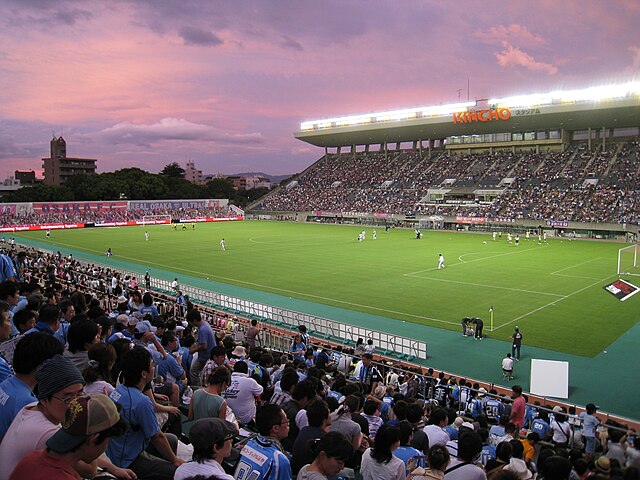
Yodoko Sakura Stadium
There are stadiums that announce themselves from a distance.
There are stadiums that impress with scale and symmetry.
And then there are stadiums that step forward and close the gap.
Yodoko Sakura Stadium doesn’t loom. It leans. It shortens the distance between intention and consequence. Between a thought in a player’s head and a sound in the stand. At its closest, the pitch sits just 5.8 metres away. That is not separation. That is proximity bordering on confrontation.
Formerly Kincho Stadium, reborn through renovation in 2021, this is not a relic polished up for nostalgia. It is a deliberately intimate football theatre, engineered to make space uncomfortable and emotion unavoidable.
At night, washed in sakura pink, it glows less like an arena and more like a living thing.
This is not football at arm’s length.
This is football close enough to feel the heat.
Club & Stadium Overview
Club: Cerezo Osaka
Nickname: The Cherry Blossoms
Stadium: Yodoko Sakura Stadium
Opened: 1987
Major Renovation: 2021
Capacity: Approx. 25,000
Location: Nagai Park, Osaka City
Built originally as a ball game field, Yodoko Sakura Stadium has lived multiple lives. Athletics. Rugby. American football. But the 2021 renovation made a decision at last.
This stadium would belong to football.
A new main stand rose. Sightlines tightened. Roofs were shaped to hold sound rather than release it. The old logic of distance was removed. In its place came closeness, steepness, and a quiet aggression in the design.
The bones stayed honest.
The intent became sharper.
The Cerezo Identity in Bricks and Mortar
Cerezo Osaka are not a club obsessed with brute force or industrial dominance. They are a club of philosophy, continuity, and feeling.
The stadium reflects that.
This is a place built to wow the Cerezo family, not overwhelm them. A ground that rewards attentiveness. That amplifies craft. That makes technical football feel personal.
Four stands, each with a different relationship to the pitch.
The Main and Back stands wrap the field with intent. The North Stand compresses belief into noise. The South Stand, uncovered and distant, reminds visiting fans that comfort is not guaranteed here.
Cerezo football is expressive but disciplined. Youthful but serious. The stadium does the same thing. It does not distract. It concentrates.
Here, space disappears quickly. Decisions must be made honestly. You cannot hide behind scale.
This is a stadium that asks questions.
How to Get There (Osaka Makes This Easy)
One of Yodoko Sakura Stadium’s quiet strengths is its location inside Nagai Park, woven neatly into Osaka’s transport network.
JR Hanwa Line
- Tsurugaoka Station: 3–5 minute walk (closest to the Main Stand)
- Nagai Station: 7–8 minute walk
Osaka Metro Midosuji Line
- Nagai Station: 5–7 minute walk
- Shin-Osaka: ~25 minutes
- Umeda: ~25 minutes
- Namba: ~15 minutes
There is no dedicated stadium parking for general spectators. Paid park lots exist inside Nagai Park, but on matchdays, public transport is the correct choice.
Follow the pink shirts. You will not wander alone.
Seating Guide: Where the Blossoms Open
Because of the renovation, Yodoko Sakura Stadium has a slightly unconventional layout. That only adds character.
Main Stand (West)
New, modern, and roofed.
- Two tiers with steep upper rows
- “Exciting Seats” bring you almost pitchside
- Excellent tactical views from higher rows
- Front rows may catch rain depending on wind
This is where football feels clinical and close at once.
Back Stand (East)
The former main stand.
- Roof only over upper sections
- Some structural pillars and rails
- Lower rows exposed to weather
Less pristine, more lived-in. A stand with memory.
North Stand (Home End)
This is the emotional core.
- Fully roofed
- Close to the pitch
- Continuous vocal pressure
When Cerezo attack, this stand does not rise. It tightens.
South Stand (Away End)
A deliberate imbalance.
- No roof
- Noticeably farther from the pitch
- Preserved space for rugby in-goals
Away fans learn quickly that this stadium is not neutral.
Note: Umbrellas are banned in all stands. Ponchos are mandatory in rain. Wear them like kit.
Matchday Rules: Order Before Emotion
Japanese football culture is expressive, but it is structured.
- Re-entry is permitted with your ticket
- Cans and glass bottles are prohibited
- PET bottles up to 600ml are allowed
- Away colours are strictly banned from Home areas
- Large flags are restricted to designated zones
- Musical instruments are limited to authorised drums
This is not coldness. It is clarity. And within it, passion moves freely.
Atmosphere: Close, Constant, Intentional
Yodoko Sakura Stadium does not roar all at once. It accumulates.
The sound arrives early and stays. Drums from the North Stand echo under the roof. Instructions from players carry into the crowd. Reactions happen instantly.
There is no delay here. No buffer.
When a challenge goes in, you hear it.
When a chance opens, you feel the intake of breath.
When a goal comes, it lands directly on your chest.
This is not spectacle football.
This is shared experience.
Food & Drink: Pink Appetite
Outside the stadium, Cerezo Bar operates as a rotating food village.
- Tsurushin Karaage: Long queues, justified
- Wanaka Takoyaki: Osaka essential
- Seasonal and opponent-themed menus
Inside, it is efficient and cashless. Cards, IC cards, PayPay. Movement matters.
The club respects that football is not just watched. It is consumed.
The Wolf and the Blossom
Cerezo Osaka’s identity lives in symbols.
The sakura represents fragility and renewal.
The wolf represents intelligence, unity, and quiet ferocity.
Lobby, the club’s wolf mascot, appears across the stadium. Statues. Graphics. Scarves. He is not decorative. He is a reminder.
This club believes in lineage. In passing pride forward. In continuity rather than reinvention.
You feel that here.
Matchday Rhythm
It goes like this:
Subway.
Park walk.
Food stall smoke.
Pink scarves.
Seat.
Drumbeat.
First tackle.
Space collapsing.
Noise settling into your bones.
You leave with the smell of raincoats, fried chicken, and something unfinished.
Why Yodoko Sakura Stadium Works for Cerezo
Some clubs want monuments.
Some want global statements.
Cerezo Osaka want connection.
Yodoko Sakura Stadium does not shout its importance. It proves it minute by minute. By closeness. By design. By refusing to let football drift away from the people watching it.
It is not a palace.
It is a shared room.
A place where football blooms briefly, intensely, and memorably.
Just like the sakura.
 doragon sports