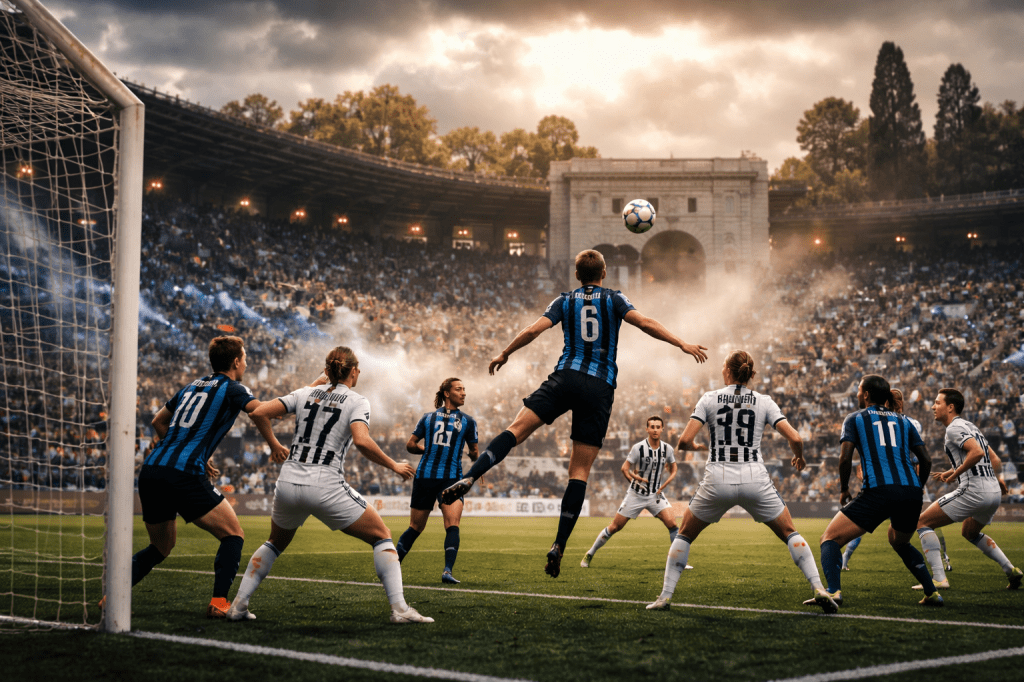
There are games that announce themselves loudly, with dominance, with spectacle, with control.
And then there are games that linger. Games that settle into the bones of a season and quietly rearrange its shape.
Inter Women’s 2–1 victory over Juventus Women at the Arena Civica Gianni Brera belonged firmly to the second category.
It was not a match Inter controlled. Juventus had more of the ball, more shots, more pressure, more moments that suggested inevitability. But football, especially in January, is rarely about who has the most of anything. It is about who recognises the moments that matter, and who survives the rest.
On Matchday 10 of the Serie A Femminile season, Inter did exactly that. And in doing so, they altered the logic of the title race beneath runaway leaders Roma.
The Context Beneath the Noise
Coming into this Derby d’Italia, both sides understood the stakes even if the table still looked forgiving. Juventus Women arrived chasing ground already lost, trying to reassert authority after a stuttering first half of the campaign. Inter Women, buoyed by recent form and fresh from a derby win over Milan, sensed an opportunity to step beyond “project” status and into contention.
This was not simply another Juventus fixture. It was a referendum.
For Inter, it was about legitimacy. For Juventus, it was about control. For the league, it was about whether Roma would be chased or merely watched.
Four Minutes That Felt Familiar
Juventus needed only four minutes to fall into habit.
A corner swung in. A crowded six-yard box. Cecilia Salvai rising unchallenged and heading home with the assurance of a defender who has scored that goal a hundred times before. It was efficient, clinical, and deeply Juventus. The sort of early strike that tends to simplify everything that follows.
Inter did not look rattled, but neither did they look dominant. They absorbed, reorganised, and then pressed just enough to disrupt Juventus’ rhythm rather than confront it head-on. It was a subtle adjustment, but an intentional one.
Nine minutes later, it paid off.
A Goal Born From Pressure, Not Possession
Henrietta Csiszár’s contribution to Inter’s equaliser will not appear in highlight reels, but it was the hinge on which the goal turned. She pressed Eva Schatzer at the right moment, forcing hesitation rather than panic. The loose ball dropped into space rather than chaos.
Tessa Wullaert saw it immediately.
Her vertical pass split Juventus’ midfield line and found Karólína Lea Vilhjálmsdóttir in stride. The finish was calm, right-footed, and precise. No flourish. No delay. Just the understanding that chances against Juventus must be taken before they vanish.
At 1–1, the game stopped feeling preordained.
Juventus Push, Inter Endure
What followed was a stretch of football that felt familiar to anyone who has watched Juventus Women dominate matches without fully killing them. They pressed higher, recycled possession, and worked the ball wide in search of Girelli, Vangsgaard, or a second-phase chance.
Cristiana Girelli came closest, her header forcing a reflex save from Cecilía Rán Rúnarsdóttir that reminded everyone why goalkeepers matter most in matches like this. Inter did not counter with ambition so much as intent. Every clearance had shape. Every duel had consequence.
They were waiting for something.
Corners as Currency
That something arrived, once again, from a set piece.
In the 35th minute, another Inter corner swung into the Juventus box. Marija Milinković attacked it with authority, rising above bodies that had momentarily lost their bearings. Her header was clean, decisive, and devastating.
Inter 2. Juventus 1.
Two corners. Two goals. No apologies.
Before halftime, Juventus nearly restored parity. Paulina Krumbiegel’s effort looked destined for the net until Katie Bowen threw herself into its path, blocking with her body in a moment that felt as important as either goal. It was the kind of intervention that doesn’t change the scoreline but changes belief.
Inter walked into the tunnel ahead, knowing exactly what the second half would demand.
The Second Half as an Act of Resistance
Juventus emerged with urgency. Inter emerged with structure.
The pattern was relentless. Juventus dominated possession, finished the match with 23 shots, and camped around Inter’s box. They probed through wide areas, pushed numbers forward, and forced Inter’s back line into constant decision-making.
The clearest chance came in the 57th minute, when a defensive lapse left Amalie Vangsgaard with an open look at goal. The shot beat Rúnarsdóttir but not Bowen, who cleared off the line with perfect timing. It was not luck. It was anticipation.
From that moment on, Inter’s defensive performance hardened into something more deliberate. Lines stayed compact. Blocks came earlier. Clearances went wider. They did not chase possession. They chased time.
Juventus threw on Barbara Bonansea. They increased tempo. They forced corners, shots, half-chances. Milinković blocked one late volley. Rúnarsdóttir saved again in stoppage time. But the equaliser never arrived.
Inter did not collapse. They did not flinch.
What the Numbers Miss
On paper, this looks like a game Juventus should have won. More possession. More shots. More territory. But football is not played on spreadsheets.
Inter scored from their best moments and defended every other second with clarity. Juventus created volume without incision, pressure without finality. The margins told the story.
This was not a smash-and-grab. It was a match plan executed with discipline.
The Table Shifts Quietly
With this result, Inter leapfrogged Juventus into second place, level on points with Fiorentina and firmly inside the Champions League positions. Roma, already crowned winter champions, extended their lead elsewhere, but the race beneath them tightened.
For Inter, this was confirmation that their recent run of results was not circumstantial. Wins over Milan and Juventus back-to-back are not anomalies. They are statements.
For Juventus Women, the questions multiply. The gap to Roma stretches. The reliance on territorial dominance without ruthless finishing begins to look like a flaw rather than a phase.
Voices After the Whistle
Gianpiero Piovani spoke of maturity. Of managing the ball rather than forcing it. Of knowing when not to play forward. Henrietta Csiszár emphasised ambition, framing the three points as part of a longer climb rather than a peak.
Massimiliano Canzi, by contrast, pointed to isolated incidents and missed chances. He was not wrong. But football rarely rewards explanations.
A Derby That Will Echo
This Derby d’Italia will not be remembered for spectacle. It will be remembered for consequence.
Inter Women did not dominate Juventus Women. They outlasted them. They out-thought them in the moments that mattered. They turned corners into currency and survival into strategy.
In January, that is often enough.
As Juventus fixtures continue and Inter matches grow heavier with expectation, this game will sit quietly in the background, reminding everyone that seasons are not always decided by who controls the ball, but by who controls the margins.
On this afternoon in Milan, Inter did exactly that.
 doragon sports