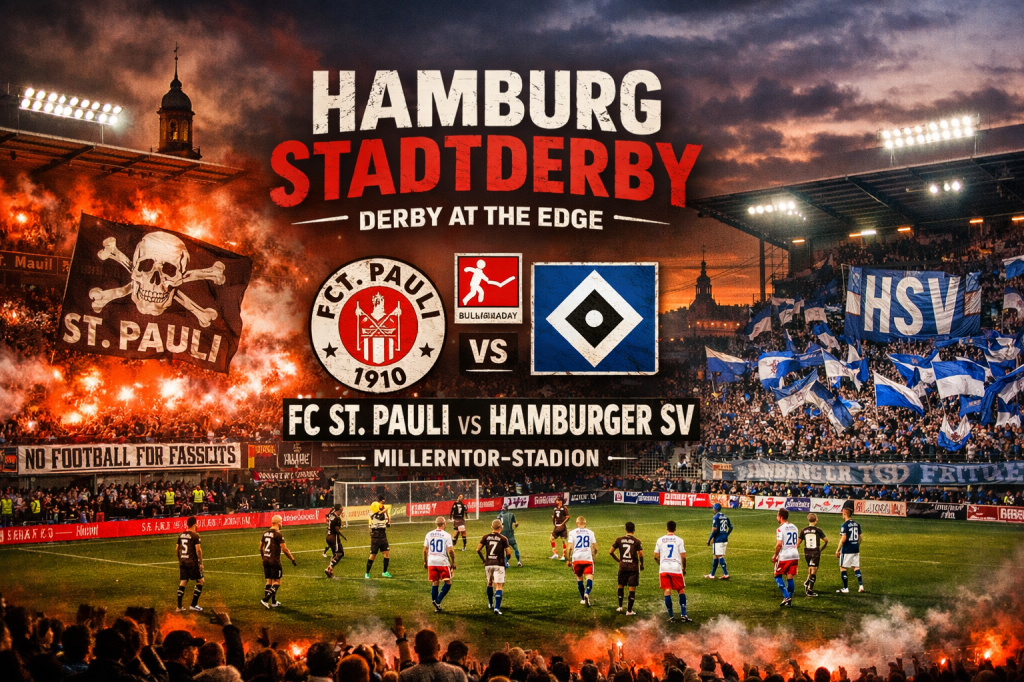
Bundesliga, Matchday 19 | Millerntor-Stadion
There are derbies that feel like football matches, and derbies that feel like weather systems. The Hamburg Stadtderby belongs firmly to the second category. When FC St. Pauli host Hamburger SV at the Millerntor this January weekend, the city will not so much watch a game as endure a controlled storm.
This is the 113th competitive meeting between the two clubs, but numbers barely scratch the surface here. Six kilometres separate Millerntor-Stadion and the Volkspark. In emotional terms, they might as well exist on different continents. One is defiance, banners, and bruised idealism. The other is memory, scale, and a long, uncomfortable conversation with former greatness. Both arrive here needing something badly.
A Derby with Real Consequences
For St. Pauli, this is not just about pride or posture. It is about survival. Sitting 18th in the Bundesliga with 12 points, the Kiezkicker are staring down the familiar spectre of relegation and the dreaded “second-year curse” that so often swallows newly promoted sides whole. Their performances have not been devoid of courage or quality, but they have been punctured, repeatedly, by time itself.
Late goals conceded. Late penalties. Late heartbreak. The recent 3–2 loss to Borussia Dortmund was a microcosm of their season: brave, expansive, briefly glorious, then undone by the final minutes. Millerntor has seen resistance. It has not yet seen enough reward.
HSV, newly promoted and tentatively re-establishing themselves in the top flight, occupy the uneasy middle ground of the table. 13th or 14th depending on the weekend, 17 points on the board, and a sense that the raw material is better than the results suggest. Under Merlin Polzin, Hamburg are creating chances at volume, but finishing them remains an unresolved argument.
This derby, then, is not a nostalgic exhibition. It is a pressure point for two clubs still writing the opening chapters of their Bundesliga return.
The First Blow Has Already Been Landed
Back in August, St. Pauli walked into the Volksparkstadion and left with a 2–0 victory. Adam Dźwigała and Andreas Hountondji struck. Giorgi Gocholeishvili saw red. HSV unravelled. It was a result that tilted the psychological balance early in the season and reminded Hamburg that promotion does not reset old hierarchies overnight.
Historically, HSV dominate the ledger. The bigger club. The heavier cabinet. European nights that St. Pauli can only mythologise. But recent meetings have been more even, and Millerntor has increasingly felt like hostile territory for the former city giant.
That matters now. Because St. Pauli believe. And belief, in relegation battles, is often the most volatile fuel of all.
St. Pauli: Playing Well, Bleeding Late
Alexander Blessin’s side are not tactically naive. They press with intent, move the ball bravely, and refuse to bunker even when circumstances beg for it. Eric Smith has been repurposed into a hybrid organiser, drifting between defence and midfield, and his two assists against Dortmund were not accidents. They were structure working as intended.
But the margins have been cruel. Two recent defeats came via late goals. Leads have dissolved. Concentration has frayed. The Millerntor home record reads two wins, one draw, four losses. Not disastrous, but not protective either.
Injuries have not helped. Captain Jackson Irvine remains sidelined. Andreas Hountondji, scorer in the reverse fixture, is out with a broken ankle. Danel Sinani is unavailable. Japanese centre-back Tomoya Ando has been thrown into the fire early, debuting against Dortmund in a match that asked questions most newcomers would rather not answer yet.
And yet, this is where St. Pauli often find themselves. Battered, bruised, but defiantly upright. The stadium does not demand perfection. It demands honesty. And this team, for all its faults, has that in abundance.
HSV: Control Without Closure
Hamburger SV’s recent 0–0 draw with Borussia Mönchengladbach felt almost cruel in its own way. Over 20 shots. Territorial dominance. No goals. It was the latest entry in a growing file marked “should have won”.
Polzin’s HSV play proactive football. Full-backs push high, particularly Miro Muheim on the left, whose delivery and movement remain one of Hamburg’s most reliable creative outlets. The midfield circulates well. The xG numbers are healthy. The conversion rate is not.
Injuries complicate matters. Yussuf Poulsen’s absence removes a focal point up front. Warmed Omari is still unavailable. Albert Sambi Lokonga’s fitness has been carefully managed. Into that gap steps Damion Downs, the Southampton loanee whose arrival has sparked intrigue and no small amount of downs HSV chatter across fan forums and HSV news cycles alike.
Away from home, however, the numbers are brutal. No wins. Six losses. Two draws. The Volkspark comfort blanket does not travel well, and Millerntor is not a forgiving place to seek redemption.
Players Who Will Bend the Game
Eric Smith remains the axis for St. Pauli. Everything slows or accelerates according to his positioning. If he is allowed time, St. Pauli can breathe. If he is crowded, the hosts begin to rush.
Ricky-Jade Jones brings pace and chaos, capable of moments that tilt momentum in seconds. His volley against Dortmund was thunderous. His late concession of a penalty was tragic. He embodies the knife-edge existence of this St. Pauli side.
For HSV, Muheim’s left flank will be a primary route forward, while Daniel Heuer Fernandes continues to quietly compile one of the league’s more consistent goalkeeping seasons. If Hamburg survive the early surge, his calm distribution could become a weapon rather than a shield.
More Than a Match: The City in Opposition
This fixture still carries cultural gravity. St. Pauli’s identity, forged in punk resistance and anti-establishment politics, is inseparable from the Reeperbahn streets around the stadium. Scarves, banners, skulls, slogans. The st Pauli shop sells more than merchandise; it sells alignment.
HSV, long the city’s flagship, represent continuity and institutional memory. European Cups. Bundesliga permanence once symbolised by the famous clock. Their support has diversified, evolved, fractured, and reassembled over years of decline and return.
At Millerntor, these identities collide audibly. It is loud. It is hostile. It is deeply personal.
How This Might Break
If St. Pauli score first, the stadium will become an accelerant. HSV’s away fragility will be tested immediately. If Hamburg weather that storm and find control, the pressure shifts sharply onto the hosts, whose season has been defined by what happens after the 75th minute.
This derby will not be tidy. It rarely is. It will swing. It will pause. It will surge again. And somewhere in those movements lies a result that could shape the rest of the season for both clubs.
One side fighting gravity. The other fighting expectation. Same city. Same night. Different fears.
At Millerntor, fear is never quiet.
 doragon sports