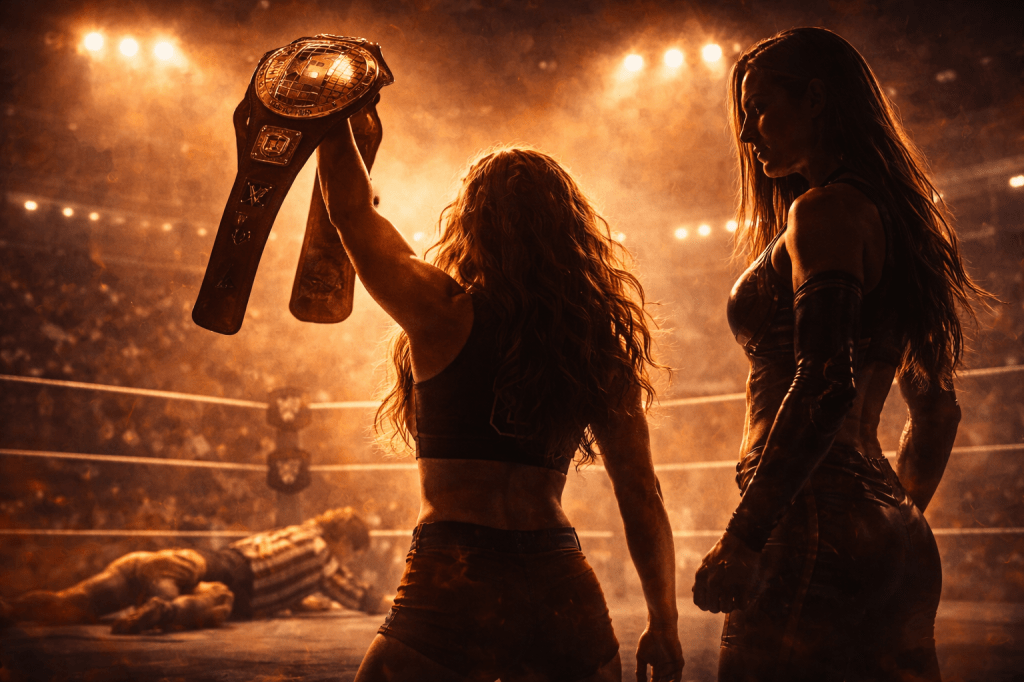
Thea Hail was never meant to be here.
That is not cruelty. That is context.
When she won the NXT Women’s North American Championship on December 16, it arrived through a botch, a mistimed shoulder, a referee’s count that kept going. Wrestling is theatre, but sometimes gravity writes the script. Blake Monroe was supposed to leave with the title. Thea Hail was supposed to leave with experience.
Instead, she left with gold.
And what followed was not chaos. It was craft.
Because rather than hide the accident, WWE leaned into the reality of it. Thea didn’t act like a fluke. She acted like a champion. Blake didn’t sulk. She simmered. The story wrote itself in glances, in tone, in frustration. The rematch at New Year’s Evil felt natural. Necessary, even. A moment where Hail could either legitimise the reign or surrender it with dignity.
It was shaping up to be simple. Clean. Human.
And then, quietly, everything changed.
The Night That Swerved
Thea Hail never made it to the ring clean.
Blake Monroe’s attack was sudden, violent, and deliberate. Steel steps. Barricade. A statement, not a sneak. NXT General Manager Ava responded with authority, banning Monroe from the building. Order restored. Structure enforced.
But wrestling is rarely about structure.
Because instead of delaying the title match, or reshaping it, or letting the audience sit in the discomfort of unresolved tension, WWE pivoted. Thea was medically cleared. Visibly hurt. Breathing shallow. And she insisted on defending the championship.
That part made sense. It fit her character. It fit her story.
The open challenge was brave. Honest. Almost poetic.
What followed was… less so.
Chaos, Then Opportunity
The locker room emptied. Women poured toward the ring. Ambition on legs. Tatum Paxley arrived with a chainsaw, which felt equal parts absurd and perfectly NXT. The crowd rose. The energy spiked.
And then Izzi Dame appeared.
Fresh off a loss to Paxley earlier that night. Flanked by The Culling. Backed by Shawn Spears and Niko Vance. The referee shoved into position. The bell forced.
The match began not because it should, but because it could.
This is where tone matters.
Because what followed was not lazy. It was not sloppy. It was, frustratingly, very good.
Thea fought. Through ribs. Through fatigue. Through the weight of a night that had already taken something from her. Dame dominated, but not cheaply. The exchanges were tight. The struggle believable. The crowd invested.
On the top rope, Hail went for control. She went for survival. The delay cost her. Dame struck. Dame Over. Spinebuster from the turnbuckle. Clean. Heavy. Final.
And just like that, Izzi Dame was champion.
The Feeling It Left Behind
Here is the uncomfortable truth:
The match worked.
The result didn’t.
Because wrestling is not just about moments. It is about momentum.
Thea Hail’s reign was an accident, yes, but it had become a story. A young gymnast from Pittsburgh, the youngest champion in the title’s history, trying to prove she belonged. Blake Monroe was the perfect foil. The rematch was the natural chapter.
Instead, that chapter was torn out.
Izzi Dame winning the title is not the problem.
Izzi Dame winning the title here is.
She had just lost. She had no narrative runway. She arrived as a vulture, yes, but not as a threat. Opportunism can be compelling, but only when it is anchored. This felt like correction, not evolution.
Creative seemed to be fixing a mistake rather than finishing a story.
And fans can feel that.
The Shapes Forming Ahead
Now the landscape tilts.
Dame as champion immediately draws attention back to Paxley, who beat her earlier in the night. That thread is unavoidable. Paxley does not forget. She does not drift. She circles.
Blake Monroe, meanwhile, sits outside the building, outside the title picture, but very much inside the emotional core of it. Heel versus heel is rarely clean. Triple threats are rarely simple. Fatal four-ways are rarely controlled.
And then there is the larger picture.
Jacy Jayne has done everything in NXT. There is a sense, quietly growing, that she is nearing the exit ramp. Blake Monroe, by contrast, feels like someone being sharpened. If this detour is positioning her away from the North American scene and toward the NXT Women’s Championship, then the pivot begins to make more sense.
Not better. But clearer.
Thea Hail, in the Middle of It All
What is lost in all of this is how well Thea Hail played the hand she was given.
She did not look like a mistake.
She did not feel like a placeholder.
She carried herself like someone learning in real time.
Her reign lasted 21 days. The shortest in the title’s history. That will be the stat. But it will not be the memory.
The memory will be that she tried. That she fought. That she stood in the ring hurt and refused to step aside.
In a company that often prizes certainty, Thea Hail gave them something more difficult. Believability.
That matters.
The Quiet Question
So where does this leave us?
With a champion who feels sudden.
With a challenger who feels unfinished.
With a feud that feels paused, not ended.
With a division that is busy, but not yet aligned.
This could become a layered story. Dame, Paxley, Monroe, Hail. Intersecting motivations. Overlapping grudges. Shared history.
Or it could become noise.
That depends on whether WWE now commits, or continues to correct.
Because accidents can become legends.
But only if you let them breathe.
And Thea Hail never really got the chance.
 doragon sports