There are football clubs, and then there are institutions of feeling. Tottenham Hotspur belong to the second category. A club that doesn’t just live in the table or the transfer rumour mill, but in memory, in frustration, in romance, in unfinished sentences that start with “if only…” and never quite end.
Spurs are not neutral. They are not beige. They are not tidy. They are a club built on flair, drama, heartbreak, rebellion and the stubborn belief that football should be beautiful before it is safe.
Welcome to the N17 fortress.
Club Identity & Origins – Born on Public Land, Raised on Defiance
Founded in 1882, Tottenham Hotspur emerged from the public land of Tottenham Marshes, not some manicured boardroom fantasy. This was football grown from the soil, from local boys with mud on their boots and ideas in their heads. By 1899 they’d settled behind the White Hart pub, and a mythology began to calcify.
The name comes from Sir Henry Percy, “Harry Hotspur” – a 14th-century rebel knight, hot-blooded and confrontational, a man who didn’t wait for permission. That spirit still clings to the club like static. It’s why the crest is a fighting cock, chest out, claws ready, perched on a ball like it owns the place.
Tottenham’s DNA is stitched with contradiction. “Audere est Facere” – To Dare Is To Do. And Danny Blanchflower’s immortal line: “The game is about glory.” That’s not a slogan. That’s a worldview.
This is the club that won the FA Cup as a non-league side in 1901, the first team of the 20th century to complete the League and Cup Double in 1961, and the side that finally broke modern European frustration by lifting the 2025 UEFA Europa League. Spurs history doesn’t move in straight lines. It zigzags. It spirals. It scars. It shines.
And yes, every season now is lived under the shadow of Tottenham standings, Tottenham news, and the constant drumbeat of Tottenham transfer news and Spurs transfer news. That’s the modern reality. But the soul? That’s older, wilder, and far less obedient.
The Stadium – A Cathedral Built for Noise (and Elegance)
The Tottenham Hotspur Stadium, opened in April 2019, is not just a ground. It is an engineering flex. A £1bn statement piece dropped into North London with the confidence of something that knows it will be photographed.
At 62,850 capacity, it’s the largest club stadium in London. Designed by Populous, the bowl is asymmetric, muscular, unapologetically modern. And then there’s the South Stand.
Seventeen thousand five hundred seats. Single tier. Sheer face. A wall. Inspired by Dortmund but sharpened for English chaos. This is not atmosphere by accident. This is atmosphere by design. The acoustics were tuned by engineers who’ve worked with U2, and you can feel it. Noise doesn’t drift here. It compresses.
It’s the sort of place Ledley King would have loved. A stage where his positioning would be appreciated, where his calm would be audible. Where a Berbatov first touch would cause a ripple before the ball even moved.
The stands lean in at 35 degrees, the steepest allowed. Fans are as close as 4.9 metres from the pitch. It’s intimate in a way that feels faintly aggressive. The kind of proximity Jermain Defoe thrived on. Six yards. Half a yard. A blink.
Quirks & Power Moves
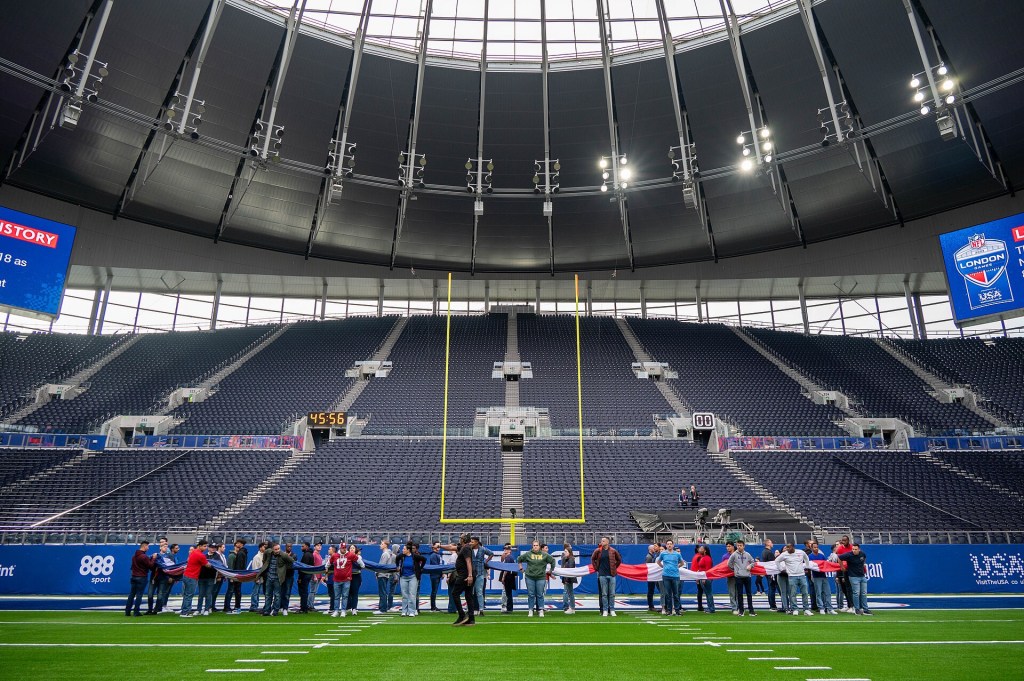
- Retractable Pitch: The grass splits into three and slides under the South Stand in 25 minutes, revealing an NFL field below. Football disappears. America appears. The stadium shape-shifts like a mechanical beast. Darren Anderton would have loved the theatre of that. He was always half winger, half illusionist.
- Crushed White Hart Lane Concrete: Embedded in the concourse floors. You are literally walking on history. Romantic. Slightly unhinged. Perfect. Steve Perryman’s footsteps are in there somewhere.
- The Golden Cockerel: 4.5 metres tall on the roof, complete with dents from an air rifle incident involving Paul Gascoigne. Spurs even in their statues have stories.
If you’ve ever searched for the Tottenham Hotspur stadium seating plan, it’s because you know seat choice matters here. This is a ground built for sightlines, angles, appreciation. For watching football as craft.
Matchday – Ritual, Friction, Release
Tottenham Hotspur Stadium is a public transport destination. No casual parking. No lazy arrivals. You arrive with intent.
- White Hart Lane Overground is five minutes away.
- Northumberland Park is quieter, smarter.
- Seven Sisters and Tottenham Hale are longer walks but part of the pilgrimage.
- Shuttle buses from Alexandra Palace and Wood Green exist for those who plan.
Security is airport-style. Bags must be A4 or smaller. This is not a place for chaos. The chaos is saved for the pitch.
Inside, the Market Place is a five-storey food cathedral. Street food energy. London flavours. Football hunger.
- The Goal Line Bar: 65 metres long, bottom-up pouring, pints in five seconds. Industrial efficiency meets lager joy.
- Beavertown Microbrewery: The first in-stadium microbrewery in the world. The “One Of Our Own” IPA is liquid identity.
- N17 Grill, The Linesman, and outside, the cult classic Chick King. Grease, loyalty, tradition.
If you’re ever Googling Tottenham Hotspur stadium parking, the answer is basically: don’t. Embrace the walk. It’s part of it.
The Town – Tottenham in Transition
Tottenham is changing. Slowly. Unevenly. With tension. The stadium has dragged regeneration behind it like a stubborn engine.
- The Dare Skywalk lets you climb the roof and stare down from nearly 47 metres. It’s part tourist attraction, part psychological test.
- OOF Gallery sits inside the stadium itself. Contemporary art where football sweat lives. A strange, brilliant collision.
- Percy House anchors the community work and history.
- F1 DRIVE runs go-karts under the South Stand. Yes, really. This place contains multitudes.
Tottenham is no longer just a postcode. It’s a project.
Best Seats & Atmosphere – Where the Feeling Lives
- South Stand: If you want volume, movement, collective madness, this is it.
- Paxton Road End: Traditionalist territory. Old Lane energy reborn.
- East Stand Lower: Tactician’s seat. You see patterns form.
- West Stand Premium: Comfort, clarity, control.
This is why the Tottenham Hotspur stadium seating plan matters. Every section tells a different story.
Tottenham Hotspur Women – Claiming the Same Stage
When Spurs Women step into this stadium, it matters. This is not tokenism. This is territory. Fair to say, it’s a bit bigger and a little more impressive than their conventional home of Brisbane Road.
Beth England – instinctive, relentless, a forward who lives for moments.
Jessica Naz – pace, directness, threat in open grass.
Maika Hamano – on loan from Chelsea, the Japanese player offers intelligence, movement, subtle chaos.
Ashleigh Neville – defensive steel, leadership.
Toko Koga – composure, technique, future energy.
Their presence here is not decorative. It’s declarative. The fortress is shared now. And it’s better for it.
Tickets, Access & Away Days
Tickets are sold via the official site in Category A, B, and C bands. One Hotspur membership is basically mandatory if you want reliability. The exchange and ticket share systems work well. The stadium is fully cashless.
Away fans sit in the north-east corner, blocks 114–118 and 234. The Antwerp Arms remains the community pub of choice. Mixed crowd. Respectful vibe. Real football energy.
Modern Spurs – The Noise, The Pressure, The Loop
To support Tottenham now is to live inside the loop of Tottenham news, Tottenham transfer news, Spurs transfer news, and the constant recalibration of Tottenham standings. Every season is expectation wrestling with memory.
The current side is under Thomas Frank, a manager who understands structure but isn’t afraid of risk. That balance feels very Spurs. Build, but dare. Plan, but allow.
The Analogy – The Stadium as Machine
The Tottenham Hotspur Stadium is an architectural Swiss Army knife. Football cauldron one night. NFL stage the next. Concert arena. Karting track. Art gallery. Brewery. Urban symbol.
It is a machine designed to feel.
On matchday, it tightens. It leans. It listens. It roars. And when Spurs are good, when the rhythm clicks, when the crowd finds the pulse, it becomes something else entirely.
Not just a stadium.
A statement.
A memory factory.
A glorious, frustrating, beautiful engine of belief.
 doragon sports